

The quick version
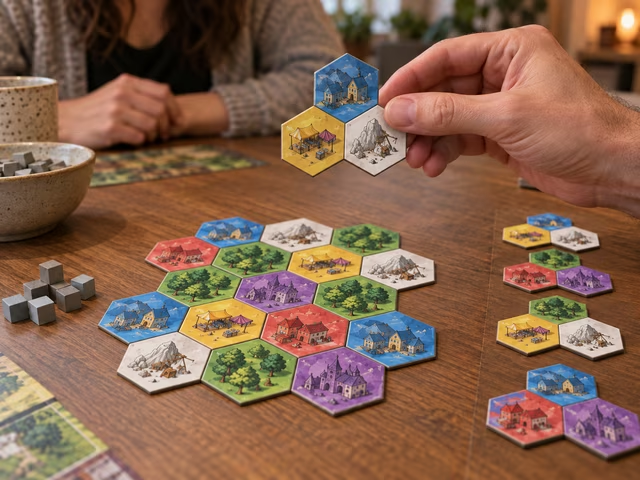
Pay stones to choose from a tile row, then attach the tile to your city or stack it over at least two tiles. When one market tile remains, refill and rotate the start. After the final row, score eligible district heights times matching plaza stars, plus stones.
Saved on this device only — clearing your browser's cache or site data removes them (no account backup).
Build the construction site
Use the two-player tiles marked 2+; add 3+ for three players and 4 for four. Shuffle those tiles and make eleven face-down stacks, with three tiles per stack for two players, four for three, five for four. The remaining four, five or six tiles form a face-up row. Each player takes a starting tile.
Give the Chief Architect marker to a starting player. Clockwise from there, give players one, two, three and four stones respectively; keep the rest as supply. The round begins at the Chief Architect and proceeds clockwise. Keep the district reference and pencil available.
Buy one tile and place all three hexes
The first tile in the row is free; a later tile costs one stone per tile before it. Return payment to the supply, remove the chosen tile, and close its gap. The final remaining tile cannot be taken: it triggers the round reset.
Place your tile with at least one edge touching your city at ground level, or rest all three hexes flat on occupied hexes at the same height. A higher tile must cover parts of at least two existing tiles, with no unsupported hexes. Rotating is allowed; flipping to the back is not. Gain one stone for every quarry you cover. Covered districts and plazas no longer count.
When only one tile remains in the row, put it first, reveal a complete next stack after it, and pass the Chief Architect marker clockwise. That player begins the new round even if this interrupts the previous turn sequence. When no stack remains to refill, finish immediately; leave the last tile unused.
Read the city from above
Only visible districts and plazas score. Blue houses score in your largest connected group. Yellow markets score only if they touch no other yellow market. Red barracks score at the city's edge. Purple temples score only when all six neighboring positions are occupied. Green gardens always qualify. Adjacency is by hex edge; a neighbor at a different height still occupies its position.
A qualifying district is worth its height: one at ground level, two on the second level and so on. Sum eligible district values separately by color, then multiply by the visible stars on plazas of that color. A color with no matching stars scores zero. Plazas do not gain extra stars from height. Add one point per unspent stone.
For example, blue houses with combined eligible height seven and three blue stars score 21. Add all five colors and stones. Highest score wins; ties go to more stones. Share a tie if that remains equal, an explicit house resolution where the printed rules stop.
Make height and multipliers clear
A district may be placed where it will not yet score; later tiles can make it eligible. Before purchasing, check both the stones paid and the fully supported placement. Keep enough room around each city for growth. Test one full color score together before final tallying.
Keep the district aid visible and distinguish district hexes from starred plazas. Before placing a raised tile, check its three supports and that it spans at least two existing tiles. Agree one optional scoring variant before setup. The construction site changes who starts each round, so move the Chief Architect marker promptly.
Players describe accessible scoring and relatively little direct interference. Let each person plan their city while the previous player finishes scoring a placement.
Already know the game?
Ideas & Twists
Choose a variation together before you start.
Akropolis · See main rules
Publisher variantLarge neighborhood
Double the value of your scoring blue-house group if its combined height value reaches at least ten. Use the normal largest-group rule first, then multiply the doubled value by blue plaza stars. Smaller groups score normally. Setup, turns, end and other colors stay unchanged.
Akropolis · See main rules
Publisher variantMarket square
Each otherwise eligible yellow market touching a yellow plaza has double its height value. It must still touch no yellow market. Add eligible market values, then multiply by all yellow plaza stars. The rest of the game is unchanged.
Akropolis · See main rules
Publisher variantExposed watchposts
Double the height value of each eligible red barracks with exactly three or four empty neighboring positions. A barracks with a different number scores normally if it satisfies the normal edge rule. Apply red plaza stars as usual; all other rules remain.
Akropolis · See main rules
Publisher variantRaised temples
A completely surrounded purple temple on level two or higher has double its height value. A surrounded ground-level temple scores normally; an unsurrounded temple still scores nothing. Apply purple stars normally. This changes only temple scoring.
Akropolis · See main rules
Publisher variantLakeside gardens
A green garden next to a lake has double its height value. A lake is an empty hex position completely enclosed by the city. Gardens without a lake still score normally. Apply green plaza stars after adding garden values. All other rules stay unchanged; try one district variant at a time.
About this guide
Use the named physical base game and its supplied cards, boards and rules. Rules below are paraphrased teaching guidance. Original STUDplay house twists are optional suggestions, not publisher rules or balance-tested claims; agree one before setup.
Ready for something different?
Find another game →