

The quick version
Book instruction and fitted equipment for 2–6 friends. Let staff teach the shot and range commands. Shoot one practice end of three arrows, then five scored ends of three. An end is one batch of arrows before collection. Shoot only on the staff signal and collect only when staff opens the range for retrieval. Add the fifteen ring scores; the highest total wins, and tied totals share the result.
Saved on this device only — clearing your browser's cache or site data removes them (no account backup).
Book the range and agree on the round
Choose a staffed indoor range offering beginner instruction and fitted recurve equipment. Before paying, confirm your exact group size, booking length, equipment included, left- and right-handed provision, clothing requirements and whether staff can accommodate one practice end followed by five three-arrow scoring ends. Ask about access needs directly; standing shooting and walking to targets are the main format here. The 2–6 range is this guide's hosting choice, not a venue capacity or supervision ratio.
Ask for full five-colour, ten-ring target faces, with each shooter's target and arrows clearly identifiable. Staff chooses the shooting distance and target size for the group, sets the lanes and backstop, and decides who may shoot together. For a comparable score round use the same distance and face size for everyone. If instruction requires different distances or faces, keep individual progress records rather than naming an overall score winner. Do not move a target or shooting line yourself.
Each shooter needs a staff-fitted bow and three compatible target arrows, an armguard, finger tab or shooting glove, and a quiver. Verify these are supplied; rental is not guaranteed. Wear closed-toe shoes and clothing that stays clear of the string; tie back long hair and remove dangling items as staff directs. Staff should inspect and fit the kit before use. Do not trade fitted bows or arrows between friends without staff approval.
Make a paper score sheet with one row per person, five end columns with room for three arrow values each, and a final total. Decide on the ordinary total-score round or one house variation before scoring. This is a recreational house format, not an official tournament round. Use World Archery's ten-ring values and shaft-at-the-line principle; competition set points, timers and shoot-offs are not part of this visit.
Learn when to shoot and when to collect
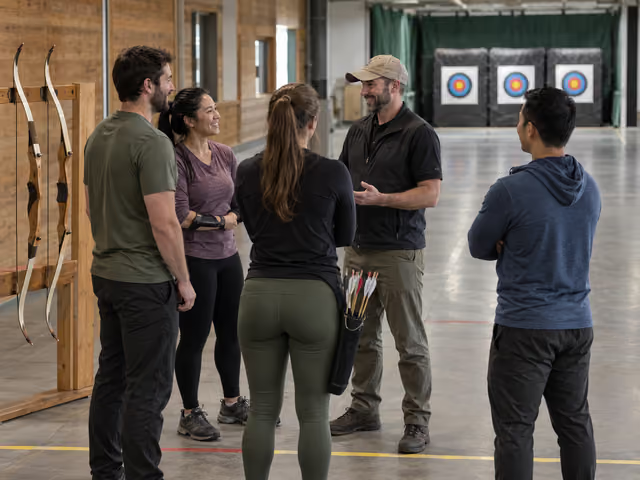
Before anyone handles a bow, have the instructor show the waiting line, shooting line, assigned target, bow rack and emergency stop. Confirm that everyone understands the actual signals used here. A common system uses two whistle blasts to approach the line, one to shoot, three to retrieve and five or more for an emergency. It is an example to recognize, not permission to act at a range with different commands.
Keep arrows in the quiver until staff permits loading at the shooting line. Point the bow and arrow toward your assigned target throughout loading and drawing; never draw toward the ceiling or across neighbouring lanes. Do not release the string without an arrow: that is a dry fire. If you drop an arrow, leave it and ask staff. After your three arrows, rack the bow and wait behind the waiting line.
All shooting must stop before anyone goes downrange. Wait for staff's retrieval permission, even if your group has finished. On an emergency command, stop immediately and follow the taught let-down and unloading procedure; do not fire the remaining arrow. If you notice a person downrange or an equipment problem, alert staff immediately. Staff controls the restart. Neither a friendly score round nor a variation changes these rules.
Practice, shoot an end, then record it
Start with instruction
The instructor demonstrates and checks stance, loading, grip, drawing, anchor, aiming, release and follow-through on your fitted equipment. Ask them to watch your first shots. When called to the line and then permitted to shoot, complete one unscored practice end of three arrows each. Do not try to learn solely by copying another beginner. Begin the score round only when staff says the group is ready; further teaching can replace scoring.
Shoot three scoring arrows
For scored end one, enter only your assigned lane on the staff command. Load and shoot one arrow at a time, using the taught sequence. Count each released arrow as an attempt, including a miss. Stop after three. If fewer lanes are available than friends, staff runs waves; a group end is complete only after every friend has had their three attempts. Waiting friends remain behind the waiting line. Do not set your own speed target or hold up the range for another attempt.
Score before pulling
When staff allows retrieval, walk to the assigned targets with bows left on the rack. Stay clear of protruding arrows. Read the three arrow values with a partner before touching the target or arrows. Record all three values and add them for that end. A disputed ring goes to staff before pulling; an arithmetic error can be corrected together on the sheet. Let staff demonstrate safe pulling, check that the area behind the person pulling is clear, and retrieve only your own arrows unless given permission.
Repeat and finish
Return behind the waiting line with all arrows accounted for and wait for the next staff signal. Repeat for five scored ends: fifteen scoring arrows per person, at most 30 points per end and 150 total. Add each person's five end totals. Highest total wins; equal totals remain tied. Return rental gear as staff directs and compare one thing each person learned. A new round needs the group's agreement and sufficient booked range time.
Read the rings and settle unusual arrows
On the full ten-ring face, score from the centre outward: yellow 10 then 9; red 8 then 7; blue 6 then 5; black 4 then 3; white 2 then 1. Outside the outer scoring ring is zero. The inner X, if printed, counts as 10 in this house round and gives no extra tie advantage. Judge where the arrow shaft meets the face. A shaft touching a boundary earns the higher ring value. For example, 9, 7 and a miss make 16 for the end.
An arrow in somebody else's face counts as your attempt but scores zero for you. Never award it to that person. If you shoot more than three arrows in an end, tell staff; once the arrows are identified, keep only your three lowest values, including misses. No bonus shot follows a poor release. A dropped arrow that was not released needs staff's decision about any replacement; never reach across the line for it.
For a bounce-out, pass-through, damaged arrow or a hit that cannot be identified, alert staff and leave the target untouched until they resolve it. Our house suggestion is to record a value only when staff can identify the hit; otherwise record zero. Do not invent a score or shoot a replacement without permission. These simplified outcomes are not a full tournament adjudication system.
If staff interrupts an end, follow their instructions first. Only resume unshot attempts if staff permits. If the session ends early, close at the last group end everyone completed; omit an incomplete group end from the comparison. Name the number of completed ends beside the result. If there are none, end with the lesson and no winner. Someone may stop sooner for comfort or fatigue; keep their record separate from the common-length comparison and never pressure them to continue.
Make it a comfortable first range visit
Tell friends the plan before booking: instruction comes first, scores are optional, and spectators or early stops are welcome within venue policy. Agree on costs and cancellation terms beforehand. Keep the booking confirmation available in the form the venue accepts. No phone is needed for the paper score round, but booking and check-in requirements vary.
Bow draw weight is the force needed to pull the string. A heavier bow is not a better beginner choice. Ask staff for a weight you can control and repeat, and speak up if a shot feels strained or painful. Community advice disagrees on exact starting weights and self-tests; use an in-person fitting rather than a number copied from a forum.
Save conversation, celebration and photographs for the waiting area with consent and venue permission. Keep the shooting line free of surprise cheering, unsolicited corrections and distractions. Let the instructor coach; a friend can help read the score sheet without reaching into someone's shot. If the kit or distance changes during the round, restart the comparison only with staff approval and enough time, or switch to personal records.
For mixed experience, choose the personal-improvement or cooperative variation. The aim is for everybody to understand the routine and get comfortable with their own equipment. Completion is a finished lesson and an agreed result, not a promised score, bullseye or amount of improvement.
Already know the game?
Ideas & Twists
Choose a variation together before you start.
Archery at a range · See main rules
House suggestion · same five endsPersonal improvement
Replace total-score ranking with improvement from your own first scored end. Record the normal ring values. End one is your baseline; after end five, find your highest end total among ends two through five and subtract the baseline. A result below zero counts as zero improvement. The largest gain wins; equal gains share the result. Shoot every end honestly rather than lowering the baseline on purpose. Everyone keeps the same fitted kit, distance and face throughout their five ends, but staff may select different starting distances for different people. Do not compare gains if someone's setup changes. All commands, three-arrow limits and retrieval rules stay the same. If five ends cannot be completed, retain personal records and name no improvement winner.
Archery at a range · See main rules
House suggestion · 2–6 shootersTeam average
Before scoring, split into two teams as evenly as possible and mix experience levels. Shoot the normal five ends individually in staff-assigned lanes and waves. Add each team's members' fifteen-arrow totals, then divide by that team's number of shooters. The higher mean wins; compare the unrounded values and keep an exact tie. With three or five people, different team sizes are allowed because the result is a mean rather than a raw sum. Example: 180 across three shooters equals 60 per shooter; 130 across two equals 65, so the pair wins. This changes score aggregation, not lane access or shooting order. Everyone needs the same distance and face size and all five ends; if that cannot happen, abandon the team comparison and keep individual records.
About this guide
This is an original recreational indoor range plan for 2–6 friends using staff-fitted recurve bows and full ten-ring faces. One practice end, five scoring ends, shared ties, early-stop handling, simplified uncertain-hit outcomes and all three variations are house suggestions. Ring values and shaft-line calls follow World Archery; selected scoring/conduct mechanics were checked against Book 3 effective January 27, 2026. The CalNASP school-program document is used only to explain a common signal system, not as an adult event specification. Staff instruction and the booked range's procedures govern equipment, distance, safety and permission to shoot. No purchased game edition applies, and no tournament timing, awards, Olympic distance or sanctioned-round claim is imported.
Ready for something different?
Find another game →