

The quick version
Take every tile of one color from one factory or the center. Put the group into one legal pattern line; overflow goes to your floor. When the supply is empty, move one tile from each completed line to its wall row, scoring each placement immediately from top to bottom. Subtract floor penalties. Repeat until a wall row is full, then add end bonuses and compare scores.
Saved on this device only — clearing your browser's cache or site data removes them (no account backup).
Open the original box and set the table
The base box has 100 resin tiles in five colors or designs, 20 each; four double-sided player boards; nine circular factory displays; four scoring cubes; one starting-player marker; one cloth bag; and the rulebook. Keep the box lid nearby for discarded tiles. Use one board and scoring cube per person; return unused boards, cubes and factories to the box.
Everyone uses the colored-wall side. The five pattern lines on the left hold one, two, three, four and five tiles. The wall on the right is a five-by-five grid; the floor along the bottom holds penalty tiles. Put each scoring cube at zero. Arrange five factories for two players, seven for three, or nine for four around an empty center. Mix all 100 colored tiles in the bag and draw four at random onto each factory.
The official opener is whoever most recently visited Portugal. If that does not select someone, use this house fallback: choose an opener by agreement. The opener puts the starting-player marker in the center and takes the first turn; turns then go clockwise. Leave every board visible and keep the shared supply within reach.
Draft into one pattern line each turn
Take a whole color group
Choose one factory and take every tile of one color from it, pushing its other tiles into the center. Alternatively, take every tile of one color from the center. You cannot combine factories or leave unwanted tiles of your chosen color behind. You must take a group on your turn; there is no pass.
Claim the next opening turn
The first person to take colored tiles from the center in each round also takes the starting-player marker and puts it in the leftmost empty floor space. It occupies a penalty space and makes that person next round's opener. Taking from a factory does not claim the marker; you cannot take the marker alone.
Choose one legal line
Place your drafted group into one pattern line, filling from right to left. A partly filled line accepts only its existing color. A line cannot accept a color already present in that same horizontal wall row. Any empty legal line can start a new color. You may use the same color in different pattern lines across different turns, but never split a single draft between lines. Tiles already in a line stay there.
Put extras on the floor
If the chosen line has fewer empty spaces than your draft, fill it and put the remainder on the floor, left to right. You may instead put the entire draft on the floor, and must do so if no line is legal. Colored tiles beyond the floor's seven spaces go directly into the box lid; they add no further penalty. Keep drafting until every factory and the center have no colored tiles left.
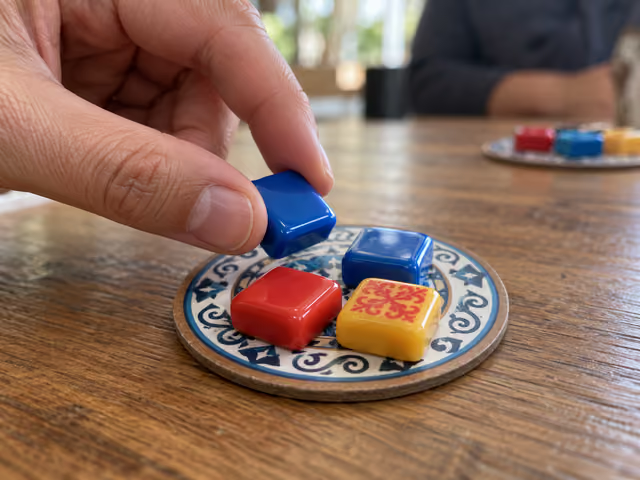
Show a factory containing two blue tiles, one red and one yellow. Take both blues, send red and yellow to the center and fill the two-space pattern line with blue. Explain that this earns no points yet. Return the demonstration tiles and reset the setup before the scored game.
Tile the wall, then deduct the floor
Work from the top line down
For each complete pattern line, move its rightmost tile to the printed space of that color in the corresponding wall row. Score that tile immediately before moving the next one. Put the other tiles from that completed line into the lid. Leave every incomplete line intact for the next round; it scores nothing yet.
Score the new tile's connections
An isolated tile earns one point. If it joins a continuous horizontal run, count every tile in that run including the new tile. Do the same for a continuous vertical run. Add the two run lengths if both exist; count a direction only when it contains another tile. Gaps stop a run and diagonal neighbors do not count. A new tile joining a horizontal run of three and vertical run of two earns five, not four or six. Do not score the whole wall again.
Deduct the occupied floor spaces
The seven floor spaces cost 1, 1, 2, 2, 2, 3 and 3 points respectively. Add all occupied-space penalties, including the starting marker's space, and subtract after wall scoring; your score cannot fall below zero. Three occupied spaces cost four points. Clear colored floor tiles into the lid and keep the starting marker in front of its owner.
Refill if the game continues
If nobody has a complete wall row, the marker's owner refills each factory with four tiles. When the bag empties, mix the discarded colored tiles from the lid into it and continue drawing. Never remove tiles from walls or incomplete pattern lines to refill. If both bag and lid are empty, begin with the factories only partly supplied. The opener returns the marker to the center and takes the first turn.
Finish the round and compare final totals
A complete horizontal row of five tiles on any wall makes this the last round. Finish everyone's wall placements and floor deductions. Filling a five-space pattern line alone does not trigger the end, and completing a wall row does not guarantee victory.
Now add bonuses once: two points for each complete horizontal wall row, seven for each complete vertical wall column, and ten for each color represented by all five of its tiles on your wall. These bonuses can overlap. Incomplete pattern lines earn nothing. Highest total wins. A score tie goes to the tied player with more completed horizontal wall rows; if still tied, share the win.
Before another game, return all colored tiles to the bag, clear every board, reset scores and choose the opener again.
Resolve the questions that interrupt a first game
Say each placement's score aloud and move the cube immediately. For the first scoring phase, inspect one board together before everyone scores their own. A printed color space is a destination, not an already placed tile. Existing tiles can contribute to a new tile's connected run; unchanged parts of the wall do not earn another score. Keep a separate total if a score goes beyond the printed track.
If a draft will not fit, take the entire color group anyway and use the floor; do not give tiles back or move old pattern tiles into another line. A same-color restriction applies to the corresponding wall row, not to your entire board. Confirm the selected source, color and destination before lifting a group while people learn. Ordinary drafting can deny another player useful tiles; explain that interaction before play.
For this friendly table, use this house correction policy: correct an illegal placement or arithmetic error as soon as it is found if the prior position and score are agreed. If they cannot be reconstructed, pause and agree whether to restart the game; do not invent a penalty. House handling for the unusual case of claiming the starting marker with an already full floor: keep it beside the board to remember the opener, with no extra penalty beyond the seven occupied spaces. Never mix that marker into the bag.
Already know the game?
Ideas & Twists
Choose a variation together before you start.
Azul · See main rules
Official gray-board variantChoose the wall layout
Everyone starts a new game on the gray side. When transferring a completed pattern line's tile, choose any empty square in its matching wall row. A color may appear only once in any horizontal row and only once in any vertical column. If no legal square remains when a line is processed, move all tiles of that pattern line to the floor, using normal overflow handling. Keep top-to-bottom processing, scoring, bonuses, finish and ties. This adds placement decisions to the same drafting game.
Azul · See main rules
Suggested house teaching variationTalk through the draft
On each turn, the active player names the source, chosen color, destination line and expected overflow before moving anything. Other players may point out rule mistakes and offer advice; the active player makes the final choice. Keep normal drafting, floor penalties, scoring and the wall-row finish. Stop offering strategic advice when everyone agrees to play independently; rule questions can still be answered.
Azul · See main rules
Suggested house seriesTwo-game comparison
With the same two to four players, play two complete standard games and add each person's final scores. For game two, the person seated clockwise from game one's initial opener starts; this replaces only the first-round Portugal selection. Reset all components between games and keep normal starting-marker control within each game. Highest combined score wins. Break a combined tie by total completed horizontal wall rows across both games, then share the result if still tied. Record first-game totals and completed rows before resetting.
About this guide
Main mechanics follow the original Next Move English base-game rulebook, bearing 2018 copyright and currently linked by the publisher. The gray-board variation is official. Opener fallback, full-floor marker handling, correction policy, demonstration, teaching format and two-game series are labeled house or hosting suggestions. Community discussions identified explanation needs; they do not establish rules or demand rankings.
Ready for something different?
Find another game →