

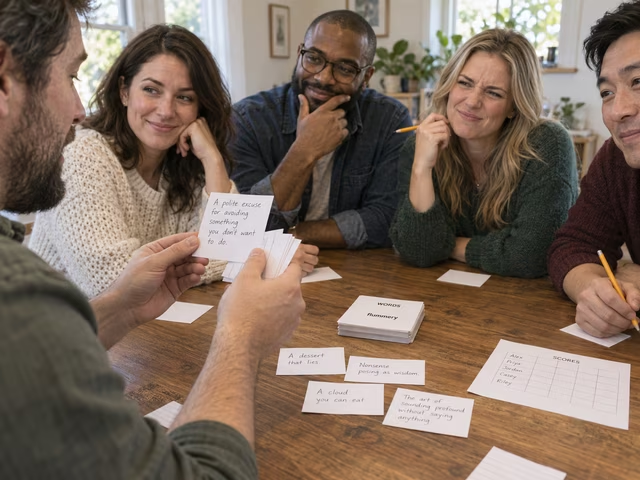
The quick version
A reader chooses a suitable category prompt and secretly copies its real answer. Everyone else writes a fake answer and initials it privately. The reader mixes and reads all answers twice. Players vote clockwise. Earn one point per opponent fooled and two for choosing truth; the reader earns three if nobody chooses truth. Everyone reads twice; highest total wins.
Saved on this device only — clearing your browser's cache or site data removes them (no account backup).
Use one shared answer format
Choose a first reader and scorekeeper. Set the board and die aside for this house format. Use the classic categories on your chosen deck and have the reader select one appropriate prompt per round. Omit any card involving unwanted adult subjects. The reader copies the published answer onto an identical slip while others write plausible inventions.
Players put their initials where the reader can see them but other players cannot. Keep invented answers concise enough to read in the same tone as the real one. The reader quietly clarifies illegible writing, mixes all slips and reads them twice without identifying writers.
Choose the truth after hearing every bluff
Before reading, compare submissions with the real answer. A substantially correct submission earns its author 3 points; remove that slip and that person does not vote. If two or more submitted the truth, award each 3 and restart with a fresh prompt under the same reader. No other scores come from the abandoned prompt.
Starting left of the reader, each eligible player names one answer. The reader records votes. Voting for your own bluff is allowed but earns no point for that self-vote. After all choices, reveal the true answer and every author.
Award each bluffer 1 point for every other player who chose their answer. Award 2 to each eligible player who chose the published truth. If no eligible voter chose it, award the reader 3. Keep already-earned correct-submission points. Add scores on paper; there are no board-space bonuses.
Pass the reader role clockwise after a completed prompt. Play two complete reader rotations. Highest total wins, with tied leaders sharing the result. This fixed endpoint and paper scoring are house adaptations.
Let a bluff be good without being loud
Use the same neutral reading style for every slip and no side comments before voting. Familiar prompts can be replaced before answers are written. Treat old trivia cards as game answers, not reliable current legal or factual advice. The activity tests recognition and invention, not who can challenge the reader most forcefully.
Already know the game?
Ideas & Twists
Choose a variation together before you start.
Balderdash · See main rules
House suggestionWords only
Use only the word-definition category for every round. Keep the exact same bluffing, correct-submission exceptions and points. This is useful when the group prefers language to entertainment trivia.
Balderdash · See main rules
House suggestionSimultaneous choice
Number responses as they are read. Everyone privately writes one number and reveals together instead of voting clockwise. Self-vote and correct-submission rules remain unchanged.
Balderdash · See main rules
House suggestionTwelve-word bluff
Limit each invented answer to twelve words. The reader may shorten the copied answer into a faithful concise paraphrase if needed, announcing that convention before play. No added factual clue may change the answer’s meaning.
Balderdash · See main rules
House suggestionTwo-person writing teams
With six players, form three pairs, each sharing one answer and score. Rotate the reader duty through the pairs; the reading pair does not submit or vote. Play two reader rotations. Score each pair as one player.
Balderdash · See main rules
House suggestionOne reader rotation
Shorten to one completed prompt per player as reader. All ordinary round rules and points remain. A canceled prompt with multiple correct submissions still requires a replacement before passing the reader role.
About this guide
Bluffing, sequential votes and scoring exceptions follow the classic Mattel rule sheet. The boardless equal-turn endpoint, clean card pool, shared ties and five variants are house choices. This is explicitly distinct from the newer score-wheel edition.
Ready for something different?
Find another game →