

The quick version
Start with 21 tiles each for 2–4 players, 15 for 5–6, or 11 for 7–8. Call SPLIT to begin. Use every tile in your own connected crossword, then call PEEL so everyone draws one. Once the center has fewer tiles than players, finish your grid and call BANANAS. A valid grid wins; words have no point values.
Saved on this device only — clearing your browser's cache or site data removes them (no account backup).
Make room for separate grids
Check that the Classic English set has all 144 letter tiles. Its pouch and instruction leaflet complete the purchased set; there are no letter-point values, racks or playing board. Clear a flat table with a separate building area for each player and a reachable center pile. Grids can spread, especially in a small group, so leave room to rearrange.
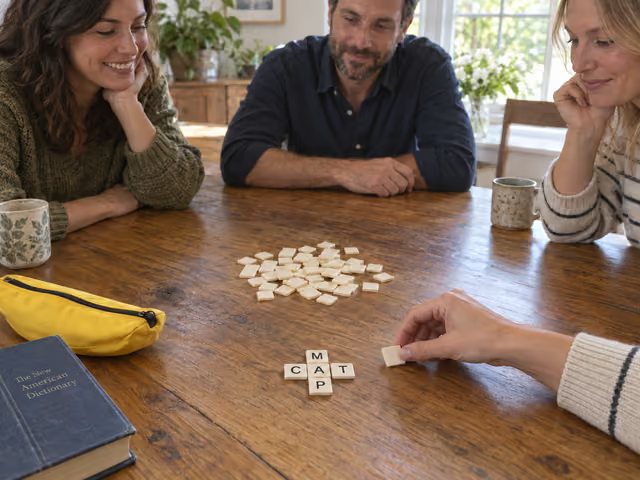
For this hosted format, have a printed English dictionary available and agree to use it for disputed words. This is a preparation choice, not an official requirement to buy a particular dictionary. Names, abbreviations and misspellings do not qualify. Settle your word standard before anyone starts.
Mix the tiles facedown in the center: this is the BUNCH. Each person draws the starting allocation without looking: 21 each with 2–4 people, 15 with 5–6, or 11 with 7–8. Leave the rest facedown. Choose one person to make the opening call.
Build, peel and check the finish
SPLIT: everyone starts
The opener calls SPLIT. Turn your starting tiles faceup and build your own crossword. Words read across from left to right or down from top to bottom and join through shared letters. All words belong to one connected grid. Check every adjoining letter sequence, including accidental crosswords; leave a gap where you do not intend a connection. You may dismantle and rebuild any part at any time.
PEEL: everyone draws
When all your current tiles are in your grid, call PEEL if the BUNCH still has at least one tile per active player. Every player, including you, takes one facedown tile and then turns it over. Even someone who has unused letters must draw. Incorporate the new letter and keep building; nobody waits for a turn.
DUMP: exchange one for three
If a letter blocks you, call DUMP, return that one tile facedown to the BUNCH and draw three tiles. Only you draw; there is no dump limit. This adds two tiles to your total. Complete the full exchange: a late dump is possible only when the returned tile plus the existing BUNCH provides three tiles. There is no partial exchange or free discard.
BANANAS: claim the hand
When the BUNCH has fewer tiles than active players, stop peeling. It need not be empty: three tiles remaining with four players is already the finish phase. The first person to use every tile in one connected grid calls BANANAS. Pause and inspect that grid, checking spelling, word eligibility and connections with the agreed dictionary. A valid claim wins the hand; there is no score for word length or leftover tiles in this main game.
If the claim fails, resume
An unacceptable word makes the claimant a ROTTEN BANANA: they are out of this hand and return their entire grid facedown to the BUNCH. Everyone else keeps their tiles and resumes from their existing grids. Count the remaining active players for the PEEL threshold; the returned tiles can make peeling possible again. The eliminated person returns next hand.
With four players and four center tiles, a PEEL gives one to each player and leaves zero. You must place that newly drawn tile before claiming BANANAS. With only three center tiles, nobody peels; the next valid finished grid can win.
Teach the calls and settle close finishes
Before dealing, demonstrate one crossing: put CAT across and use its A as the middle of MAP down. Point out that one tile serves both words. Show that a PEEL affects everyone and a DUMP affects only its caller, then remix the demonstration tiles into the BUNCH.
A short valid word is useful; the main game does not impose the three-letter minimum suggested below. Use the agreed dictionary to settle unfamiliar words rather than changing the standard after a finish. Do not award Scrabble letter points, discard awkward letters for free, or connect separate grids between players.
Suggested house conventions for calls: finish each announced draw or exchange before another call is acted on, so overlapping PEEL calls do not accidentally create two draws. Pause immediately on BANANAS and keep the claimed grid fixed during inspection. Treat a disconnected grid or unplaced tile at a finish claim as a failed claim, using the same elimination and tile return as an unacceptable word. If two valid finish calls genuinely cannot be ordered, share that hand's win; if one claim is invalid, apply its elimination and inspect the other. If all remaining players agree they are stuck, end the hand unawarded and remix for another rather than inventing a leftover-tile score. These are host conventions, not published Classic tiebreak rules.
Faster players can repeatedly force draws on everyone else. For a mixed-experience table, teach rearranging first and offer Banana Smoothie if the race feels frustrating. To play again, return every tile, mix facedown and deal the starting allocation again. Stop after any completed hand; there is no required match length.
Already know the game?
Ideas & Twists
Choose a variation together before you start.
Bananagrams · See main rules
Publisher variation · 2018 Classic leaflet; remainder convention is a house ruleBanana Smoothie
Replace the changing BUNCH with fixed hands: divide the 144 facedown tiles equally, with no PEEL or DUMP. House convention for an indivisible total: deal the same whole number to everyone and leave the remainder unused in the pouch. Call SPLIT and race to use the entire hand in one valid grid. Use normal winning-grid checks. Under the 2018 leaflet, an agreed stalemate or tied finish goes to the longest valid word in a grid; equal longest-word lengths mean another hand. Older leaflets use a different stalemate rule, so announce this version first.
Bananagrams · See main rules
Suggested house match · inspired by the publisher’s best-of suggestionFirst to two hand wins
Play ordinary hands, remixing and redealing after each. First to two sole hand wins wins the match. House convention: a shared or unawarded hand gives no player a match win; replay that hand. This can require more than three hands and does not guarantee a session length.
Bananagrams · See main rules
Suggested house variationThree-letter minimum
Require every across and down word to have at least three letters, including short words accidentally formed by adjacent tiles. Keep the usual deal, PEEL, DUMP and finish. Check the minimum before every PEEL and at BANANAS. This removes easy two-letter placements and asks the whole table to rebuild more often; agree it before dealing rather than imposing it on a struggling player.
About this guide
Reviewed October 2, 2026. Main mechanics and the selected Smoothie finish follow the publisher's 2018 Classic English leaflet, hosted by a retailer. The former Bananagrams instructions URL now redirects to Moose Toys' product page, which confirms components but does not expose the full rules. Printed-dictionary preparation, call handling, unresolved ties/stalemates, Smoothie leftovers the first-to-two match and its tie accounting are explicit host conventions. Three-letter minimum is a house variation. Community reports inform teaching advice, not official rules.
Ready for something different?
Find another game →