

The quick version
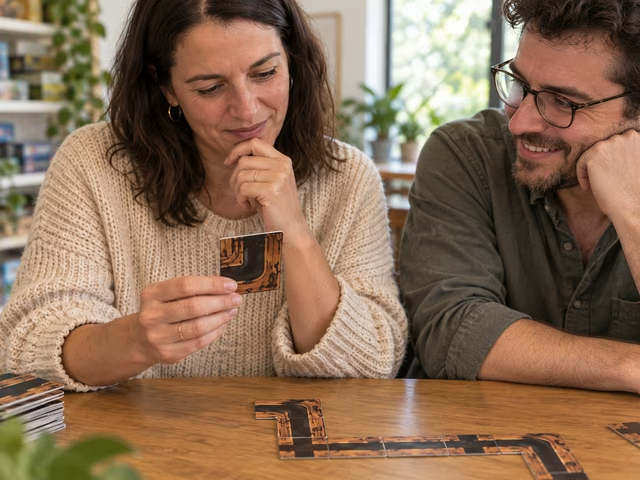
Start with the five-exit side and three cards each. Take turns adding one legally matching tunnel card, then draw a replacement. Win as soon as every tunnel is closed. If the cards finish with any route still open, everyone loses.
Saved on this device only — clearing your browser's cache or site data removes them (no account backup).
Leave room for a spreading maze
Place the double-sized start card centrally with its five-exit easy side up. Shuffle the 69 tunnel cards and deal three privately to each player. Keep the rest as a face-down deck. Choose the youngest player to start under the printed rule and go clockwise.
Use a large clear surface. Card paths can spread much farther than the box suggests; cups and spare components should be outside that area.
Extend, join or close a tunnel
On your turn add one hand card so it connects to at least one existing card. Rotate it as needed. Every touching edge must match: tunnels connect to tunnels and closed wall edges to walls. Cards cannot overlap or cover existing paths. Do not leave a path end aimed at an incompatible adjacent edge.
After placing, draw one replacement. Discuss which exits are dangerous and how the shared maze could close, but do not show or precisely describe your hand cards. The active player chooses the placement.
If none of your cards fits anywhere, put your hand below the draw deck and draw three new cards. This is a remedy for no legal play, not a way to discard an inconvenient hand. Try the replacement hand; if no legal move is possible even after cycling the available cards, the group loses rather than repeating forever.
Check every open route
The group wins immediately when all tunnels are blocked by printed ends or join into closed paths with no escape. There is no score or individual winner.
The English booklet says both 'until the draw pile is empty' and 'after all cards have been placed.' For this guide, use the latter reading: when the deck empties, continue taking turns with remaining hand cards without refilling. Skip empty hands. If any tunnel remains after all playable cards are exhausted, everyone loses. Agree this edition boundary before starting.
Verify all touching edges
Ask another player to trace the new card's edges before drawing. A connection that looks useful from one angle may mismatch a second edge. Slide the whole connected layout carefully if room is needed; do not alter relative positions. A table edge is not a tunnel closure.
Players report that closing every tunnel can be surprisingly difficult. Keep several open ends reachable instead of letting one branch run off the table.
Already know the game?
Ideas & Twists
Choose a variation together before you start.
Bandido · See main rules
Publisher difficulty choiceSix exits
Start with the six-exit side of the start card. Keep three-card hands, normal placement and the same agreed deck-exhaustion ending. There is one more initial route to contain.
Bandido · See main rules
Original STUDplay house twistOpen planning
Keep all three hand cards face up in separate player areas. Discussion may refer to exact cards, but each owner still plays only one on their own turn. This removes the usual hidden-hand restriction.
Bandido · See main rules
Original STUDplay house twistFour-card hands
Deal and refill to four cards instead of three. When no card fits, replace the whole four-card hand using the usual bottom-of-deck remedy. All other placement and winning conditions remain.
Bandido · See main rules
Original STUDplay house twistOne rescue exchange
Give each player one paper token. Before playing on their turn, they may discard it to place one hand card at the bottom of the deck and draw its top card, even when they have legal moves. They must then play normally. If the deck is empty, the exchange is unavailable.
Bandido · See main rules
Original STUDplay house twistKeep the courtyard clear
Before dealing, place one blank card-sized paper rectangle two card widths from the start card. No tunnel card may overlap that rectangle, and it never acts as a wall that closes a tunnel. The maze must route around it. All path-edge matching and the all-exits-closed win remain.
About this guide
Use the named physical base game and its supplied cards, boards and rules. Rules below are paraphrased teaching guidance. Original STUDplay house twists are optional suggestions, not publisher rules or balance-tested claims; agree one before setup.
Ready for something different?
Find another game →