

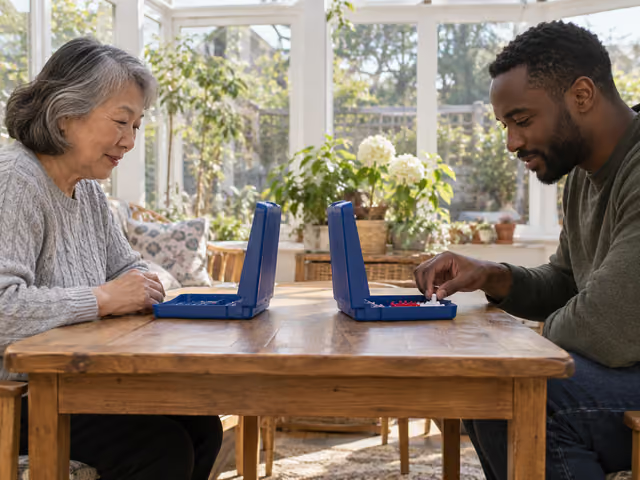
The quick version
Sit opposite one another with raised cases hiding each fleet. Place five ships straight across or down inside your ocean grid. Choose a first player. Call one unused letter-number coordinate; the defender reports a miss or a hit and the ship's name. Mark white for a miss and red for a hit on your target grid; the defender also marks hits on their ship. Alternate after every shot, including hits. Announce each sinking immediately. The first player to sink all five opposing ships wins.
Saved on this device only — clearing your browser's cache or site data removes them (no account backup).
Place a complete fleet behind each screen
This guide uses Hasbro's physical A3264 five-ship classic game, English instruction sheet 0719A3264348. Bring two portable cases, ten ships total, the set's red hit pegs and white miss pegs, and a stable table with two seats. Each player needs one carrier with five holes, one battleship with four, one destroyer with three, one submarine with three and one patrol boat with two. Older editions may use different ship names; check your supplied sheet before playing.
This edition includes 84 red and 168 white pegs in the box. Divide those between the cases: 42 red and 84 white per player. Use your set's supplied pegs and sheet. No cards, dice, score sheet, timer or device is required. For a new set, apply its labels and detach the ships carefully; follow the supplied assembly directions for removing rough plastic.
Sit facing each other and raise both case lids. Check from your seat that you cannot see the opposing horizontal ocean grid. Your lower ocean grid holds your own ships; the upright target grid records your shots at the opponent. Both grids use rows A–J and columns 1–10.
Place all five ships secretly on your ocean grid. Each occupies consecutive cells horizontally or vertically, fully inside the numbered grid. Do not place ships diagonally, overlap them, stack them, or cover coordinate labels. The ships can be adjacent: this edition does not require a gap around them. Keep the layout fixed once play begins. Choose who starts before either player fires.
Call, answer and record one shot
Call a new coordinate
Choose an unmarked space on your target grid and say its letter and number clearly, such as 'H-6'. This names the same coordinate on your opponent's ocean grid. The defender repeats the coordinate if they need to confirm it before answering.
Report the result accurately
If no ship occupies that cell, the defender says 'Miss'. The shooter puts a white peg at that coordinate on their target grid. The defender does not need to mark an incoming miss on their own ocean grid. If a ship occupies the cell, the defender says 'Hit' and names that ship. In this edition the name is given on every hit, not only when the ship sinks.
Mark hits on both sides
For a hit, the shooter puts a red peg at the called coordinate on their target grid. The defender puts a red peg in the corresponding hole of their own ship. Wait until both records are correct, then pass the turn. A hit does not earn another shot in the main game.
Announce a sinking immediately
When every hole of a ship has been hit, its owner announces which ship has sunk. The carrier needs five distinct hits, battleship four, destroyer three, submarine three and patrol boat two. Leave sunk ships and target pegs in place so previous shots remain clear.
Finish on the last ship
Continue alternating single shots until one player sinks the opponent's fifth ship. That player wins immediately; the opponent does not get an equalizing turn. There are no points to total and no tied result in this sequential format. For another game, clear the pegs, secretly place the complete fleets again and choose the starting player.
If you call H-6 and hear 'Hit, submarine', mark H-6 on your upright target grid. Your opponent marks the H-6 hole of their submarine below. You do not mark your own fleet for a shot you fired.
Keep the hidden information and records fair
Explain the two grids and the hit-name rule before hiding the fleets. Community players report remembering different announcement rules and importing extra turns from apps; use the selected physical sheet for this game. Speak softly, leave room to reach the peg trays, and keep spectators where they cannot see a fleet and advise the opponent. A seated game still requires players to distinguish coordinates, handle small pegs and exchange results; discuss any assistance privately without exposing a fleet.
A useful search approach is to spread early shots across the grid, then try cells immediately above, below, left or right of a hit to learn the ship's direction. Avoid repeatedly calling spaces already marked. A ship cannot run diagonally, but another ship can sit beside it: do not automatically treat every neighboring cell as water after a sinking. These are suggestions, not guaranteed winning strategies.
The supplied sheet does not specify penalties for accidental repeated calls, forgotten announcements or an exposed fleet. Agree on a house remedy first: before the defender answers an accidental repeated or invalid coordinate, let the shooter correct it. If a response or peg was wrong, pause and correct both records; announce a missed sinking as soon as noticed. Do not award an automatic bonus shot. If the true records cannot be reconstructed, or a fleet is accidentally exposed, this guide suggests abandoning that game without a winner and setting up new fleets. Deliberately moving ships or giving false answers breaks the agreed game.
Already know the game?
Ideas & Twists
Choose a variation together before you start.
Battleship · See main rules
Official A3264 optionSalvo
Replace the single shot with one shot for each of your own ships still afloat at the start of your turn. With all five ships afloat you get five shots; with two sunk you get three. Fire and resolve each shot one at a time, marking it and hearing its hit or miss before choosing the next coordinate. Name hit ships as in the main game. A sinking of your own ship reduces your next turn's allowance; hitting an opponent's ship does not increase yours. Alternate after the allowance is used, and stop immediately if the opposing fifth ship sinks. Placement and hit requirements stay unchanged.
Battleship · See main rules
House suggestionHit and continue
Use the main single-shot game, but let the shooter take another unused-coordinate shot after each hit. Keep shooting until a miss ends the turn, or until the opposing fifth ship sinks and ends the game immediately. Each shot is answered and marked before the next, and hit ships are still named. This replaces alternating after every shot; do not combine it with Salvo. Setup, ship lengths and all other rules stay the same. It can make a discovered ship lead to several consecutive shots, so both players must choose this rule before setup.
About this guide
Main play follows the English A3264 sheet 0719A3264348 currently served by Hasbro's English-India instruction page: five ships of lengths 5/4/3/3/2, red hits, white misses, ship names on every hit and one shot per turn. The US listing currently downloads Spanish/Portuguese sheet 1219A3264IB2 with 73 rather than 84 red pegs; core mechanics agree. This identifies the reviewed edition, not a claim that every currently sold Battleship box has these contents. Salvo and hidden-name Salvo are official options. Hit and continue, first-player selection and mistake/redeal remedies are stated host choices. Electronic, aircraft, four-ship and app formats are separate.
Ready for something different?
Find another game →