

The quick version
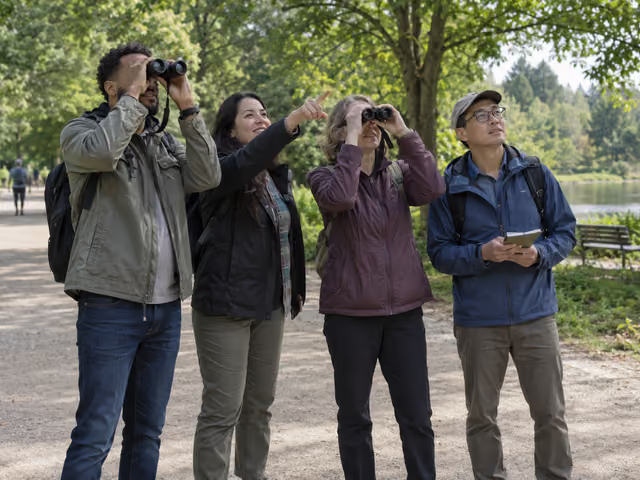
Choose a permitted park route everyone agrees to walk, a meeting point and a finish time. Bring shared binoculars and a local bird reference. Start with a quiet look and listen. When someone finds a bird, describe its location using a landmark, let others get a view, and note its appearance and behavior. Walk to the next stop together. Return on time and share one observation each; there is no species target or winner.
Saved on this device only — clearing your browser's cache or site data removes them (no account backup).
Choose the route and bring enough to share
Choose a familiar, permitted public park loop or out-and-back route with space to pause off the throughway. Check current opening hours, closures, surface, distance, slopes, toilets, weather and return directions before inviting people. Tell friends those specifics and ask what route, breaks and pace work for them. Confirm any entry or parking charge. A paved path alone does not establish that the whole outing meets someone's access needs.
Agree on the exact meeting point, finish time and a turnaround point or time that leaves enough time to return. Pick a route that fits that plan; this guide does not promise a fixed duration. Everyone may ask to pause or head back. Stay together rather than splitting up to pursue sightings. The host checks the group count before leaving each observation stop.
Bring one working pair of binoculars for every two people, rounded up: one for two, two for three or four, and three for five or six. Borrowing is fine if arranged in advance. Also bring one printed bird reference covering your region, one shared notebook and a working pen. Each person brings water, suitable walking shoes and protection for the actual weather; add food or other supplies appropriate to the route. The host carries a charged phone for safety and return coordination. Bird ID apps, a camera and extra optics are optional; a phone screen is not needed to identify birds in this format.
Find the view before finding a bird
Before setting off, practice on a stationary landmark. Adjust the binocular hinge until the two circles become one view. Set the eyecups for your glasses and follow the binocular's instructions for focus and individual-eye adjustment. Shared binoculars may need readjusting for each person. Wear the strap and keep the lenses pointed away from the sun.
Look at the landmark with your eyes first. Keep your gaze there while raising the binoculars, then focus. Lower them if you lose the target, locate it again and retry. Practice describing a position: 'The fork in the bare tree beside the path; on the right branch.' A direction from one person's viewpoint may need translating for someone standing elsewhere. Stop walking while using optics.
Look, share the view, then move together
Begin with a quiet pause
At the first safe stopping place, lower voices and look across the ground, shrubs, trees and water that are actually present. Listen for calls and watch for movement. There is no required turn order, bird count or race; anyone can notice something.
Help others locate it
Describe a landmark and where the bird is relative to it before trying to name it. For example, 'On the fallen branch beside the pond, just above the water.' Leave a viewing gap, share binoculars willingly and ask whether everyone who wants a look has found it. If the bird flies away, say where it went; do not chase it.
Gather clues
Notice size and shape, where the colors or markings sit, what the bird is doing and the habitat. Then compare those clues with the local reference. A note such as 'small brown bird, slim bill, hopping in reeds' is useful even without a species name. Add the place and date to the notebook; keep uncertain names marked as uncertain rather than settling them by a vote.
Continue at the group's pace
When everyone is ready, put optics down and walk to the next safe stop. Rotate who carries the shared notebook if they want to. Watch common birds as well as unfamiliar ones. If little is visible, listen or move to the next planned stop; do not add a longer detour to make the outing feel successful.
Return and close the outing
Turn back when the agreed plan requires it, or earlier for weather, fatigue, route problems or anyone's needs. At the meeting point, confirm everyone has returned and invite each person to share one sight, sound, behavior or unanswered question. No observations is also a valid outcome. There are no points, winners or ties. Agree explicitly if everyone wants a separate later outing.
Rather than asking a newcomer to name a bird, ask, 'What is it doing, and what part of it caught your eye?' Naming can follow observation. A missed view or an unknown bird is not a failed turn.
Give birds and other visitors room
Follow the site's rules and stay on permitted paths. Keep away from nests, roosts and sensitive areas; never handle birds or move vegetation to expose them. Watch from a distance and withdraw if your approach interrupts their activity. This outing uses no bait, call playback or imitated calls to lure birds closer. That is a deliberately stricter host choice than the American Birding Association's general advice to limit audio attraction.
Keep passing space clear and aim binoculars and cameras away from people's homes. Give others a view rather than occupying the best spot for a photograph. Ask before photographing friends or sharing their pictures. Do not publish sensitive nest locations. These are observation stops, not a reason to block a path or enter private land.
Handle missed views and uncertain names
If someone cannot find a bird, restart with the nearest clear landmark and let them try the optics after readjusting. If the bird is gone, describe what you noticed and carry on. Nobody has to confirm seeing what others saw. Make room for questions, and let quieter friends offer their observations before the most experienced person explains an identification.
If two names are proposed, compare the actual clues and local reference. Keep a question mark if the evidence is incomplete; naming the bird is not a contest. A camera can help preserve details, but photographing is optional and does not extend the agreed return plan.
If you choose to use Merlin, treat its suggestions as leads. Check them independently against the bird or recording, habitat, range and season; do not report an unverified suggestion to eBird. Keep comparison recordings inaudible to nearby birds, using headphones or reviewing later. This guide's shared notebook is a casual observation record, not a formal eBird checklist.
Keep the group intact if someone wants to return. If separated accidentally, stop searching and use the pre-agreed meeting and contact plan to reunite; do not start an unplanned off-path search. End the outing when the route or conditions no longer fit the group. The activity's purpose is shared attention, not collecting the largest list.
Already know the game?
Ideas & Twists
Choose a variation together before you start.
Birdwatching walk · See main rules
Host suggestion · practice finding the same birdLandmark relay
At each observation stop, one volunteer describes a bird's location without naming its species. A second person locates it and describes the position in their own words for the next friend. Continue through anyone who wants to try, then discuss its identity. Change the first speaker at the next stop. If the bird leaves, end that relay and continue the walk; there is no penalty or score. Keep the main route, shared equipment and return plan.
Birdwatching walk · See main rules
Host suggestion · watch what birds doBehavior notebook
Replace the emphasis on species names with a shared page of behaviors: feeding, bathing, flying, resting, preening or calling. At each stop, invite one observation and record only what someone actually saw or heard, with its location. The examples are prompts, not a checklist you must complete. At the meeting point, each person chooses one behavior to describe. Repeated behaviors are welcome; keep the main equipment and route, with no points or target count.
Birdwatching walk · See main rules
Host suggestion · changes the optics requirementEyes-and-ears walk
Leave binoculars out and observe from the same permitted path with unaided eyes and ears. All other main-format preparation, the printed reference, notebook, personal essentials and host safety phone remain. Use broader descriptions when details are too distant; do not approach a bird to compensate for missing optics. At each stop share one sight or sound, then finish with the same return and recap. This variation needs no binoculars; bring the other equipment listed above.
About this guide
This is a suggested small-group park outing, not a competition, purchased game edition or official bird-count protocol. The 2–6 range, optics-sharing ratio, host safety phone, route/return structure, recap and all three variations are authored hosting choices. ABA supplies birding ethics; Cornell supplies observation, identification and optics guidance. The no-lure rule is stricter than ABA's limit-on-playback guidance. Optional Merlin use does not turn its suggestions into confirmed sightings. Formal eBird submissions and organized bird counts have separate requirements.
Ready for something different?
Find another game →