

The quick version
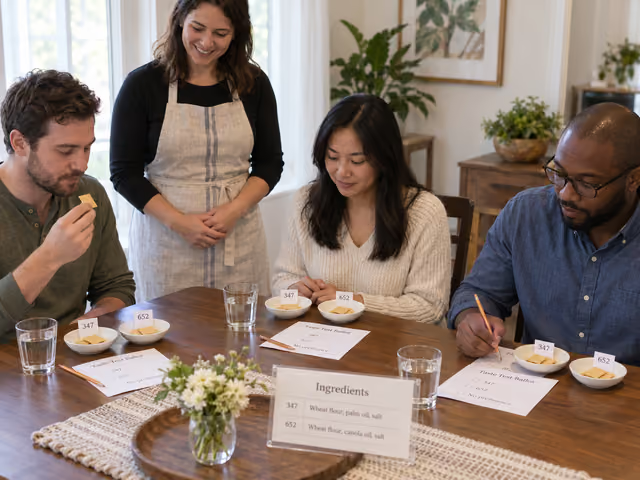
Agree on two plain cracker products everyone can and wants to taste. The host labels equal portions 347 and 652, keeps the brand key private, and gives each taster both samples, water and a ballot. Read the ingredients first. Taste privately, sip water between samples, then mark 347, 652, no preference or pass. Once everyone is finished, count preferences, reveal the brands and compare notes. There is no participant winner in this main format.
Saved on this device only — clearing your browser's cache or site data removes them (no account backup).
Choose the foods before hiding the brands
Choose one host who will know the brands and will not submit a ballot. Everyone else is a taster. Three people means one host and two tasters; eight means one host and seven tasters. The host can sit beside the table. This is an authored home format, not a purchased game or a formal sensory panel.
Before shopping, ask about allergies, dietary restrictions, foods people dislike and whether they want to taste at all. Choose two similar, familiar, packaged plain crackers that every taster approves. Check each current package, even if you have bought it before. Keep complete ingredient lists, allergen statements, advisory warnings and preparation details available for each sample code before anyone eats. Anyone may inspect the original package; revealing a brand is preferable to hiding information they need. If suitable products cannot be agreed, choose another activity.
Use clean hands, a clean table and separate clean dishes. Follow each package's storage and handling directions. Keep the two products separate while portioning; do not treat similar labels or a tiny sample as an allergy guarantee. People who prefer to observe can help with the tally or discussion without tasting.
Make one private pair for every taster
Let T be the number of tasters. Set out exactly 2T matching small dishes, T water glasses, T ballots and T pencils. For the largest group, that is 14 dishes and seven of each other item. Put two small cracker pieces from each product in every taster's corresponding dish, matched as closely as practical for portion size. That requires 2T pieces of each product, or 4T pieces total. Keep unused food separate from tasted portions.
Assign product A to code 347 and product B to code 652 on a private key. Use those codes consistently on the dishes, ballot and ingredient sheet; put branded packaging aside after everyone has had the information they need. Place 347 on the left for alternate tasters and 652 on the left for the others. With an odd taster count, one order has one extra person. Keep all pairs at the same serving conditions. Everyone needs room to reach their own food and write.
On each ballot write: 'Preference: 347 / 652 / no preference / pass. One taste or texture note: ___. Optional brand guess: ___.' On the host's tally sheet make four columns with the same choices. A name is unnecessary; use a seat number if you need to resolve an unclear ballot. Explain that guesses are optional and unscored.
Taste, choose and reveal
Start with the disclosed food
The host says: 'These are two plain crackers. Here are the ingredients for each code. You may taste, skip or stop. Try the left sample, sip water, then try the right. Keep your reactions private until everyone has marked a ballot.' Confirm that each person is ready before starting.
Taste your own pair
Each taster picks up their own first piece, tastes at their own pace, then takes a sip of water before the second sample. Eyes stay uncovered. Use the spare pieces in your own dishes if you want to compare again. No one feeds another person, races, or pressures them to finish food. Stop tasting whenever you wish.
Lock one response
Mark the code you prefer and, if you wish, one short reason such as 'crisper' or 'less salty'. Choose no preference if you tasted both and have no favorite; choose pass if you did not complete the pair. Fold the ballot. Do not announce brands, guesses or opinions before all ballots are folded or passed.
Count and uncover
The host counts 347 and 652 votes separately, reports no-preference and pass responses separately, then reveals the key and packages. More preference votes makes that product this group's favorite for this flight. Equal votes are a shared result; if neither code receives a vote, report no group preference. Participants do not earn points or win in the main format. Let each person decide whether to share their note or brand guess.
Finish this flight
The activity ends after the reveal and discussion. Clear individual dishes and preserve untouched leftovers according to their labels. If everyone wants another flight, first choose and approve a new pair, prepare fresh dishes and a new private code key, and start again. Each flight has its own result; do not turn several flights into an improvised tournament.
Before serving, say: 'If you prefer 652, mark 652. If you tasted both but cannot choose, mark no preference. If you stopped after one, mark pass.' This demonstrates the choices without using an extra sample.
Keep the surprise friendly and the record honest
A favorite is a preference, not a correct answer. Let people explain what they noticed without correcting their taste or ridiculing a brand guess. A small friend-group tally does not establish which brand is generally better, healthier or worth buying. Brand-hidden also does not mean fully blind: shape, ingredient information and prior experience can still identify a product.
Before the reveal, ask the taster to clarify any ballot with two preference marks; if they decline, record it as no preference when both samples were tasted, otherwise pass. Once the key is revealed, leave submitted choices unchanged. A mislabelled or mixed-up dish invalidates that person's pair: record a pass, correct the preparation, and offer a fresh pair only if they want it. If you cannot reconstruct the key reliably, announce that the flight has no valid result.
If somebody announces a brand before all responses are in, finish eating only by choice, label that flight as a revealed tasting, and discuss rather than presenting its tally as a blind comparison. Starting again requires willing tasters, fresh portions and new codes; nobody owes a retry.
Keep the first gathering to one pair. More foods create more preparation and can tire people of tasting. Participation is voluntary throughout, and observing counts as joining the gathering. The seated setup is not a promise that the food, writing or tasting will suit every access need.
Already know the game?
Ideas & Twists
Choose a variation together before you start.
Blind taste test · See main rules
House puzzle using the triangle-test methodFind the odd cracker
Replace the preference question with one three-sample puzzle. Keep the same host and 2–7 tasters, but use 3T dishes and three small portions per taster: two from one approved product and one from the other. Number each taster's tray or place setting and label its positions 347, 652 and 918; the codes identify positions within that tray, not fixed brands across trays. On a private per-tray key distribute AAB, ABA, BAA, BBA, BAB and ABB orders across the tasters; repeat an order if there is a seventh taster. Record the odd code for each tray. Provide complete ingredients and allergen information for each tray position even if it reveals a clue. Taste left to right with water between samples; retasting your own samples is allowed. Each willing taster privately circles one odd code or passes. Collect every answer before revealing: one point for the correct odd sample, zero for a wrong answer or pass. Stop after this one puzzle; all tasters with the highest score share the result, including a tie at zero. The host is unscored. This casual, potentially unbalanced home puzzle cannot establish a scientifically detectable difference; never withhold food information to improve it.
Blind taste test · See main rules
House flight using preference-ranking practiceThree-brand ranking
Replace the two-product flight with three approved plain cracker products and 3T dishes. Give each taster one matched portion from each, coded 347, 652 and 918 with a single private brand key, complete food information and a three-position ballot. Rotate which code is tasted first across the tasters. Taste all three with water between samples and privately rank each code once: first, second and third. If you cannot or do not want to complete an order, pass on the entire ballot; do not force a preference. Retasting your own portions is allowed. Collect all ballots before revealing. Give each product three points for every first-place vote, two for every second-place vote and one for every third-place vote; sum only complete ballots. Reveal the brands and totals. Highest total is this group's preferred product for the flight; equal totals share that place, and no complete ballots means no ranking. No participant wins. Finish with the reveal; these totals do not measure how much better one food is.
Blind taste test · See main rules
House comparison suggested by cooking discussionsPlain, then with a topping
Before starting, approve one familiar ready-to-eat topping along with both cracker products, including its full ingredients, allergen information and package handling needs. Add two extra sample dishes per taster, topping, and separate clean serving utensils for the two products. Prepare two rounds: the main plain-cracker pair, then a second pair with equal small amounts of the same topping on equal cracker portions. Keep all topping and food handling within package directions. Label each pair with 347 and 652 using the same private product key. After the plain round, fold its ballots but do not reveal the brands or discuss preferences yet. Sip water, try the topped pair, and fold a second ballot with the same four choices. Retasting your own portions is allowed. Collect both rounds, tally each separately, then reveal everything once. Discuss whether the favorite changed; ties, no-preference and passes work as in the main guide. Finish after the two-round reveal. This shows a preference in two serving contexts, not proof that cooking erases differences.
About this guide
Main method: two coded samples, a private preference ballot, counting and a code reveal, from the opened Food Analysis and Quality Control manual, pp. 87–90. This is a STUDplay home adaptation, not a commercial edition or formal panel. The 3–8 total headcount, crackers, portion counts, alternate order, retasting, voluntary no-preference/pass choices, friendly discussion and dispute remedies are house hosting choices. Triangle and ranking mechanics draw on pp. 120–121 and 103–104; puzzle points, ties and ranking abstention are house conventions. The Hong Kong source supplies coded tasting and water-between-samples practice; its discrimination question, no-retasting instruction and spitting protocol are not imported. Full food information always takes priority over brand concealment.
Ready for something different?
Find another game →