

The quick version
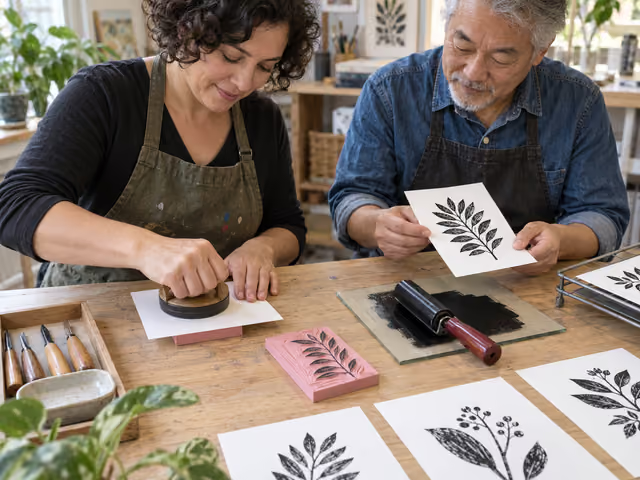
Choose a simple design and mark which parts will stay white. Brace the block on a bench hook and carve away from your body and free hand. Ink the raised surface, lay paper on top and rub its back with a baren. Lift a test print, adjust, then re-ink for every copy. With N people, each maker produces N finished prints: keep one and give one to every other person after drying. There is no score or winner.
Saved on this device only — clearing your browser's cache or site data removes them (no account backup).
Prepare a paper-printing table
This beginner project supports 2–6 adults. Use one unmounted 4 × 6 inch Speedball Speedy-Carve soft block per person, rather than flooring scraps, wood or hard traditional lino. The ink is black Speedball Water-Soluble Block Printing Ink for paper; Fabric, Professional Relief and Oil-Based are different product lines. Buy individual supplies or check a kit against the inventory below. A kit name alone does not ensure enough tools for the group.
- For each person: one block, one compatible palm-handle carving set with a small V gouge and wider U gouge, one bench hook that braces securely against the table, drawing paper, pencil and eraser.
- For every two people: one soft-rubber brayer, one smooth washable inking plate or sturdy acrylic slab, one baren for rubbing prints, and a blunt palette knife for handling ink. Share these at a printing station.
- For N people, each maker needs N finished sheets plus at least four spare proof sheets, all smooth lightweight printmaking paper about 5 × 7 inches or larger. Bring extra paper for retries. That starting allowance is 12 sheets for two people or 60 for six, plus drawing paper.
- For the group: black ink with sufficient supply for repeated inking, protective table covering, a clean tool tray, scrap paper for wiping excess ink, rags, soap, water and access to handwashing. Check ink and tools before inviting everyone; no fixed tube quantity guarantees the whole run.
- Provide a well-lit seated work place for every carver, separated ink and clean-paper areas, and a drying rack or protected flat drying area where wet prints cannot overlap. Keep food and drinks away from the work.
The host should practice a small print first and be able to demonstrate a controlled cut. Follow the supplied tool and material labels. Fit blades according to the handle instructions, checking they are secure before carving; handle the cutting end carefully and store spare blades in the tool tray or their case. No press, phone, printer, iron, solvent transfer or heating step is needed.
Choose what prints and what stays white
Start by drawing around the block on paper. Within that rectangle, plan a few broad shapes or lines: a leaf, a crescent or a geometric pattern makes a manageable first project. The raised block takes ink; removing a part makes that part white in the print. Try a white-line design inside a solid dark rectangle before attempting a fully cleared background.
Draw the chosen design directly onto the block in pencil. The print will reverse left and right. Avoid lettering for the first block; if you include it, draw it backwards on the block. Agree the N-print exchange target before cutting. Use your own design or an image you have permission to reproduce, and ask before altering another person's work.
Carve, proof and print the set
Carve with a clear cutting path
Brace the block against the bench hook. Keep your free hand and body behind the blade's travel path; cut away from both. Rotate the block to change direction. Make shallow controlled cuts with the V tool for lines and the U tool for wider areas. Never force a stuck cut. Stop if the block slips or the tool needs heavy pressure, and reset or ask the host for help.
Ink and pull a proof
Put gouges in the tray and clear loose shavings. Roll a small amount of ink into a thin even film on the plate, then coat the raised block without flooding its cuts. Lay a proof sheet over the inked block. Rub the whole back with the baren while keeping the sheet still, then peel it away. Place the proof face up in the drying area.
Adjust before the full run
Look at the proof together. Identify white areas that still picked up ink, missing coverage or a reversed design. Change one thing at a time. Wipe and dry the block before additional carving, then repeat the proof. A carved-away shape cannot be restored; keep the new design, simplify it or use a new block if one is available.
Print one copy per participant
Take turns at shared printing stations, one person handling a station at a time while others draw, carve or inspect proofs. Re-ink before each impression and use a fresh sheet. With N people, choose N finished prints from your run: one to keep and N−1 to exchange. Prints may vary naturally; show any incomplete print honestly and replace it if materials allow. Label the drying position with the maker's name on separate paper.
Dry, exchange and close
Leave prints separated until dry enough to handle and stack according to the ink's directions and actual conditions. Do not promise a fixed drying time. Once dry, each maker keeps one and hands one to every other participant. If drying extends beyond the gathering, the host keeps labeled sets separated and arranges collection. Finish when everyone has their agreed set and supplies are cleaned. There are no points, winners or ties.
Before everyone carves, the host draws one simple line on their own block and makes one shallow cut with hands behind the blade. Point out that this cut will become a white line in the dark printed area. Use that block's proof to show the result, then let each person begin their own design.
Keep the work safe and the exchange fair
Show the proof to its maker before suggesting changes. Small handmade differences are part of the project; the exchange is not a judged contest. If copies run short, pause and agree a smaller exchange or later collection with everyone affected. Do not quietly promise someone a print that does not exist. A person may choose to design, ink or inspect prints with a partner rather than carve; agree who controls the blade before starting.
For patchy printing, check that the ink is still workable, the layer is thin and the whole sheet received pressure. Water-soluble ink can dry on the plate during conversation: clean dried material off and roll fresh ink. Do not fix it by adding water; Speedball advises against that. Smudges can come from paper movement; filled lines suggest excessive ink. Test again before removing more material.
Clean this specified ink from the block, brayer and plate with soap and water as directed, then dry and store the tools. Wipe up leftover ink first and follow local disposal guidance. Keep the sharp tools separate from the washing area, where someone could reach into water without seeing them. Wash hands before handling clean prints. Paper-printing ink is not a substitute for a fabric-printing process.
Stop for fatigue, a damaged tool or unsafe hand placement. Soft blocks still require sharp gouges and controlled hand work. Comfortable seating, good light and a helper can support participation, but this setup does not guarantee it meets every access need.
Already know the game?
Ideas & Twists
Choose a variation together before you start.
Block printing · See main rules
House project suggestionOne subject, different interpretations
Before drawing, choose one shared subject such as local leaves, a place you all know or a geometric shape. Everyone makes their own interpretation on one block. Keep the same materials, cutting method and N-copy exchange. At the finish, each maker describes one design choice; nobody ranks the work.
Block printing · See main rules
House experimentA ghost-print comparison
After one ordinary inked proof, immediately pull a second proof onto an extra sheet without re-inking. This lighter second impression is a ghost print. Compare the two before resuming normal re-inking. Add at least one experiment sheet per person beyond the main inventory. Keep producing N ordinary finished prints for the exchange; do not replace promised copies with ghosts unless everyone agrees.
Block printing · See main rules
House collaborationPaired design and print shop
For 2, 4 or 6 people, work in pairs on one block per pair. Agree one design together; one person carves while the other checks the drawing, then swap at a safe stopping point with the tool placed down. Each pair needs one block, carving set and bench hook, plus N finished sheets and at least four proof sheets. Pull N finished copies of the pair's design: each pair member keeps one and every other participant gets one. Each person ends with N÷2 different designs, one from each pair. The printing stations, ink, drying and safe-cutting rules remain the same; there is no competition.
About this guide
Speedball's current product guidance and studio tutorials inform this soft-block, water-soluble paper-printing method. The group project and print exchange are suggestions. Other inks, fabric printing and harder carving materials need their own methods.
- Speedball · block printing and mirror-image FAQs ↗
- Speedball · Speedy-Carve blocks and compatible inks ↗
- Speedball · Water-Soluble paper-printing ink, modification and cleanup ↗
- Handprinted studio · single-color beginner carving and hand-printing tutorial ↗
- Brittany Peterson · small-block design, practice and print process ↗
Ready for something different?
Find another game →