

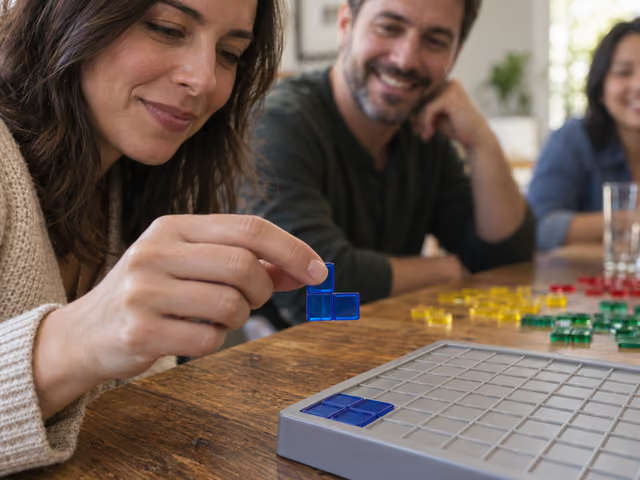
The quick version
Choose four colors and distinct starting corners. Each first piece covers its corner square. Take clockwise turns placing one piece that touches your color at a corner and never along an edge. Other colors may touch freely. If none of your remaining pieces fit legally, pass. Keep playing until all four colors are finished or blocked; count squares left off the board, and the lowest total wins.
Saved on this device only — clearing your browser's cache or site data removes them (no account backup).
Check the set and choose corners
Use Mattel's classic Blokus BJV44 English edition, instruction sheet BJV44-0920, with a square 400-cell board. Duo, Trigon, Junior, Shuffle and Roll & Write have different equipment or rules; this guide does not teach them.
Give each player all 21 pieces of one color. Every color has one single-square piece, one two-square piece, two three-square shapes, five four-square shapes and twelve five-square shapes. Check for missing pieces before playing; a missing piece changes both options and the final count. Each color's complete supply contains 89 unit squares. Keep the supplies separate and visible beside the board.
Sit around a stable table where everyone can see the whole grid and reach their corner. Assign each person the nearest distinct corner, choose a starter, and go clockwise. The BJV44 English sheet allows choosing the starter; an older classic sheet fixes blue, yellow, red, green. Use the BJV44 method for this main game. Agree to basic scoring before starting. No timer, phone or score sheet is required for a single game.
Place one shape each turn
Start at your corner
On your first turn, choose any one of your pieces and place it flat on empty cells so one of its squares covers your assigned corner cell. A piece merely near that corner is insufficient. Each other person starts from their own corner on their first turn.
Find a legal connection
For every later placement, at least one square of the new piece must touch an existing piece of your color diagonally at a corner. None of the new piece may share a side with any previously placed piece of your color. It may touch more than one of your pieces at corners. Different colors may touch at sides or corners. All squares must fit empty cells inside the board; no overlap, stacking or overhang.
Turn the piece before committing
Rotate or turn over an unplaced piece to try its different orientations. Keep its connected shape intact. Check the whole piece, not only the corner you connect: another part might touch your own color along a forbidden edge. Once a legal piece is placed, it stays there. Take one placement, then the next person plays.
Pass only when blocked
If no remaining piece fits legally anywhere, announce that you are blocked and skip that color's future turns. A person who used every piece also skips future turns. Others keep taking turns in the same clockwise order. Do not pass merely to wait for a better opening: other players add pieces but never remove them, so a genuinely blocked color cannot regain a legal move.
Before the scored game, use two blue pieces to show a legal diagonal corner touch and an illegal edge touch. Show that blue may share an edge with a yellow piece. Return every demonstration piece to its owner and clear the board before starting.
Count unused squares
Finish when every color has either used all its pieces or has no legal placement left. Finishing your own supply does not end everyone else's game. Count the individual squares in your unused pieces, rather than the number of pieces. A remaining five-square shape and two-square shape total seven; one remaining four-square shape totals four, so four wins that comparison. The lowest unused-square total wins.
For this guide, equal lowest totals share the win. The BJV44 sheet gives no tie-break procedure; sharing the result is an explicit house convention. Basic scoring has no last-piece bonus. Use the separate bonus-scoring variation only if agreed before play. Return all pieces to their color supplies before another game and check that each has 21 again.
Keep moves clear and newcomers involved
Start by looking for room to grow beyond your home corner. Larger shapes become harder to fit as the grid fills; smaller ones can help you squeeze through later. Keep several exposed corners available rather than creating a trail with only one exit. These are useful approaches, not compulsory moves or a promise of winning. Avoid treating a region as owned: any opponent who can reach it legally may use it.
Prepare a candidate during other turns, then recheck it after their placements. Let newcomers ask whether a move is legal before releasing a piece. Do not put several candidate pieces on the board at once or shift existing pieces to test a fit. Blocking is part of the game; make it about the available space rather than personal criticism. Invite a first-time player to identify their next open corner so they can see the connection rule in practice.
When a move is disputed, check empty cells, same-color corner contact and every possible same-color edge contact. Different-color contact is legal, including a teammate's color in the partners variation. Suggested house remedy: if a newly placed piece is illegal and the next person has not played, return it and let that person choose a legal move. If discovered later, pause; undo only the illegal placement and replay from that turn if everyone can reconstruct the intervening moves. Otherwise abandon that game without a winner and reset. These remedies are host suggestions, not printed penalties.
Before declaring someone blocked, let them check their remaining small pieces against every exposed corner, including rotations and flipped orientations. Do not declare the whole game finished just because one person is out. For mixed experience, give everyone the same practice demonstration and offer legality help when requested; avoid taking over another person's strategy. This seated format still needs usable vision, piece handling and board reach; discuss individual adjustments with the group.
Already know the game?
Ideas & Twists
Choose a variation together before you start.
Blokus · See main rules
Official BJV44 optionBonus scoring
Keep four players, setup, placement and the finish unchanged, but choose advanced scoring before the first move. Each unused square scores −1. A color that places every piece scores +15 instead; if its single-square piece was the final piece it played, add another +5 for +20 total. Playing the single square last earns nothing extra when other pieces remain unused. Highest score wins; equal highest scores share the win under this guide's house tie convention.
Blokus · See main rules
Official BJV44 formatTwo people, two colors each
Use the same complete 20×20 set with two people. One controls blue and red from opposite corners; the other controls yellow and green from the other opposite corners. Arrange the corners clockwise blue, yellow, red, green and always take turns in that color order. Make one move for the active color, skipping only a finished or blocked color. Your own two colors are still different colors: edge contact between them is legal, but a blue piece must connect to blue, never merely red. Finish when all four colors are finished or blocked. For basic scoring, add unused squares from both colors; lowest combined total wins, with equal totals sharing the win. If advanced scoring is chosen instead, score each color separately and sum its signed scores; highest combined score wins. This is classic Blokus's two-color format, not the separate Duo game.
Blokus · See main rules
Older classic official option, using advanced scoringPartners across the board
Keep four people, one color each, and use the team format in Mattel's R1983-0920 classic sheet. Blue and red form one team; yellow and green form the other. Arrange clockwise blue, yellow, red, green and use that fixed turn order, so partners have opposite corners. Each person places only their own color; every placement must connect to that same color under the normal corner rule. Agree that partners may discuss plans openly as a house communication convention; each player commits their own move. After all colors finish or block, calculate each color's advanced score (−1 per unused square, or +15 for all placed, with +5 if the single square was last). Add partners' scores; the higher team total wins, with equal totals sharing the win. No extra equipment is needed.
Blokus · See main rules
House session suggestionFour-game color circuit
For four people who want repeated games, bring paper and a pen. Arrange the corners clockwise blue, yellow, red, green and keep those corner colors fixed for all four games. Each game uses basic scoring and clockwise turns beginning with blue. After each game, record every person's unused-square total, clear the board, and move each person one seat clockwise so everyone plays each color and starting position once. Play exactly four complete games, even if someone wins early. Add each person's four unused-square totals; lowest sum wins, and equal sums share the result. Individual-game wins give no extra points; bonuses and partners do not apply. This changes the session result, not legal placements.
About this guide
The main game uses the English BJV44-0920 sheet's chosen starter, clockwise turns and basic scoring. Its bonus and two-player rules are separate options; the partners format comes from the older R1983-0920 sheet and deliberately uses that sheet's fixed color order and advanced scoring. The main game is for four people; the two-player variation changes that count. Shared ties, practice demonstration, repair remedies, partner discussion and the four-game circuit are house suggestions. The sheets impose no orientation restriction; rotating and turning over unplaced shapes is the ordinary physical interpretation used here.
Ready for something different?
Find another game →