

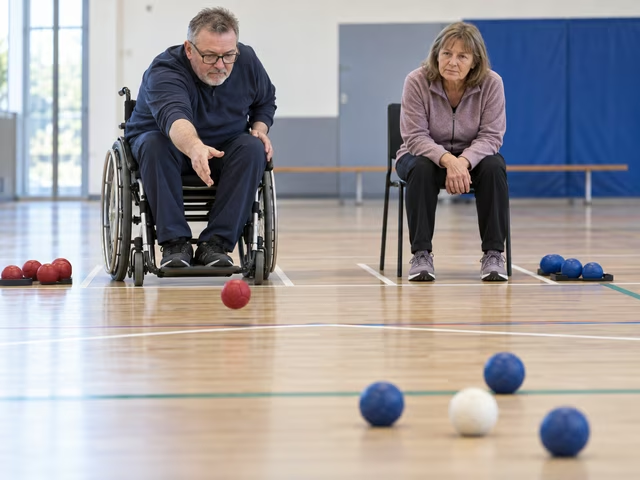
The quick version
Each player has six balls. The jack player sends the white ball into the valid area and follows with a colored ball. The side farther from the jack plays next until it becomes closer or runs out. After all balls, score each ball closer than the opponent’s best. Play four ends.
Saved on this device only — clearing your browser's cache or site data removes them (no account backup).
Get the game ready
Use a community boccia court or ask a trained host to tape its 12.5 m by 6 m layout, including throwing boxes, the V-shaped invalid-jack area and center cross. The rules source includes the diagram. Do not guess the V from an ordinary rectangle. Put red in box 3 and blue in box 4. Make seats stable and leave room for each person’s equipment and assistance.
Toss for colors. Red initiates ends one and three, blue ends two and four. Allow comfortable preparation time, with no competition clock in this house session. Players choose their own shots; assistants position equipment only under the player’s direction. Recreational seating and assistance here are not competition classification rules.
Play the first game
Place the jack
From the throwing box, propel the jack beyond the V line and inside the boundaries, then play a colored ball. If the jack is invalid, give the other player a jack attempt. Continue alternating attempts until valid; the player who placed it plays the first colored ball. If that colored ball is out, the same player continues until one stays in or their balls are exhausted.
Chase the closest position
The player whose nearest ball is farther from the jack plays next. A valid ball may move the jack or other balls. Keep playing from that side until it becomes closest, then change sides. When one player has no balls left, the other plays all remaining balls. The host announces the next color.
Handle boundaries and ties
A colored ball touching an outer line or leaving court is removed for that end. If the jack leaves, put it on the marked cross, or just in front of it if occupied, and continue. For equal nearest distances, this house version makes the last player play again; continue alternating until the tie is broken or one side runs out.
Measure before clearing
When all twelve colored balls are played, compare the nearest balls without moving them. Score one for each ball of the closer color lying nearer than every opposing ball. If the closest colors are exactly tied, score one for each ball sharing that closest distance, on its own side. Record both totals, then collect the balls.
Four ends, highest total
After four ends, add the points; the higher total wins. A tied total is a shared result in this house session. Alternate the initiating color as scheduled even if the previous end was won by the other player. Allow a break between ends whenever needed.
Help everyone get started
Explain every measurement aloud and ask before touching personal equipment or repositioning a player. The host retrieves balls so reaching the far court is not required for play. A ramp is an option for controlled delivery, not a compulsory substitute for a chosen hand or foot technique. Keep the floor clear and wait for the current ball to stop before the next delivery.
Already know the game?
Ideas & Twists
Choose a variation together before you start.
Boccia · See main rules
Suggested house variationAlternating deliveries
After the jack and first colored ball, alternate red and blue regardless of which is closest. Keep normal scoring and four ends. If a ball is out, it still uses that turn. Saving a ball for the final reply becomes a different tactical choice.
Boccia · See main rules
Suggested house variationProtected jack
Mark the jack’s position with a small flat marker after it stops. If a colored ball moves it, finish that ball’s movement, then restore only the jack to its mark, placing it immediately beside an occupying ball toward the throwing line if necessary. Keep all colored balls where they finish. Use normal turns and scoring.
Boccia · See main rules
Suggested house variationPairs planning
Use four seated players in two pairs, with three balls per person and six per side. Teammates may discuss every delivery and choose which partner plays when their side is called. Alternate the jack between all four people over four ends. Use ordinary closest-side turns and team scoring.
Boccia · See main rules
Suggested house variationTwo target lanes
Divide the valid playing area into left and right halves with a flat center line. Before the end, the jack player chooses a half and must land the jack there. Colored balls may finish anywhere. Alternate choosing player over four ends; score normally. The chosen side changes the angles available from each box.
About this guide
This is recreational boccia: ordinary stable seating, no time limits, flexible assistance, simplified equidistant-turn handling and a drawn-match finish are explicit house choices. Sanctioned classifications and assistant restrictions are separate. All five variations are editorial.
Ready for something different?
Find another game →