

The quick version
Shake the covered 4×4 grid, settle all 16 cubes, then reveal it as you flip the 90-second timer. Write words of at least three letters by following touching cubes without reusing a cube within a word. Stop at time. Read every list and cross out shared words on all lists. Score each remaining valid spelling once: 3–4 letters = 1, 5 = 2, 6 = 3, 7 = 5, 8+ = 11. Highest total wins; tied highest totals share the win under this guide's house finish.
Saved on this device only — clearing your browser's cache or site data removes them (no account backup).
Check the edition and prepare the table
Use the Classic C2187 set with a 4×4 grid base, fitted lid, 16 letter cubes and its 90-second sand timer. Older electronic-timer sets and larger Boggle grids have their own instructions; do not borrow their timing or components for this game.
Give each player a pen and enough paper for a private word list. Put the base in the middle of a stable table. Everyone must be able to read every face without leaning across someone else's list. Keep the timer visible. A printed English dictionary supplies word checks after the hunt, so a phone is not required.
Agree which dictionary and edition you will use before shaking. Proper nouns are excluded by the manufacturer. For this table, also announce this house vocabulary policy: accept standalone dictionary words spelled entirely with letters, excluding entries labeled only as abbreviations and words requiring a hyphen or apostrophe. Ordinary slang is eligible if it meets that policy and is in the agreed dictionary. This policy supplements the C2187 sheet; it is not a quotation of its official exclusions.
Choose the finish now: one 90-second round, with tied leaders sharing the win. The manufacturer permits a single round; sharing a tie is this guide's house convention. If you want several rounds, agree the number before play, add each round's points, and use the same shared-tie finish.
Reveal, hunt and compare
Start together
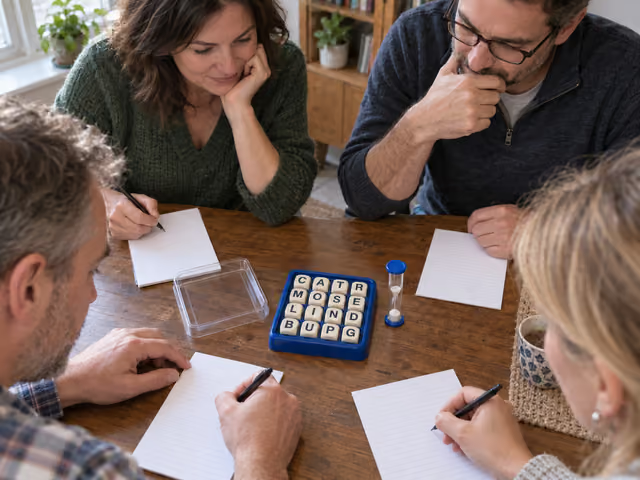
Check that all 16 cubes are in the base, fit the lid, and shake. Wiggle the covered grid until one cube sits in each pocket. When everyone is ready, flip the timer and lift the lid together to reveal the faces. Everyone immediately searches and writes privately; there is no first player or alternating turn. Leave the cubes where they settled.
Follow a legal path
A word needs at least three letters. Each next cube must touch the previous one by an edge or corner; the path may bend and change direction. Never use the same physical cube twice within one word. Different cubes showing the same letter are fine. The Qu face supplies Q and U together and counts as two letters: QUILT can use four cubes but is a five-letter word. Find each word on the grid before writing it.
Write distinct spellings
Write a spelling once even if you see several paths or know several meanings. A singular and its plural are separate words if both have legal paths and you write both before time. Shorter words inside longer ones also count if they independently meet the word and path rules. Do not call out discoveries during the hunt. When the sand ends, stop writing; keep the grid intact for checks.
Read all lists before adding points
Take turns reading the complete lists aloud. Whenever a spelling appears on two or more players' lists, everyone with that spelling crosses it out. Finding it by a different path does not save it. Check disputed remaining spellings in the agreed dictionary and have their writer show the cube path without moving cubes. A word that fails either check earns zero. Use this house checking procedure after the timer, with no bonus or extra penalty for a challenge.
Score and finish
Count each remaining valid spelling once. Award 1 point for three or four letters, 2 for five, 3 for six, 5 for seven, and 11 for eight or more; count Qu as two letters. Add the points, then compare totals. The highest total wins this one-round game. Under the announced house finish, equal highest totals share the win, including an all-zero round. Finish every list and check before reshaking. For another game, clear the scores and shake a fresh grid.
If two players wrote LAMP, both cross it out, even if they found different paths. A player with unshared, valid QUILT and BRISK earns 2 + 2 = 4. Repeating QUILT on that player's own list never adds another 2. These are scoring examples, not words guaranteed on your shake.
Make the first hunt and word checks clear
Before the scored shake, use an unscored demonstration grid. Point out one touching chain, one illegal jump and why revisiting a cube is different from using another cube with the same letter. Then cover and shake again so nobody has a head start on the actual round.
Keep list reading orderly. A word does not have to be familiar to the table to qualify: check the chosen dictionary rather than taking a vote. This format does not require the writer to define it. Dictionary presence alone does not override the proper-noun exclusion or your announced house vocabulary policy.
For a disputed path, trace one cube at a time with a finger held above the grid. A path may turn diagonally, but it cannot skip a gap or use one cube twice. A Qu face cannot act as a bare Q. Do not rotate individual cubes to produce a word. Wait until all claims are settled before picking up the base.
If the grid is knocked over during the hunt, use this house restart: void that round, replace all 16 cubes, shake a fresh grid and restart with empty lists and a reset timer. If it is disturbed during checking and a disputed path cannot be reconstructed by agreement, void the round and replay it rather than guessing a score.
Several extra friends require another clear-view table or a separately agreed team format. Do not present six as an official player limit or squeeze more people into a view they cannot use. The quiet search is followed by spoken list comparison and the shake makes noise; this is not a silent activity or an accessibility guarantee.
Already know the game?
Ideas & Twists
Choose a variation together before you start.
Boggle · See main rules
Manufacturer-supported optionTraditional three-minute hunt
Keep the same C2187 grid, word rules, cancellation and scoring, but give the hunt three minutes. Flip the 90-second sand timer a second time when it empties, and stop after that second run. Hasbro explicitly offers this option. Assign someone to watch and flip it promptly. This changes hunt time, not the time needed to compare lists or resolve words. Keep the announced shared-tie finish.
Boggle · See main rules
Suggested house variation · four or six playersPartner word lists
Make two or three pairs. Each pair shares one pen, one list and one score; both partners may search and quietly discuss words. Duplicate cancellation now happens between pair lists, not between partners. Use the same 90-second timer, legal paths, dictionary policy and word-length points. Highest pair total wins, with tied leaders sharing the win. Arrange equal views and keep voices low enough that you do not give another pair your answers. This replaces the individual competition.
Boggle · See main rules
Manufacturer-supported solo optionSolo high score
For one player, run the same 90-second hunt and validate the list afterward. There are no other lists to cancel against; score every distinct legal word once using the usual length table and dictionary policy. Record the total, then shake a new grid to try to beat it. The finish is a scored round rather than an opponent's defeat. Random grids differ in opportunity, so the total is a personal practice record, not a controlled comparison.
About this guide
Mechanics come from the English Classic C2187 sand-timer sheet and Hasbro's C2187 product page, reviewed October 2, 2026. This guide deliberately selects a two-to-six-person table and one round. Vocabulary restrictions beyond proper nouns, shared ties, checking procedure, disturbed-grid restarts and partner lists are labeled house conventions. The sheet supports solo play and a second timer flip for three-minute rounds. Community discussions informed the dictionary and duplicate-spelling explanations; they do not establish official rules or measured demand.
Ready for something different?
Find another game →