

The quick version
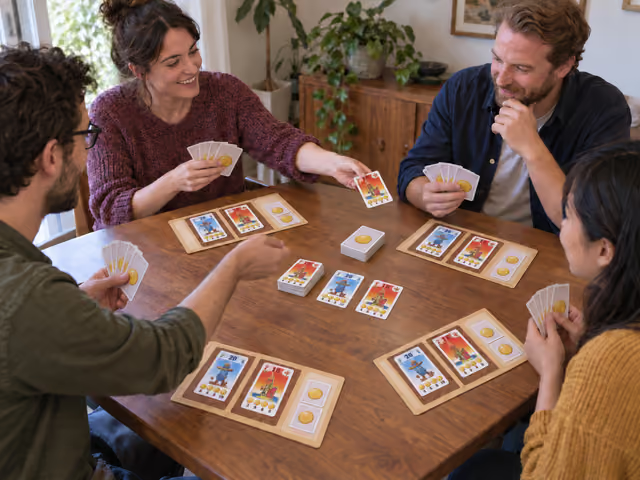
For 3–5 players, deal five ordered cards each. Use three fields each with three players, two each with four or five. On your turn, plant the first hand card and optionally the next; reveal two cards and trade with the others; everyone plants what they accepted; then draw three cards to the back of your hand. Harvest whole matching fields for the value printed on their bean cards. End after the draw pile empties for the third time and score all fields.
Saved on this device only — clearing your browser's cache or site data removes them (no account backup).
Choose the base game and deal an ordered hand
This guide uses the English AMIGO 25th Anniversary Edition, product 02200, base game for 3–5 players. Its box also contains expansion and two-player rules; those are different formats. Older Rio Grande rules may allow buying a third field. This base game does not.
Sort out only the 104 base cards: 20 Blue, 18 Chili, 16 Stink, 14 Green, 12 Soy, 10 Black-eyed, 8 Red and 6 Garden Beans. Leave Coffee, Brandy, Cocoa, Field and Magpie Beans and the metal AMIGO Bean Coin in the box. The ordinary card backs are your scoring coins; you do not need separate money, paper or a timer.
Give everyone a field mat and overview card. With three players, use the three-field side; with four or five, use the two-field side. Choose a starting player and leave the starting-player card in front of them for the whole game. Turns proceed clockwise.
Shuffle the base cards and deal five to each person, adding each card behind the preceding one. Everyone may look at their own hand, but never rearrange it. Keep the oldest card at the front, fully visible to its owner. Put the remaining deck coin-side up in the middle, with room for a face-up discard pile and two revealed cards. Keep each player's coin pile separate from their fields.
Understand fields and harvesting before the first turn
Each field holds one bean type, arranged in an overlapping column so you can count the cards. You may grow the same type in two separate fields, but their harvest values are calculated separately. To plant a different type when all fields are occupied, first empty a field by harvesting it.
You may harvest at any time, including another player's turn. Count every card in the chosen field and check that bean's printed beanometer. Take the largest reward whose required bean count you meet. For example, three or four Stink Beans earn one coin; five or six earn two; seven earn three; eight or more earn four. The large number at the top of a card is that type's total supply, not its harvest value.
Turn the earned number of cards from that field coin-side up into your coin pile. Discard the rest face up. The entire field becomes empty, even when the harvest earns zero coins. Coins stay out of the playing deck; do not spend or trade them. You cannot harvest part of a field.
Protect a lone bean: you cannot harvest a field containing exactly one card while any of your other fields contains two or more. This applies even if harvesting the larger field feels wasteful. If all your occupied fields have one card, you may harvest any of them; empty fields do not prevent that. With three fields, having two single-card fields and one larger field still protects both singles.
Follow four phases on every turn
1. Plant from the front
The starting player begins. Plant the first card in your hand into a matching field or an empty one. Harvest legally first if necessary. You may then plant the new first card, but never a third hand card in this phase. With an empty hand, skip this phase.
2. Reveal two and make deals
Reveal the top two deck cards. They belong to the active player, who can keep them for planting or offer them. Only deals involving the active player are allowed. Either party may offer cards from anywhere in their own hand, regardless of position; the active player may also offer the two revealed cards. A deal may exchange unequal numbers or be an accepted gift. Nobody has to agree. Keep hand cards in position until the deal is accepted, then remove the exact agreed cards, leaving the others in their original relative order.
Keep received beans separate
Place received cards horizontally beside your fields. They do not enter your hand, and cannot be traded again. Planted beans and coin cards cannot be traded. Trading can continue using hand cards even after both revealed cards are taken or reserved. Other players cannot trade directly with each other. The active player announces when trading ends.
3. Plant everything accepted
Everyone plants all cards they received in deals or gifts. The active player also plants any of the two revealed cards they kept. Each person chooses the order for their own new beans; legally harvest fields as needed, possibly more than once. You cannot decline a bean after accepting it, discard it instead of planting, or save it in hand. Only these newly received/revealed beans are planted now; your remaining hand waits.
4. Draw three and pass
The active player draws three cards one at a time and adds them to the back of their hand in drawn order. Nobody else draws in this base format. The person to the left takes the next turn. If the draw pile empties, follow the finish section before drawing more.
Before the real deal, use a spoken example: 'My next card is a Blue Bean, but both my fields grow other types. You grow Blue Beans and have a Red Bean I want. We can trade from our hands even if neither revealed card is involved.' Explain that both received cards must be planted in phase 3. A Blue-for-Blue swap between two hands is also legal and can let both people plant beans stuck farther back in their ordered hands. This demonstration adds no cards or points.
Count deck exhaustions and finish at the right moment
The opening draw pile is the first pass. On its first and second exhaustion, shuffle only the face-up discard pile into a new coin-side-up draw pile and continue the interrupted draw. Hand cards, fields and earned coins stay where they are. Announce each exhaustion so everyone knows which pass is in progress.
When the draw pile empties for the third time, do not reshuffle it again. If this happens while revealing cards in phase 2, finish that turn's trading and planting phases with whatever was revealed, even if there is only one card. Then stop before phase 4. If it empties during phase 4, stop immediately; do not finish the three-card draw or give everyone another turn.
Everyone now harvests all remaining fields at their printed values for final scoring. Cards left in hand earn nothing. Count coin-side-up cards: one card equals one coin. Highest total wins. For a tie, start at the marked starting player and walk clockwise around the table once; the tied player encountered last wins. The starting player themselves is first in that ordering. Keep the marker fixed so this can be resolved.
The rulebook does not specify a separate remedy for a first or second exhaustion with an empty discard pile. If that rare situation leaves no deck to rebuild, this guide suggests a house fallback: finish trading and planting if currently in phase 2, otherwise stop drawing; then harvest all fields and score normally. Declare that fallback before play rather than improvising an advantage.
Make the market easy to join
Before an accepted deal, name the bean types and quantities on both sides, then let each player check where the incoming beans would go. A gift can be helpful, but receiving it creates a planting obligation. Ask rather than pushing a card onto someone. You can decline a deal or gift; you cannot simply discard your own unwanted revealed beans.
Invite quieter players to make an offer before closing the market. The active player can ask for a different bean or a bundle rather than repeatedly insisting on one impossible exchange. Getting an awkward card out of your hand is itself a benefit; compare both players' field needs instead of judging every trade solely by equal card counts. Players may still refuse deals as a game decision.
For a first game, this guide suggests agreeing to immediate exchanges of eligible bean cards only. Do not make future deliveries binding, borrow coins or promise special rule exemptions. That is a table agreement, not an extra official trading rule. Community tables disagree about promises; concrete immediate deals are easier to track.
Resolve disputes by checking the four phases, the printed beanometer and the hand's unchanged order. Never move an offered hand card until agreement. If someone accidentally rearranges a hand, stop before more actions: restore the known order if everyone can establish it. If not, this guide suggests continuing with the current order, marking the accident, and enforcing the rule thereafter; the published rulebook gives no accident penalty. Do not turn this house remedy into permission to sort.
Everyone needs to see bean types and small harvest symbols, keep a hand ordered and follow spoken deals. Use good light, identify cards by name and allow time to inspect an offer. For another game, return scored coins and all other cards to the correct base deck and choose a starting player again.
Already know the game?
Ideas & Twists
Choose a variation together before you start.
Bohnanza · See main rules
House suggestion · same 3–5 players and base cardsTwo-pass harvest
Agree before shuffling that the game ends on the second draw-pile exhaustion instead of the third. Reshuffle after the first exhaustion only. If the second happens in phase 2, finish trading and planting, then score; if it happens in phase 4, stop drawing immediately and score. Harvest all fields, ignore hand cards and use the same coin-count winner and clockwise tie rule. All other phases, hand order, field counts and trading restrictions stay unchanged. This removes one deck pass; it does not promise a number of minutes.
Bohnanza · See main rules
Official anniversary option · 3–7 playersMore beans, everyone draws
Use the edition's Three New Types of Beans variant: add 24 Coffee, 22 Brandy and 4 Cocoa Beans to the 104-card base set. Then remove Cocoa for 3 players (150 cards), Coffee for 4–5 (130 cards), or Cocoa and Garden for 6–7 (144 cards). Use three fields each with 3 players and two fields each with 4–7; the edition supplies the extra mats. Everyone still starts with five ordered cards. Replace phase 4: starting with the active player and proceeding clockwise, every player draws ONE card to the back of their hand on EVERY turn. End on the second exhaustion with 3 players, or third with 4–7. If the final exhaustion occurs during this shared draw, stop immediately without completing the circuit. The phase-2 finish, final harvest, winner, tie rule, hand order and trading restrictions otherwise stay the same. Leave Field and Magpie Beans and the AMIGO Bean Coin out.
Bohnanza · See main rules
Official anniversary Field Bean option · 4–5 playersEarn a third field
Use exactly the 104 base cards plus 22 Brandy Beans and 3 Field Beans (129 cards). Leave Coffee, Cocoa and Magpie Beans and the AMIGO Bean Coin out. Everyone starts with five ordered hand cards and two fields. Use the preceding option's phase 4: everyone draws one card clockwise starting with the active player after every turn. Finish on the third exhaustion, stopping the shared draw immediately if it happens there. The special harvest is a field of exactly TWO Field Beans: discard both, earn no coins, and turn your mat to three fields for the rest of the game, preserving your other planted beans in fields one and two. If you already have three fields, that two-card harvest earns nothing. A field of THREE Field Beans instead earns three coins and no additional field. The one-bean protection rule, whole-field harvest, trades and final scoring still apply; Field Beans are ordinary plantable/tradable beans until harvested. You cannot buy a field. This adds a new harvest choice rather than granting everyone a free third field.
About this guide
Main rules follow AMIGO's 25th Anniversary English base game, printed pages 3–10, for 3–5 players. More beans, everyone draws follows pages 10–11; Earn a third field follows pages 11–12. Two-pass harvest is a community-observed house suggestion. Immediate-deal agreement, teaching example, accident remedy and empty-discard fallback are explicitly suggested host arrangements. Do not mix older Rio Grande field purchases or starting deals into this edition. The separate two-player Duel, metal Bean Coin and Magpie rules are outside this guide's main format and twists. Community experiences inform hosting, not official mechanics or popularity claims.
Ready for something different?
Find another game →