

The quick version
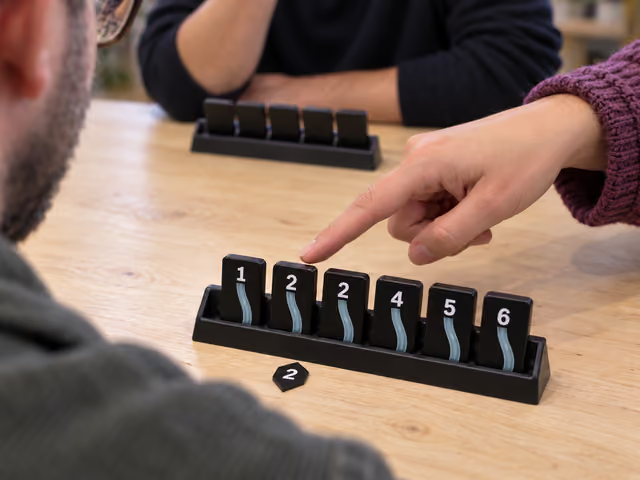
Start with Mission 1: shuffle the 24 blue wires numbered 1–6 and deal them evenly among the racks. Sort each rack separately, smallest to largest, facing its owner. Each person marks one wire with its matching Info token. The Captain starts: name a number you actually hold and point to that exact wire on a teammate’s rack. A match removes both wires; a miss leaves both in place, marks the targeted wire’s actual number and advances the error dial. Keep taking turns clockwise until every rack is empty or the dial reaches the skull.
Saved on this device only — clearing your browser's cache or site data removes them (no account backup).
Prepare the introductory mission
This guide plays Mission 1, Training, Day 1, from the physical English base game: the 2024 Pegasus Spiele North America edition, rulebook v1.0, currently listed as article 51280.USA. Keep the printed Mission 1 card beside the board. Later missions and the Pro Kit expansion change the setup and rules; their equipment and special wires are outside this first game.
Bring the board with its attached detonator dial, Mission 1 card, 24 blue Wire tiles (four each of 1, 2, 3, 4, 5 and 6), the blue numbered Info tokens for 1–6 (two of each value), six green Validation tokens for those values, one Character card per person including the Captain, and four or five tile stands as below. Keep the rulebook available. Use a flat table with space for the board, racks, clue tokens and cut tiles in front of each rack. The full base set contains more components; leave blue 7–12, all yellow/red wires, shared Equipment cards and unopened mission boxes aside. Mission 1 has no shared Equipment cards. Each Character card still supplies its personal Double Detector.
Choose the Captain and racks
Choose the first Captain at random and give them the Captain Character card; others choose a different Character card. With two people, use two racks each. With three, the Captain uses two racks and each other person uses one. With four or five, use one rack per person.
Deal to racks, then sort
Shuffle all 24 mission wires facedown and deal as evenly as possible to the four or five racks. Four racks receive six tiles each. With five racks, four receive five tiles and one receives four. If you have two racks, receive and sort each rack separately; never combine the two deals into one sorted line. Sort each rack in ascending order from its owner’s left to right. Tile faces are visible only to their owner. Keep gaps and cut tiles in their original positions during play.
Set public information
Set the dial to the printed starting sector for the actual number of people, not the number of racks. Put the Info and Validation tokens within reach. Starting with the Captain and proceeding clockwise, each person takes one available Info token and places it directly in front of a blue wire with that number. A person with two racks still places only one opening token, on either rack. Everyone can see these clues.
Read the mission and communication limit
Read Mission 1’s setup, then turn the card over so its mission rules are visible. All 24 wires must be removed to succeed. Discuss general tactics and equipment, but keep specific deductions to yourself: do not describe your hand, hint at values, repeat information from earlier turns, or talk through guesses. Use the required cut announcements and rule-authorized tokens to communicate wire information.
For an unscored demonstration, put one blue 2 in each of two racks and mark the second rack’s 2 with an Info token. The first person points to that tile and says, ‘This wire is a 2.’ Show both matching tiles being placed faceup in front of their racks. Return these pieces, then shuffle all 24 wires for the mission; this example is not the full setup.
Take one action, then pass clockwise
Attempt a Dual Cut
The Captain takes the first turn. Choose a number on an uncut wire in your own hand, point unambiguously to one uncut wire on a teammate’s rack, and announce that number. You must actually hold it. Do not show which of your own wires you intend to cut. You may target a wire whose number is already marked by an Info token; a certain match is useful.
Resolve the attempt
If the targeted wire matches, its owner removes it and puts it faceup immediately in front of its original place; you remove one matching wire from your hand and place it faceup in front of your rack. If you have several matching wires, choose one. If it does not match, neither wire is removed: advance the dial one sector. Reaching the skull ends the mission immediately. Otherwise the targeted owner puts an Info token showing that wire’s actual value directly in front of it. Your own attempted wire stays hidden and uncut.
Use your Double Detector when needed
Once per mission, on your own Dual Cut, you may turn your Character card facedown and target two different uncut wires on a single teammate’s rack, announcing one number you hold. They need not be adjacent; you cannot split the targets between two racks. If either matches, the owner removes exactly one matching target and you remove one of your matching wires. If both match, the owner chooses one and does not say that both matched. If neither matches, advance the dial once and, unless that ends the mission, the owner marks one of the two targets with its true-number Info token, choosing which. The unused target remains hidden. This replaces that turn’s ordinary Dual Cut; it is not an extra cut or a permanent ability.
Alternatively, make a Solo Cut
Instead of a Dual Cut, remove a complete remaining set of a number from your own hand. If you hold all four copies, remove all four. If two copies have already been cut and you hold the remaining two, remove those two. Merely holding two or three while another copy is still hidden with a teammate does not allow a Solo Cut. Both of your racks form one hand for this check, so a legal remaining pair may span them. Put the removed wires faceup in front of their original rack positions.
Track completion and continue
Whenever all four copies of a number have been removed, place one green Validation token over that number on the board. It confirms that number is finished; it is not a clue for a still-hidden tile. After your action, the next person clockwise with any uncut wires takes a turn. Empty players’ turns are skipped, but a player with one empty rack and another nonempty rack remains active. Take one cut action per turn, even if a different Solo Cut is also available. There is no ordinary pass.
Finish as one team
Succeed immediately when every rack is empty. Fail immediately if the dial reaches the skull. This mission contains no red wires, so there is no red-wire action or instant red-wire loss to resolve. There are no individual points, competing winners or ties. The dial counts mistakes, not elapsed time; do not add a countdown. For another attempt, pass Captain to the left, reset the dial, return tokens, turn Character cards faceup, shuffle all 24 wires and deal again.
Suppose you have two 4s. If the other two 4s have already been cut, you may remove your pair on your turn. If either other 4 is still on someone’s rack, your pair cannot be Solo Cut yet. Check the faceup cut tiles, without narrating this deduction during the mission.
Help the group read the puzzle
Before play, explain how ordered racks create information: in Mission 1, a tile to the owner’s left of a marked 4 cannot exceed 4, and one to its right cannot be below 4. Equal numbers are possible. If all four 3s have been cut, no hidden tile can be a 3. Demonstrate these ideas with visible practice pieces, then leave each person to reason through their own turn. Difficulty and taste vary; do not promise that every deal has a certain solution or that everyone will enjoy limited discussion.
Resolve a cut only after the active person has chosen a specific tile and announced the value. The target owner checks that tile; nobody may steer the choice with a nod, facial hint or finger movement. A failed guess reveals the targeted tile’s value through an Info token, not by removing it and not by revealing the active person’s tile. Leave the hidden tile upright. If both Info tokens of a needed value are occupied, reuse one whose wire is already cut; if neither is free, the publisher’s FAQ allows the target owner to announce the value and clearly identify the affected wire so everyone can remember it. That narrow exception does not allow other wire discussion.
Keep each rack’s order intact and do not slide surviving tiles together after a cut. Reaching across to point can knock a rack, so agree on clear pointing before the deal. With two racks, keep them visibly separate. General reminders such as ‘You still have your Double Detector’ are allowed; ‘That one must be a 2’ and ‘Remember what I guessed last turn’ are not. The Captain starts play and handles setup, but does not direct everyone’s deductions.
If someone announces a number they do not hold, the official FAQ leaves the response to the group and suggests removing another wire they do hold while advancing the dial once for the information gained. This guide suggests agreeing before play to use that remedy. Do not treat an illegal number as a free clue. For an accidentally exposed hand or a sorting mistake that has already misled guesses, this guide suggests ending that attempt without recording success and dealing again; that is a house remedy, not an official penalty. Explain the misunderstanding after the attempt, then let another Captain lead.
Choose seating and light that let each person read their own tiles and see every public clue without revealing hidden faces. Seated, low-movement play still needs visual number recognition, memory, pointing and comfort with restricted discussion. Make any accommodation together; do not claim universal access. Stop after the introductory mission or replay it while the rules settle. To progress, use the next purchased mission card’s complete instructions, including any two-person changes, special-wire preparation and equipment; do not simply add unfamiliar pieces to this setup.
Already know the game?
Ideas & Twists
Choose a variation together before you start.
Bomb Busters · See main rules
House teaching suggestionOpen-rack rehearsal
Use the same 24 blue wires, people, separate racks and starting dial, but turn every rack’s numbers so the whole group can see them and allow spoken deductions. Keep the requirement to hold your announced number, one cut action per turn, correct Solo Cut conditions, error-dial movement and all-racks-empty finish. Discuss why each choice works. This removes the hidden-information puzzle and is a teaching exercise, not a completed campaign mission. Afterward shuffle, restore owner-only faces and normal communication limits, and play Mission 1 from a fresh setup.
Bomb Busters · See main rules
House challenge suggestionDeduction without the Double Detector
For a replay of Mission 1, agree before dealing to leave every Character card’s Double Detector unused. Keep one opening Info token per person, the same 24 wires, rack allocation, starting dial, ordinary Dual and Solo Cuts, failed-guess clues, communication limits and shared finish. Each Dual Cut must target exactly one wire. This removes a safety tool and can make an uncertain choice harder; do not compensate by adding secret signals or extra clues. Keep this challenge result separate from standard mission progress.
About this guide
Main format is the physical English base game’s introductory Mission 1 for 2–5 people, not all 66 missions. Official v1.0 supplies general mechanics; the photographed English Mission 1 card confirms 24 blue 1–6 wires, no shared Equipment cards and retained personal Double Detectors. The current official French FAQ clarifies two-rack Solo Cuts, same-rack Double Detector targets, unavailable Info tokens and a suggested illegal-number remedy. Demonstration, exposure/sorting restart and both variations are explicit host or house suggestions. Printed mission instructions govern later scenarios and editions; no expansion rules, audio missions or broad edition-equivalence claim is imported.
Ready for something different?
Find another game →