

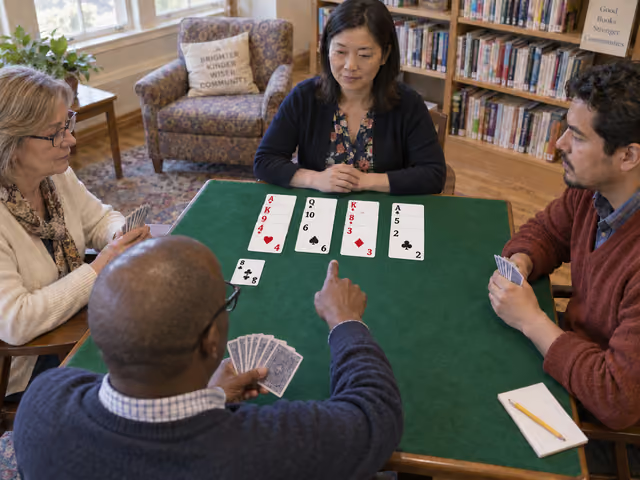
The quick version
Sit opposite your partner and deal 13 cards each. Starting with the dealer, bid or pass clockwise; a bid of 2 hearts promises eight tricks with hearts trump. After a bid, three consecutive passes settle the contract. The first person on the winning side who bid its suit is declarer. Their left-hand opponent leads, partner exposes the dummy hand, and declarer chooses cards for both hands. Follow suit when possible. Play all 13 tricks, score the result, and pass the deal left. After four played deals, higher total wins.
Saved on this device only — clearing your browser's cache or site data removes them (no account backup).
Choose partners and mark four deals
This guide uses traditional Chicago, or four-deal bridge, from the ACBL Laws of Rubber Bridge, Appendix 4. Its contract points can carry toward a game; it is different from scoring every deal independently. Ordinary playing cards work. Keep a second differently backed deck only if you want to shuffle the next deal while playing this one.
Choose two pairs and sit partners opposite each other. For a random start, everyone draws a card from a shuffled deck: the two highest are partners, and the highest deals first. Break equal ranks by spades, hearts, diamonds, clubs. Return the drawn cards. Cards rank ace high, then king, queen, jack, 10 down to 2; there are no special jokers.
Draw two score columns labeled with the pairs' names. A horizontal line separates bonuses and penalties above from contract points below. Leave space for further lines below. Also write deal numbers 1–4 with their dealers. Mark vulnerability: deal 1 neither pair; deals 2 and 3 the dealer's pair only; deal 4 both pairs. Vulnerability means larger penalties and some larger bonuses. This schedule stays fixed regardless of earlier results.
Have the player on dealer's left shuffle and the player on dealer's right cut. Deal one card at a time face down clockwise, starting left, until each person has 13. Count before bidding and keep cards private. Gather and redeal an incorrect deal with the same dealer and deal number.
Use the auction to choose a promise
Dealer makes the first call
Say pass, or a level from 1 to 7 plus clubs, diamonds, hearts, spades or notrump. The level counts tricks beyond six: 1 promises seven, 4 promises ten, 7 promises thirteen. In notrump, no suit has trump power. A bid describes the pair's combined target, not just the bidder's own tricks.
Go clockwise and raise legally
At the same level the order is clubs, diamonds, hearts, spades, notrump. Any higher level outranks every lower level: after 1 spade, 1 notrump or 2 clubs is legal, but 1 heart is not. You may jump levels, raise partner, or pass. Passing now does not stop you bidding on a later turn if the auction is still open.
Double or redouble when allowed
On your turn you may say double if the latest bid belongs to an opponent and only passes have followed it. You may say redouble if an opponent has doubled your side's latest bid and only passes have followed that double. Both change scoring, not the number of tricks needed. A new bid cancels any double or redouble on the old bid.
Stop after consecutive passes
After any bid, double or redouble, three consecutive passes end the auction. The latest bid, with any surviving double or redouble, is the contract. If all four pass before anyone bids, shuffle and redeal with the same dealer; that passed-out deal does not use one of the four played deals.
Identify declarer
On the side that made the final bid, the person who first bid that final suit or notrump is declarer, even if their partner made the final raise. Partner is dummy; the other pair are defenders. Say the contract, declarer, target and vulnerability aloud before the opening lead.
North says 1 heart, East passes, South says 2 hearts, West passes, North passes, East passes. North is declarer in 2 hearts, needing eight tricks. South is dummy. East, to North's left, leads the first card.
Give your bids shared meanings
Auction rules tell you what is legal; a bidding agreement helps partner understand what you hold. For a first session, this guide suggests a simple house agreement: suit bids describe at least four cards in that suit; raising partner shows at least four-card support. An opening 1 notrump shows 15–17 high-card points and a balanced hand, shaped 4-3-3-3, 4-4-3-2 or 5-3-3-2. Other notrump bids suggest fairly even suits. Every double means you expect to defeat the opponents, rather than asking partner to choose a suit. Use no artificial bids, forced responses or secret signals. Tell both opponents this agreement before dealing. Experienced pairs may instead disclose their own shared system.
Count ace 4, king 3, queen 2 and jack 1 to estimate strength; these hand-evaluation points are not the score. As conservative starting advice, open at the lowest level in a longest suit with about 13 high-card points, or use the agreed 1 notrump opening. Partner can show a different four-card suit or support yours. Look for eight cards in one suit between your hands. Stay low when combined strength is uncertain; another legal bid is a larger commitment, not a requirement to keep talking. This starter agreement is a learning aid, not Standard American Yellow Card.
Play thirteen tricks
Lead and expose dummy
The defender on declarer's left plays one card face up. Dummy now lays all 13 cards face up in separate overlapping suit columns, with trumps on dummy's right if there is a trump suit. Declarer names the suit and rank for each dummy play; dummy moves that named card and offers no tactical advice.
Play from each seat in order
Continue clockwise from the opening leader: dummy, the other defender, then declarer. Each contributes one card from the hand at that seat. You must follow the led suit if that hand has any of it. If it has none, play any card: trump or discard. You need not trump, overtrump, or beat partner's card.
Find the winner and collect
If any trumps were played, the highest trump wins; otherwise the highest card of the led suit wins. A different nontrump suit cannot win. Keep each four-card trick together face down in the winning pair's pile, separate from other tricks, so the final count can be checked.
Lead from the hand that won
The winning seat leads any card to the next trick. If dummy won, declarer chooses the next lead from dummy, not from their own hand. Continue clockwise for each trick until all 13 are played. The declaring pair combines its tricks and compares the count with six plus the contract level.
With hearts trump, suppose West leads the ace of spades. Dummy has a spade and must play it. East has no spades and plays the 2 of hearts. Declarer follows with a spade. East's small trump wins and East leads next. In notrump, West's ace would win that same spade-led trick against a heart discard.
Separate contract points from bonuses
Agree on the trick count before mixing cards. If the declaring pair makes its target, score only the tricks promised beyond six below the line: 20 each in clubs or diamonds; 30 each in hearts or spades; 40 for the first notrump trick and 30 for each further one. Multiply these contract points by two if doubled or four if redoubled. Extra tricks are overtricks: put 20 each above the line in an undoubled minor-suit contract, or 30 each in an undoubled major or notrump contract. Overtricks do not help complete a game.
A pair completes a game when its contract points since the latest line reach at least 100, in one deal or across several. Give it 300 above the line if not vulnerable on this deal, or 500 if vulnerable. Draw a new horizontal line under both pairs' contract points. Both now start a fresh game count at zero; the points already written still count in the final total. A game does not end the four-deal session. Add no best-of-three rubber bonus.
On deal 4 only, if the declaring pair makes a contract but its current game count remains below 100, give that pair an extra 100 above the line. A partscore already sitting there earns no bonus unless that pair makes a partscore on deal 4. Earlier partscores get no separate bonus.
Example: on deal 1, North–South bid 2 hearts and take nine tricks. Record 60 below and 30 above. On deal 2, East–West bid 1 notrump and take seven: record 40 below for them. On deal 3, North–South bid 2 diamonds and take eight: add 40 below, completing their game with 60 + 40. If North was the first dealer, North–South are vulnerable on deal 3, so add 500 above and draw a line across both columns. East–West's old 40 remains in their final total but cannot help complete their next game.
Score doubles, slams and failed contracts
For making a doubled contract, add 50 above the line; for making a redoubled contract, add 100 instead. Doubled overtricks are 100 each if not vulnerable or 200 if vulnerable; redoubled overtricks are 200 or 400 each. These replace ordinary overtrick values. Multiplying contract points can itself complete a game: 2 hearts doubled and made gives 120 below the line.
If the declaring pair falls short, it gets no contract points or overtricks. The defenders score above the line for each missing trick. Undoubled: 50 each when declarer is not vulnerable, 100 each when vulnerable. Doubled, not vulnerable: first missing trick 100, second and third 200 each, every further one 300. Doubled, vulnerable: first 200, every further one 300. For redoubled penalties, double the corresponding doubled total. Down three doubled is therefore 500 not vulnerable or 800 vulnerable.
Bid and make level 6 for a small slam: add 500 above if not vulnerable or 750 if vulnerable. Bid and make level 7 for a grand slam: add 1000 or 1500. These are extra to any game and double/redouble bonuses. Taking twelve tricks in a lower contract does not earn a slam bonus.
This traditional format also scores honors, even if the contract fails. After play and before gathering the hands, a player can show four of A-K-Q-J-10 of the trump suit originally held together for 100 above, or all five for 150. At notrump, all four aces originally in one hand earn 150. Honors may belong to either pair; they never complete a game. Do not combine cards across partners to claim them.
Check each result and finish together
After scoring a played deal, dealer passes left and the next numbered vulnerability applies. After deal 4, add every point above and below all lines in each column. The higher total wins. House finish: equal totals are a draw; begin a fresh four-deal set if everyone wants another. Reset both score columns and the vulnerability schedule for the new set. A fifth active player waits or joins the next set.
Explain one unscored trick before dealing: lay out four example cards, demonstrate following suit and trump, then return them all to the deck. During scored deals, keep hands private except dummy. Say calls clearly and write them in order if anyone struggles to remember. Ask opponents about their bidding meanings on your turn, and discuss what worked after the deal, rather than coaching partner during it. Let new players make a manageable contract instead of pushing every auction toward a slam.
For this friendly session use these explicit house remedies. Catch a wrong count before bidding and redeal. If an insufficient bid, illegal double or call out of turn is caught before the next call, withdraw it and take the proper legal turn; partner must not use the revealed intention. If the auction has progressed, abandon the deal and redeal at the same numbered slot. Catch a wrong-hand lead or failure to follow suit before the trick is gathered, return that trick's cards and replay it legally from its original leader. If already gathered, or if private cards or tactical help have affected later choices, abandon the deal and redeal at the same slot with previous scores unchanged. These generous learning remedies replace formal infraction penalties; they are not tournament law.
For a scoring disagreement, recount the intact trick piles and check contract, double status and declarer's vulnerability. Show any honor claim before mixing hands. Correct arithmetic before agreeing the final totals. House remedy when the result cannot be reconstructed: cancel that deal's points and replay its numbered slot with a fresh shuffle. The four-deal finish requires four valid played results, not four attempts.
Already know the game?
Ideas & Twists
Choose a variation together before you start.
Bridge · See main rules
Suggested house variation using duplicate contract scoresIndependent-deal scoring
Keep four played deals, dealer rotation, the same vulnerability schedule and the passed-out redeal rule. Replace carried partscores with separate scoring on each deal: add 50 to every made contract whose multiplied contract points are below 100, or 300/500 for game when they reach at least 100 on that deal. Never carry contract points forward, award the fourth-deal 100 bonus, or score honors. Keep all ordinary overtricks, double/redouble premiums, slams and undertrick penalties. Add each pair's four scores; higher total wins, equal totals draw. For example, 2 hearts making nine undoubled scores 60 + 30 + 50 = 140. This is a single-table total-points game, not a duplicate tournament comparing the same hands across tables.
Bridge · See main rules
Suggested house rotationThree partnerships
With the same four people A, B, C and D, play three complete four-deal sets: AB versus CD, then AC versus BD, then AD versus BC. Change seats so each new pair sits opposite. Keep traditional scoring and reset game counts and vulnerability for each set; choose the first dealer by a new draw each time. Give each player their pair's full final point total for that set, including bonuses, and add each individual's three totals. Highest individual total wins; equal highest totals share the win. Twelve played deals let everyone partner each friend once; do not rotate mid-set.
Bridge · See main rules
Suggested unscored learning variationOpen-hand rehearsal
Before the scored set, deal all four hands face up and skip the auction for two practice deals. On the first, designate the dealer as declarer in 1 notrump; on the second, pass the dealer left and use 1 heart with that dealer declaring. In both, the opposite hand is dummy, declarer's left-hand opponent leads, and all thirteen tricks follow the normal suit and winning rules. Anyone may explain a choice before it is committed. Compare the declaring pair's tricks with the seven-trick target; record no points and name no winner. Gather all cards, then start a freshly shuffled ordinary four-deal set with private hands and its own first dealer. These practice deals never consume scored slots.
About this guide
Reviewed October 2, 2026. Main format selects traditional four-deal Chicago in ACBL Rubber Laws Appendix 4, with carried contract points and honors. ACBL's Learn page combines independent-deal wording with carried-partscore wording; the selected Appendix controls here. WBF auction and trick-play laws cross-check shared mechanics; duplicate board handling and tournament penalty procedures are not imported. The starter natural bidding agreement, no-clock teaching advice, random-start procedure for the rotation, tie finish and friendly infraction remedies are disclosed house choices. Independent-deal scoring is a separate labeled variation, not a second rule to apply simultaneously.
Ready for something different?
Find another game →