

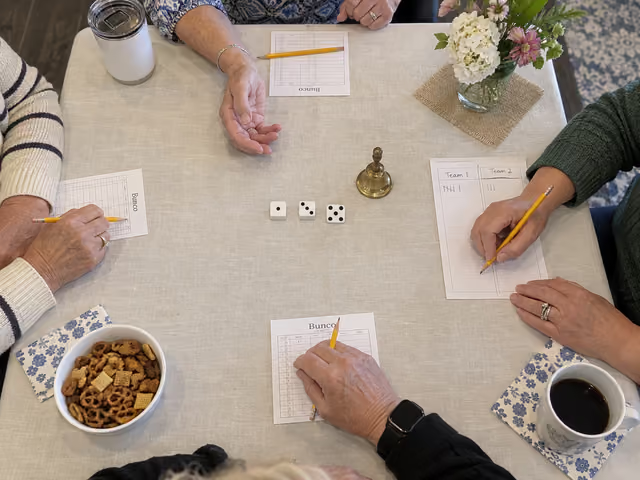
The quick version
In round 1, roll for 1s; in round 2, roll for 2s, and so on through 6. Score 1 per matching die, 21 for three matching dice, or 5 for any other triple. Keep rolling until a roll scores zero. When a head-table team reaches 21 or more, ring the bell; current rollers finish their turns, then compare table totals and move.
Saved on this device only — clearing your browser's cache or site data removes them (no account backup).
Prepare three tables and two sets
Seat exactly four people at each of three tables. Label them 1 (Head), 2 (Middle) and 3 (Low), with room to change seats and a bell everyone can hear. Put three ordinary six-sided dice and a table tally sheet at each table; put the bell at table 1. Dice cups and trays are optional. You do not need a branded box.
Give each person a pencil and a named scorecard. On plain paper, make two blocks headed Set 1 and Set 2, each with six lines numbered 1–6 and space for W or L. Add a separate Bunco tally. Each table sheet needs the current set and round, the two pairs’ names and their running points. Keep personal cards with their owners; leave table sheets and dice at their tables.
Choose initial seats together. Opposite seats are partners: A with C, B with D around a four-seat table. Select a scorekeeper at each table for this round. Before play, announce this guide’s host choice: two complete sets, a break after the first, most individual round wins overall, with shared winners if tied. Also recognize most Buncos separately, sharing that result if tied. Neither a timer nor one trip around the table ends a round.
Roll, score and finish the round
Start together
The head table announces “Set 1, round 1: roll for ones” and rings the bell. Each table’s scorekeeper rolls its three dice first. Tables play at the same time; there is only one active roller at each table.
Read one roll
Roll all three dice together. One or two dice showing the round number score 1 each. Three of that number make a Bunco worth 21 total, not 21 plus 3: say “Bunco” and mark one personal Bunco tally for the roller alone. Any other three-of-a-kind scores 5 and is a mini Bunco, not a personal Bunco. Every other roll scores zero. Never add the face values.
Continue or pass
Add the roll’s points to the roller’s partnership total. Roll all three dice again whenever you scored, including after a mini Bunco. A zero-point roll ends your turn; keep the points already earned and pass the dice left. The next person belongs to the other partnership. Table points belong to the current pair; personal wins belong to each player.
Listen for the head-table bell
At table 1, add points as each roll occurs so a team reaching or exceeding 21 triggers the bell immediately. Reaching 21 or rolling a Bunco at tables 2 or 3 does not end the round. At the end bell, only the person already taking a turn at each table continues, including the head-table roller, until a roll scores zero. Count those points and any further Buncos. Do not pass to a new roller.
Resolve a tied table
After current turns finish, the higher partnership total wins that table. If tied, start with the scorekeeper and give all four players one turn each, passing left with the same target number. This guide’s house clarification is to retain normal bonus scoring, continue each turn until a zero-point roll and count personal Buncos in these turns. Add points to the tied totals. Give everyone their turn before comparing; do not ring the bell at 21 during a roll-off. Repeat a full four-turn cycle if still tied.
Record before moving
Both members of the table’s winning pair mark W on the matching set/round line of their own cards; both others mark L. Each person records only Buncos they actually rolled. A mini Bunco never enters that tally. Confirm the table totals and personal marks before clearing the table score for the next round.
In round 3, 3–3–5 earns 2; 5–5–5 earns 5; 3–3–3 earns 21 and one Bunco for its roller; 1–2–6 earns zero. Points are kept when a later roll earns zero. Reset the demonstration points before ringing the first real start bell.
Move tables and make new partners
Use this movement map after every round except the final one. Table 1 winners stay and its losers go to table 2. Table 2 winners go to table 1 and its losers go to table 3. Table 3 winners go to table 2 and its losers stay. Each destination receives exactly four players.
At tables 1 and 3, one of the two stayers moves into an adjacent vacant chair so the stayers sit next to each other. At table 2, the arriving pair from table 1 sits in adjacent chairs and the arriving pair from table 3 fills the other two. Fill remaining seats at tables 1 and 3 with their incoming pair. Opposite seats are now partners; former partners are next to each other. This explicit seating method is host guidance for implementing the source’s required partner change.
Choose a scorekeeper at each newly seated table, write the new partnerships and reset table points to zero. The head table checks all tables are ready, announces the next target and rings the start bell. After round 6 of Set 1, record results, move as usual, take the agreed break, then start Set 2 with target 1 again. You need not remember a pair’s earlier points: only personal W/L and Bunco tallies carry forward.
Finish after the second round of sixes
Set 2, round 6 ends with the same bell, remaining turns and table-tie procedure. Mark that final W or L, then stop. Each person should have twelve round results; W plus L must total twelve. Count personal wins and Buncos separately.
For this guide’s announced host result, the person or people with the most W marks win. Separately name the person or people with the most Buncos. Final ties are shared: Buncos do not secretly break a wins tie, and accumulated table points do not become an overall score. To play again, use fresh personal cards or a clearly separate block and choose initial seats again.
Make the first round easy to follow
Run the four-roll example before starting. Ask each table to identify its partner, its scorekeeper and where winners and losers go. Keep the current set and target number written where everyone can see them. Announce the target after every move; a round may include many trips of the dice around the table. There is no minimum number of turns before the head table reaches 21.
Choose these practical house remedies before play: if a die leaves the rolling surface or rests tilted, reroll all three and score only the replacement roll. Stop to confirm the roll before picking up dice. If a Bunco call is forgotten, count the witnessed triple when the table agrees it happened; this relaxes the source’s call requirement. If there is uncertainty about whose turn was active at the end bell, let the scorekeeper identify that person before anyone resumes.
For a score disagreement, pause that table and reconstruct the last witnessed roll and running total. Correct it while the evidence is clear; if it cannot be settled, the host makes a consistent house ruling before movement. Keep completed round marks intact. With fewer than twelve arrivals, this exact three-table guide is not ready: arrange a replacement or agree a separately explained smaller format. Do not improvise ghost credit or uneven tables halfway through a set.
Already know the game?
Ideas & Twists
Choose a variation together before you start.
Bunco · See main rules
Suggested house variationOne-set finish
Play one complete set of rounds 1–6 instead of two. Stop after recording round 6, resolve table ties normally, and compare six personal W/L results. Keep shared final ties and the separate most-Buncos result. This changes the commitment, not the scoring or movement.
Bunco · See main rules
Suggested house variationTraveling marker
Add one small marker on the head table. Every true Bunco transfers it to its roller; pass it by hand between tables. Keep all normal points, wins and personal Bunco marks. The last holder after the final round’s remaining turns and any table roll-offs earns a separate last-Bunco recognition. For simultaneous claims, the host chooses a clear order and announces it. If nobody rolls a Bunco, there is no holder or result. This adapts the source’s optional traveling format.
Bunco · See main rules
Suggested house variationStay at your table
Keep all twelve people at their original three tables throughout. At each table label players A, B, C and D. Use A+C against B+D in rounds 1 and 4; A+B against C+D in rounds 2 and 5; A+D against B+C in rounds 3 and 6. Rearrange chairs so the current partners face each other. Repeat the same sequence in Set 2. Keep head-table control, scoring and personal results; replace only the between-table movement. This trades meeting more players for fewer table changes.
About this guide
Rule family: Dice Game Depot’s twelve-player Bunco, reviewed October 2, 2026. Its PDF and FAQ govern scoring, head-table control, continuing active turns, movement and equal-turn table roll-offs. Roll-off bonus handling, two sets, shared final category ties, explicit chair placement, dispute remedies and the listed variations are host choices. This is not Winning Moves Box of Bunco: that edition uses different bonus values and an all-table stop for any true Bunco.
Ready for something different?
Find another game →