

The quick version
Give everyone three game points, five finish cards and a spectator tile. Set the seven camels' starting positions and load all six dice into the pyramid. On your turn choose one action: take a leg-prediction ticket, place your spectator tile, reveal a die using a pyramid ticket, or submit a finish card. With six to eight players, forming a partnership is a fifth option. Score each leg after five dice are revealed. A finish-line crossing ends the race immediately; score the last leg and finish predictions. Most points wins; ties share victory.
Saved on this device only — clearing your browser's cache or site data removes them (no account backup).
Set the race and give everyone their cards
Use the physical second edition, specifically the 2024 Lookout Games reprint and its English rules. This guide supports three to eight people. The first edition, Supercup expansion, Camel Up Cards and Off Season are different formats. All printed Egyptian Pound coins are game points in this session.
Check the full set: one board with its palm-tree assembly; five colored racing camels and matching dice; black and white crazy camels; one grey die; one dice pyramid and cap; twenty leg-prediction tickets, four per racing color; five pyramid tickets; forty finish cards, five for each of eight characters; eight spectator tiles; eight partnership cards; one starting-player marker; and eighty point coins, fifty worth one and thirty worth five. Keep the supplied rules available. Use a stable table with enough space for everyone to see the track and keep their cards and tickets separate.
For each racing color, stack its leg tickets with the two 2-point tickets at the bottom, then 3, then 5 on top. Put those five stacks and the five pyramid tickets in their marked spaces. Sort the coins into a shared bank. Give each person three points, all five finish cards of one character and that character's spectator tile. Keep finish-card hands hidden. With six to eight players, also give each person their matching partnership card, available side up; with three to five, leave partnership cards in the box. Return unused characters' components to the box.
Roll the five racing dice once together. Place each matching camel on space 1, 2 or 3 according to its die. Stack camels sharing a space in any chosen order, facing clockwise. Roll the grey die once for each crazy camel: 1 places it on space 16, 2 on 15, and 3 on 14. Ignore the numeral's color for these setup rolls. If both start on the same space, put the second on the first. Face both counterclockwise.
Load all six dice into the pyramid, replace its cap and put it on the board. Give the starting marker to the youngest player, as the printed rules specify. That person takes one action; turns continue clockwise. Before starting, point out the finish line, the two finish-prediction areas and the five available pyramid tickets.
Choose exactly one action on your turn
Predict this leg
Take the top ticket from any nonempty racing-color stack and put it in front of you. It predicts that camel will lead at the end of this leg, not necessarily win the race. You may collect multiple tickets, including several of one color, across later turns. Earlier tickets offer more points if correct.
Place or move your spectator tile
Put your tile on an empty track space, choosing its cheering or booing side. The space must contain neither camels nor another tile, cannot be space 1, and cannot be next to any other spectator tile. If your tile is already out, this action relocates it to a different legal space and lets you choose its side again. Its landing effect is explained below.
Reveal a die
Take one available pyramid ticket. Turn the pyramid upside down, shake, turn it upright and press its release button once over the table to release one die. Move the indicated camel using the movement rules below, then leave the die in a dice tent and keep the ticket. That die stays out until the leg ends. This action earns one point at leg scoring. After the fifth ticket is taken and its movement resolved, score immediately; do not draw the sixth die.
Predict the final leader or last-place camel
Choose one finish card from your hand and place it face down on top of the matching final-leader or last-place prediction pile. You may put different cards into either pile on later turns. Played cards cannot be withdrawn, changed or reused; unplayed cards stay in your hand. These piles last through every leg and score only at the race's end. You can predict only the five racing colors.
Form a partnership with six to eight players
As a fifth possible action, if your partnership card is available, choose someone else whose card is also available. Exchange the two cards and turn both to their partnership sides. Under the printed rules that person cannot refuse. You are partners only for this leg; neither can form another partnership during it. Each remains an individual competitor and keeps their own tickets and points. The scoring benefit is explained below.
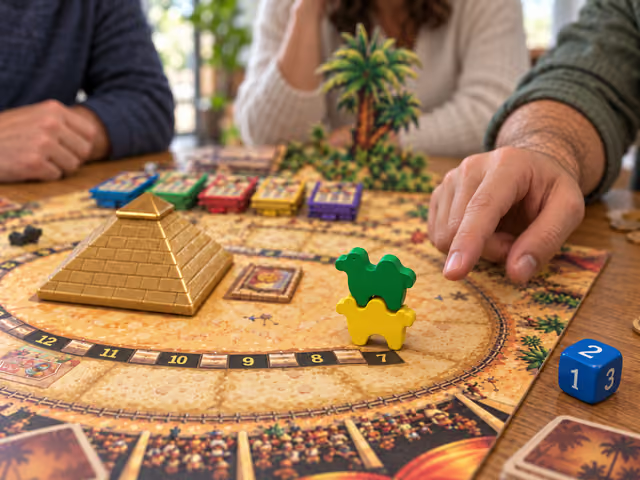
Demonstrate with two racing camels before their setup rolls: green on yellow. Moving yellow carries green; moving green leaves yellow behind. Green ranks ahead while they share a space. Then do the real setup rolls so the demonstration does not alter the race.
Move the indicated camel and everything above it
A colored die moves its racing camel clockwise by the shown 1, 2 or 3 spaces. Lift that camel and every camel above it as one unit; leave all camels beneath it in place. Keep the moving unit's internal order. If it lands on an occupied space, put the whole moving unit on top of the existing stack. Passing a camel or tile has no effect; only the landing space matters.
The grey die normally moves the black or white crazy camel matching its numeral color counterclockwise by the shown distance. There are two exceptions: if only one crazy camel carries any racing camels, move that carrier regardless of the numeral color; if the crazy camels sit directly on one another with no racing camel between them, move the top crazy camel. These cases select the carrier or top camel, respectively. It carries everything above it and normally lands on top of any destination stack. A crazy camel can transport racing camels backward.
When a moving unit lands on a spectator tile, give that tile's owner one point from the bank, once for the entire unit. A cheering tile moves the unit one extra space in its moving camel's forward direction; land on top of any destination stack. A booing tile moves it one space in that camel's backward direction; place the arriving unit underneath any destination stack. Keep the unit's internal order. Thus cheering sends a crazy camel counterclockwise and booing sends it clockwise. The passengers follow the camel being moved, not their own facing. All pieces retain their original facing.
The spectator tile stays in place after use. It can affect a later landing during the same leg; only its owner's relocation action or the end-of-leg cleanup removes it. If any moving camel crosses the finish line, the race ends immediately, including a crazy camel crossing counterclockwise. Do not take another turn to complete the leg.
Score five-die legs, then the finish
A leg ends after five of the six dice have been revealed, so one die remains inside the pyramid. Rank only racing camels: farther clockwise along the track is ahead, and a higher racing camel in the same stack is ahead of a lower one. Ignore black and white for ranking, even if one is on top. Give the starting marker to the player to the left of the person who revealed the fifth die.
Each ticket for the leading racing color earns its large printed value, 5, 3 or 2 points. Each ticket for the second-place color earns one point. Every ticket for a third-, fourth- or fifth-place color loses one point. Each pyramid ticket earns one point. In a six-to-eight-player partnership, each partner may independently copy the reward of one of the other person's leg or pyramid tickets; add it to their own result without taking the ticket or reducing the other person's reward. Copying is optional, so decline an unfavorable ticket. Partnership cards do not copy finish cards.
Add together your leg-ticket results, pyramid tickets and any copied reward, then receive or pay that net amount. Example: a leading 5-point ticket, a last-place ticket and two pyramid tickets give 5 minus 1 plus 2, or six points. Points cannot fall below zero. Keep coins in front of you; stacking them is allowed and you need not announce an exact total during play. Exchange denominations with the bank at equal value when needed.
If the race continues, return all leg tickets to their color stacks in 5, 3, 2, 2 order from top to bottom; return all five pyramid tickets and the five revealed dice; return spectator tiles to their owners; and reset all partnership cards to their owners, available side up. Camels stay where they are. Finish-prediction piles stay untouched. The marker's new holder starts the next leg.
If a camel crosses the finish line, freeze the resolved movement and score the unfinished final leg once using tickets actually acquired. Skip preparing another leg. The highest racing camel in the most advanced stack is the overall leader; the lowest racing camel in the least advanced stack is last. If a crazy camel carries racing camels over the finish line counterclockwise, those passengers count as least advanced; their stack order still ranks higher racing camels ahead of lower ones.
Resolve the final-leader pile first, in order from earliest card played to latest: the first correct color earns eight points, the second correct color five, the third three, the fourth two, and every further correct card one. Each incorrect card loses one point; incorrect cards do not use a place in the correct-card reward sequence. Apply the zero-point floor when a loss cannot be paid. Resolve the last-place pile the same way against the actual last racing color, with its own reward sequence. Unplayed finish cards earn nothing.
Count each person's final points. Highest total wins; equal highest totals share victory. The player predicting the winning camel is not automatically the winning player. For another race, reset everyone to three points and repeat the complete setup.
Make the changing race easy to follow
Before lifting a stack, say which camel the die selected, the direction and the distance. After movement, identify the first two racing camels and show which dice remain possible. Everyone can inspect the revealed dice; the sixth die is not guaranteed a turn this leg. Predictions trade earlier rewards against later information, so let each person make their own choice.
Use the die tents and the remaining pyramid tickets to settle whether a leg is over. A stack landing earns the spectator owner one point, not one per camel. A booing arrival goes under an existing stack; an ordinary or cheering arrival goes over it. Check the grey die's carrier and direct-stack exceptions before moving black or white. Distinguish visible leg tickets from hidden finish cards, and keep finish piles in their original play order.
If the pyramid releases two dice, use this agreed house remedy: if the group cannot unambiguously identify which emerged first, return both without looking for an advantageous result, shake again and release one; the taken pyramid ticket still covers this action. Agree before play. If a bumped stack can be reconstructed unanimously, restore it; otherwise this guide suggests ending that race unscored and restarting. These are host remedies, not official penalties.
With six to eight people, explain compulsory partnership-card exchange before play, and use it only as a game action. A seated setup can reduce movement, but fine pieces, color identification, readable tickets and pyramid noise may need help; arrange a shared mover or read ticket values aloud if useful, without making an access guarantee.
Already know the game?
Ideas & Twists
Choose a variation together before you start.
Camel Up · See main rules
House suggestion · visible informationOpen finish predictions
Keep the normal setup, turns and scoring, but put finish cards face up in the two prediction areas. Arrange each pile as an overlapping chronological row, earliest at one end, so both color and play order stay visible. Played cards still cannot be withdrawn. Correct finish cards earn 8, 5, 3, 2, then 1 in order; incorrect ones lose one. Leg tickets, crazy camels, partnerships, finish-line ending and shared ties are unchanged. This lets everyone respond to opponents' choices rather than hiding those choices.
Camel Up · See main rules
House suggestion · shortened raceOne-leg sprint
Use the same setup and actions, but finish after the first five revealed dice and their movement, unless a finish-line crossing ends it earlier. Freeze positions and score that leg once, including partnership rewards with six to eight people. Treat the current first and last racing camels as the final colors for both finish-card piles, using the usual ordered rewards and one-point losses. Highest point total wins, shared ties stand, and points never fall below zero. No cleanup or second leg follows. Early finish predictions matter more because there is only one leg to place them.
Camel Up · See main rules
House suggestion · two complete startsTwo-race series
Agree before setup to play exactly two full races and record each person's final points on paper. Run the first race normally. For the second, reset coins to three per player, return all tickets, tiles and cards, reroll all starting positions, and use the person to the first race's starting player's left as the new starter. Do not carry coins or partnerships between races. Add each person's two final totals; highest combined total wins and equal leaders share victory. Paper and a pen are additional supplies for this variation.
About this guide
The main game follows the 2024 Lookout second-edition English rules, including crazy camels and the six-to-eight-player partnership action. The publisher's current reprint supports 3–8, which is the guide's exact range. Printed Egyptian Pound coins serve only as game points here. All three variations and accidental-release/bumped-stack remedies are explicit house suggestions. Older two-player listings, expansions, Cards and Off Season are not imported. The demonstration and table narration are host advice.
Ready for something different?
Find another game →