

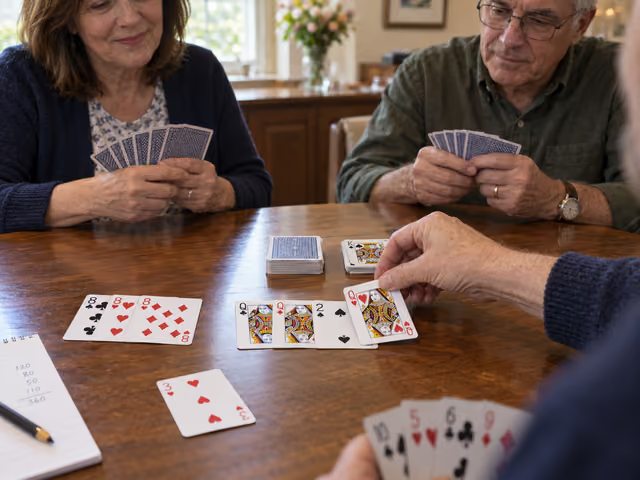
The quick version
Deal eleven each. Draw one stock card or legally take the entire discard pile, optionally meld, then discard one. A meld is three or more equal ranks; seven or more is a canasta. Your partnership needs a canasta before either partner empties their hand. Score both teams after each hand; once either reaches 5,000, the higher total wins.
Saved on this device only — clearing your browser's cache or site data removes them (no account backup).
Seat partners, prepare 108 cards and deal
Combine two complete 52-card decks and exactly four jokers: 108 cards. Remove advertising or instruction cards. Matching backs keep the stock from giving away which deck a card came from. Leave space for the stock, one discard pile, and two separate team areas for face-up melds and red threes. Give each person a seat; put partners opposite each other. Keep a two-column score sheet and pencil beside the table.
Choose the first dealer randomly. Shuffle the combined pack; the person to the dealer's right cuts. Deal eleven cards to each person, one at a time clockwise. Put the rest face down as the stock and turn its top card face up beside it to start the discard pile. If it is a joker, two or red three, leave it sideways in the pile and turn another card on top; repeat until the top is neither wild nor a red three. A black three may remain on top, blocking the first pickup.
Everyone immediately lays any dealt red threes face up in their team's area and draws one replacement for each from the stock. Replace another red three the same way until the hand contains no red threes. Red threes are bonus cards, not melds. Start both cumulative scores at zero and announce each team's opening requirement: 50 points for the first hand. The person left of the dealer takes the first turn; turns move clockwise. Rotate the dealer one seat clockwise after each scored hand.
Build equal-rank sets and open your team's melds
A normal meld has at least three cards, including at least two natural cards of one rank from four through ace. Suits do not matter. Twos and jokers are wild substitutes; no meld may contain more than three wild cards. Three queens is a meld, as is two queens plus a two. A queen, king and ace is a run and is not a meld here. All-wild melds are not allowed.
Partners share their face-up melds. Add only to your team's sets, and combine all of your team's cards of the same rank into one meld. You cannot borrow cards from opponents or move a played wild card to another meld. At seven or more cards, the set is a canasta: all natural cards makes it clean; any wild card makes it mixed. A canasta contains at least four natural cards. More matching cards may be added after seven, but it still earns only one canasta bonus. Adding a wild to a clean canasta makes it mixed.
Card values are: joker 50; ace or two 20; eight through king 10; four through seven and black three 5. Red threes use the separate bonus rules below. Your team's first turn of melding must reach its opening minimum using the values of the cards actually laid down: negative cumulative score requires 15; 0–1,495 requires 50; 1,500–2,995 requires 90; 3,000 or more requires 120. Several legal melds laid down together can meet the minimum. Once either partner opens, both may meld freely for the rest of that hand. Red-three and canasta bonuses never count toward opening.
For example, three kings are worth 30, and two queens plus a two are worth 40. Played together they open a team needing 50, but fail a team needing 90. Check the total before committing cards. The special concealed exit described below has a stock-draw exception to the opening minimum.
Draw, optionally meld, then discard
Begin with one draw
Take the top face-down stock card into your hand, or use the discard-pile procedure below instead. Never do both. If you draw a red three, lay it face up with your team's red threes and draw a replacement, repeating if necessary. If the last stock card is a red three, reveal it and end the hand immediately: there is no replacement, meld or discard.
Meld if you wish
After the draw, put down legal new sets or add cards to your team's sets. Meet your team's opening minimum if it has not opened yet. You may also keep your cards and make no melds. Keep the cards needed for a legal discard and a legal hand ending; without a team canasta you must still have at least one card after discarding.
End with one discard
Place one card from your hand face up on the shared discard pile. This ends your turn. A discarded two or joker goes sideways to mark a freeze; a black three blocks the next pickup but is not a lasting freeze. Red threes belong in the bonus area, never in an ordinary discard. Do not discard from a face-up meld. Only a legal exit by melding your whole hand skips the discard.
After the red-three replacements, the player left of the dealer can simply draw one stock card and discard one. Nobody has to produce a meld on the first turn.
Check the top card before taking the whole pile
Never take the pile when its top card is a wild card or a black three; a red three is also unavailable as a top pickup. A buried wild card, or a red three turned up during setup, freezes the pile for both teams until someone legally takes it. Keep that card sideways and visible. The pile is also frozen against a team that has not yet made its opening meld, even if there is no sideways card.
When frozen against your team: show two natural cards from your own hand matching the rank of the top discard, and meld all three. A wild cannot replace either card in this pair. Even if your team already has that rank on the table, you still need the natural pair in hand; merge the cards into that existing meld. If your team has not opened, also meet its opening minimum now using cards from your hand and the top discard only. You may lay other legal melds from your hand at the same time. Cards buried in the pile and bonus points cannot help you qualify.
When not frozen against your team: immediately meld the top discard with two matching natural cards from your hand, or one matching natural and one wild, or add it directly to your team's existing meld of that rank. The resulting meld must remain legal. In this selected format an existing completed canasta can receive that top card too.
Show the qualifying cards and check the opening total before touching the rest of the pile. Then take every remaining discard into your hand, not just the top one. You may now make further melds. A red three found inside the pile goes face up in your bonus area with no replacement draw. Finish with one discard unless legally going out. After the entire frozen pile is taken, its sideways freezing card is gone; a fresh pile has no buried freeze until another freezing card enters it.
A useful check: the top discard is a nine, and the pile is frozen. A nine plus a joker in your hand cannot take it, even if your team has nines on the table. Two natural nines can. A black three buried under that nine does not itself freeze the pile in this guide.
Go out legally or recognize an empty stock
Your partnership must have at least one canasta before either partner goes out; completing it on that same turn is allowed. After drawing or taking the pile, go out by melding all remaining cards, or by melding all but one and discarding the last. The hand ends immediately and nobody else takes a turn. Without a team canasta, you must retain at least one card after your discard. Do not meld everything except your last discard and accidentally empty your hand.
You may meld three or four black threes, with no wilds, only on the turn you actually go out. A pair of black threes cannot be melded. Going out normally earns your team 100. Asking your partner is optional: if you ask whether you may go out, do so just after drawing or taking the pile and before any further melding, other than the meld required to take the top discard. Their yes or no is binding for that turn. Ask only when you can legally carry out a yes.
A concealed exit earns 200 total instead of 100: you have not previously melded or added to your partner's melds, and you lay your entire hand in one turn, with or without a last discard, including a complete canasta of your own. Earlier red-three exposure is allowed. Adding to your partner's cards cannot qualify as concealed. If your team is unopened and you drew from the stock, this concealed exit need not meet its opening minimum. If you took the discard pile, you still have to meet the opening minimum before taking its buried cards.
This table also adopts Bicycle's specific one-card restriction: if your hand contains just one card and the discard pile contains just one card, you cannot take that pile, even when its top could be added to your team's meld. Draw from the stock instead. If the stock is empty, that unavailable pickup ends the hand.
If the final stock draw is not a red three, complete that turn normally. With no stock left, continue only through legal discard-pile pickups. An unfrozen top discard matching your team's existing meld must be taken unless the one-card restriction applies; a pickup requiring you to form a new meld is optional. A frozen pile still needs the natural pair. As soon as the next player cannot take the pile, or legally declines an optional pickup, end the hand without a draw, meld or discard from that player. Do not reshuffle the discard pile. Nobody earns a going-out bonus for stock exhaustion.
Count both teams, then check 5,000
For each team, add the card values of everything it legally melded, including every card inside completed canastas. Add 500 for each clean canasta and 300 for each mixed canasta. Add the team's going-out bonus, if any: 100 normally or 200 concealed. Then subtract the card values left in both partners' hands, even cards that could have formed sets. Unplayed cards do not get a final chance to meld.
Add 100 for each exposed red three if your team has made at least one meld. All four red threes together earn 800 instead of 400. If your team has no meld at all, these amounts are negative: subtract 100 each, or 800 for all four. Having a canasta is not required to earn the red-three bonus in this selected Classic format. Keep red-three bonuses separate from the card-value sum.
For example, a clean canasta of seven kings contributes 70 in card values plus its 500 bonus: 570 before other cards and bonuses. If your team's melded-card total is 230, with one clean canasta, one red three and an ordinary exit, and the two hands together contain 60 points, that hand scores 230 + 500 + 100 + 100 − 60 = 870. A hand score or cumulative score can be negative.
Record each hand and cumulative total for both teams. If neither total reaches 5,000, gather all 108 cards, shuffle and deal the next hand with the next dealer; recalculate each team's opening minimum from its new cumulative score. Once either team reaches at least 5,000 after a completed hand, higher cumulative score wins, even if both crossed 5,000 together. The team that went out need not win. For an exact tie, this table's explicit house convention is to continue with another full hand, retaining totals, repeating while tied.
Explain the tricky decisions before dealing
Start with an unscored demonstration using loose cards: make a three-card meld, show a seven-card canasta, then test one pickup with a natural pair and another with a natural plus a wild. Reassemble and shuffle the complete pack before the real deal. Put the card values and both opening minima on the score sheet. Keep each team's same-rank cards together and count a canasta before squaring it into a stack.
Say the rule family aloud. Do not import Modern American rules for special sevens, special aces, all-wild canastas, thirteen-card hands or two required canastas into the main game. Black threes are stop cards here; Bicycle's web instructions use different freeze wording. If someone remembers another version, select a complete format before starting rather than changing a rule midhand.
Keep the discard pile squared, with its freezing card visible; do not search buried cards to decide whether a pickup qualifies. As a house information convention for this friendly table, nobody sifts the pile during play; check its top and visible freeze marker only. Keep hands private and avoid telling your partner which rank to discard. Reading the public score, opening minimum or red-three replacement rule aloud is useful; the optional go-out question has its specific timing above.
For a mistaken opening or illegal pickup caught before the next player acts, this table's house remedy is to restore the cards and stock to their known prior positions and have that player complete a legal turn. If a pile was already mixed into a hand so its original contents cannot be agreed, cancel that hand for no score and redeal with the same dealer. Do not invent a point fine or secretly keep borrowed cards. Confirm both hand scores while melds and remaining hands are still separate.
Already know the game?
Ideas & Twists
Choose a variation together before you start.
Canasta · See main rules
Suggested house variationTwo-hand match
Replace the 5,000-point finish with two completed hands. Keep the same partnerships, dealer rotation, opening minima and all hand scoring. Higher cumulative total after hand two wins; if tied, play additional full hands until the totals differ. A stock-exhausted hand still counts as a completed hand. This reduces the number of scheduled hands without promising a number of minutes.
Canasta · See main rules
Published Classic variation · opt in before dealingAlways require the natural pair
Treat the discard pile as frozen against everyone throughout the hand. Every pickup requires two matching natural cards in the player's hand plus the top discard; an existing table meld alone, or a natural plus a wild, cannot qualify. Keep the opening minimum, whole-pile pickup and forbidden top-card rules. When the stock is empty, a legal pair pickup is optional; if the next player declines or cannot take it, score the hand. Nothing else changes.
Canasta · See main rules
Suggested house variationTwo canastas before going out
Require your partnership to complete two canastas before either partner may empty their hand, instead of one. Either kind counts. All other meld, discard, score and stock-exhaustion rules remain. A concealed exit now has to leave your team with two canastas and still include a complete new canasta made entirely in that player's one-turn reveal, without adding to partner's melds. This changes when you may finish; it does not convert the game into Modern American Canasta.
About this guide
Main mechanics follow Pagat's Classic section, not its Modern American section. Fresh manufacturer review at Bicycle corroborates the meld, card-value, exit and scoring framework but differs on black-three freezes, opening upcards, dealt red-three timing and partner-question timing; this guide explicitly selects Pagat on those points. The one-card-hand/one-card-pile restriction is a separately identified table adoption from Bicycle. Tie continuation, the no-sifting convention, error recovery and suggested twists are labeled table rules. The always-frozen twist is a published Classic variation. Community discussions explain teaching needs and do not override the selected rules.
Ready for something different?
Find another game →