

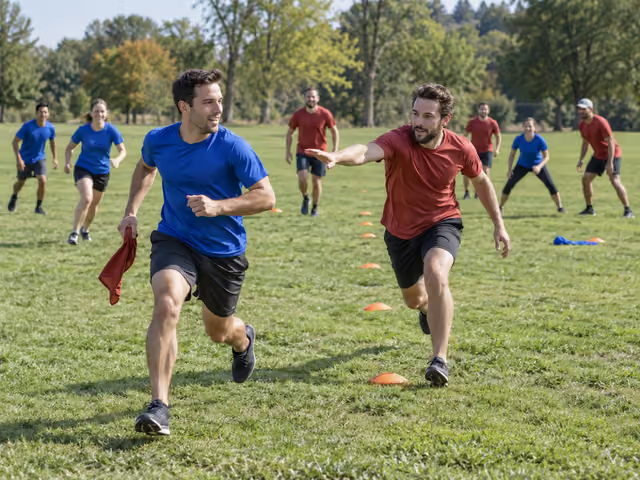
The quick version
Everyone plays at once. Take the opposing flag across the center line with both feet in your own half to win a round. A tag in enemy territory sends you to jail; one teammate can rescue one prisoner, then both walk home safely. Jailing the entire opposing team also wins a round. First to two round wins takes the match.
Saved on this device only — clearing your browser's cache or site data removes them (no account backup).
Mark the field before anyone runs
Choose a level grass field with room to run, turn and stop. Walk it together in daylight: keep roads, water, holes, hard obstacles and other park users outside the playing area. Wear closed-toe shoes. Use flat markers, not loose cord or raised tape, on running routes.
Bring two contrasting loose cloth flags, such as bandanas; 24 flat field markers; and an identifier for each player, divided evenly between two colors. Use shirts or snug fabric armbands that cannot trail or snag. The identifiers show teams; they are never pulled off to make a tag. There is no ball, flag belt or flagpole.
Make a rectangle split into equal halves. As a starting layout, use about 30 by 20 metres for eight players; enlarge it for more players only if everyone can still see the boundaries and hear a stop call. This is a house starting point, not a regulation size. Use four markers for the corners and two for the center line's ends. Put one flag marker near the back of each half, at equal distances from the center. Lay each cloth flag beside its marker, fully visible and easy to pick up. Do not tie, bury or move it during play.
Use four markers around each flag to mark a roughly 3-metre guard buffer. Use four more to mark each jail, about 2 by 2 metres, toward the side of its half and away from the flag and main running lanes. Make jails equally reachable. Defenders stay at least 3 metres from the jail unless an active opponent approaches within that distance. Explain these spaces on a walk-through; there are no hidden boundaries.
Balance two equal teams of four to ten by the group's running confidence. The listed headcounts are active players; an optional observer is extra. With an odd number, rotate one person into the next round rather than making unequal teams. Choose a host to call starts and pauses. Agree that anyone can call STOP, and everyone must stop immediately.
Raid, rescue and finish a round
Start together
Stand anywhere in your own half. Confirm both teams are ready; the host calls GO. There are no individual turns. Spread out to defend, distract, retrieve the flag or rescue teammates, and change roles as play develops.
Make a light tag
You may tag an opponent only when both your feet and both theirs are inside your home half. Use one light hand touch on the upper arm, shoulder or upper back. A touch is enough: no pushing, grabbing clothes or flags, blocking with your body, tackling or diving. A tagged player stops trying to play and walks directly to the jail in that half. They cannot tag, carry a flag or rescue anyone on the way.
Reach the flag
Defenders remain outside their flag's marked buffer until an active attacker enters it; then they may enter to tag, leaving again when no attacker remains. The buffer is not a safe zone for attackers. Pick up the opponent's loose flag and carry it in your hand. Keep it visible. Passing, throwing, hiding it in clothing and moving your own flag are not allowed in this format. Never wrestle for it.
Reset a failed carry
If the carrier is tagged, or the flag falls to the ground, call PAUSE. Everyone stops in place while the flag is returned to its original marker. A tagged carrier goes to jail; an untagged player who simply dropped it remains active at the drop spot. Neither team may advance or take another flag during the pause. The host calls GO once the reset is complete.
Free one teammate
An active teammate who is not carrying a flag can touch one prisoner's hand inside the marked jail before being tagged. Prisoners keep both feet inside the jail and do not form reaching chains. One successful rescue frees that prisoner and the rescuer for a protected walk straight home, each with hands on their head. They cannot carry a flag, tag or make another rescue during that walk. Both must get fully into their own half before lowering their hands and playing again. If tagged before touching the prisoner, the rescuer joins the jail instead.
Confirm the round winner
A flag carrier wins the round as soon as both feet reach their own half with the opposing flag still in hand. Your own flag need not be at its marker. Call STOP immediately. A team also wins if every opposing player is in jail at once; a player already freed and walking home is not a prisoner. Award one round win, not points for individual tags or rescues. If two winning events happen together and their order cannot be agreed, replay the round with no point.
Reset and finish the match
Return both flags, empty both jails and switch field halves after each scored round. Keep the same teams and put the flags back at the same marked positions. The host starts the next round when everyone is ready. First to two round wins wins the match; at 1–1, play the deciding round. If the group stops before that finish, record the completed round score and call the match unfinished rather than inventing a winner.
Blue has four players. Three are jailed; the fourth touches a prisoner before Red tags them. Blue now has two prisoners and two players walking home safely. Red has not jailed the whole team and has not won the round.
Settle close calls and keep people involved
Before the scored game, demonstrate one light tag, a failed flag carry and a one-person rescue with its protected walk. Show exactly where both feet must be to be safe. A flag merely reaching over the center line does not win. Players straddling the line cannot be tagged under this house rule, but cannot stand there to obstruct anyone.
Leaving the outside boundary counts as being tagged: walk to the opposing jail. If carrying a flag, use the failed-carry pause and return it to its marker. Step away from an obstacle rather than chase through it. Pause for a fall, an unrelated person entering the field or anyone needing a break.
Honor a clear tag. For an uncertain tag, rescue or finish, stop and agree what happened before restarting. If nobody can establish the order, replay that round with the score unchanged. A defender entering a guard buffer early must step back; if that violation prevents a pickup or rescue and the outcome cannot be agreed, replay the round. Pauses are for resolving the situation, not making new rules mid-chase.
Encourage rescues instead of leaving the same people waiting in jail. If teams repeatedly stall, pause between rounds and choose the no-jail or timed variation below for a new match. If one team dominates, agree a new team split and reset the match score. Do not change boundaries, teams or tag rules during a live round.
Already know the game?
Ideas & Twists
Choose a variation together before you start.
Capture the Flag · See main rules
Suggested house variationWalking Capture the Flag
Replace running with walking for everyone, including carriers and rescuers. If someone runs, they must walk to the opposing jail even if they ran in their own half; a carrier also triggers the normal flag-reset pause. Keep light-touch tags, both-feet finishes and first to two round wins. Walking still requires movement and balance; it is not a seated or guaranteed accessible format.
Capture the Flag · See main rules
Suggested house variationReturn home instead of jail
Remove jails and rescues. A tagged or out-of-bounds player walks straight home with hands on their head and cannot participate until fully back in their own half. A tagged carrier still triggers the flag-reset pause. Only a flag capture wins a round; jailing everyone is no longer a win condition. Keep first to two round wins. This trades rescue tactics for less waiting.
Capture the Flag · See main rules
Suggested house variationPlay to a chosen stop time
Add a visible clock or timer and agree the match limit before starting. Replace first to two round wins with the most round wins by that limit. Keep both ways to win a round, reset after each point and swap halves each time. For a dispute replay, the clock continues; stop it for a safety pause. At the final signal, stop immediately and discard the unfinished round. Higher completed score wins; an equal score, including 0–0, is a draw. There is no extra chase or overtime.
About this guide
Friendly daylight house format, reviewed October 2, 2026. Primary sources differ on guard distances, rescue immunity, flag drops and winning. This guide fixes one combination explicitly: visible cloth flags, 3-metre guard buffers, no safe flag zone, no passing, one-prisoner rescue with both people walking home, reset-on-drop pauses and first to two round wins. It does not claim Xoso league compliance or REDUX kit rules. Headcounts, field starting size, marker allocation, disputes and variations are hosting choices; source age groups and estimated times are not adopted.
Ready for something different?
Find another game →