

The quick version
On your turn, draw and place one matching tile, optionally put one available meeple on an unoccupied feature of that new tile, then score every completed feature and return its meeples. Farmers stay until final scoring. After the last tile, score unfinished features and fields; highest total wins, with shared wins for a tie.
Saved on this device only — clearing your browser's cache or site data removes them (no account backup).
Sort the box and make room for the map
The selected box contains 72 base land tiles, 12 River tiles, 40 regular meeples in five colors, five abbots, a scoreboard and rules. For the main game, put the 12 River tiles and all abbots back in the box. Keep all 72 base tiles, including tiles with garden pictures; those gardens have no scoring role unless you add The Abbot.
Find the base start tile with the dark back and place it face up near the middle of a clear table. Leave room on every side for the landscape to grow. Shuffle the other 71 base tiles face down into reachable stacks. Each of the two to five players takes eight regular meeples in one color: put one on zero on the scoreboard and keep the other seven as your supply. Return unused colors to the box. A meeple is a small wooden follower; the score marker stays on the track.
The official opener is the youngest player; turns then go clockwise. Explain before starting that farmers are included and cannot come back during the game. For an introductory game without farmers, choose the labeled variation below before the first turn. Keep track of each full circuit of the score track so a wrapped marker does not lose points.
Place a tile, choose a follower, then score
Make the first placement
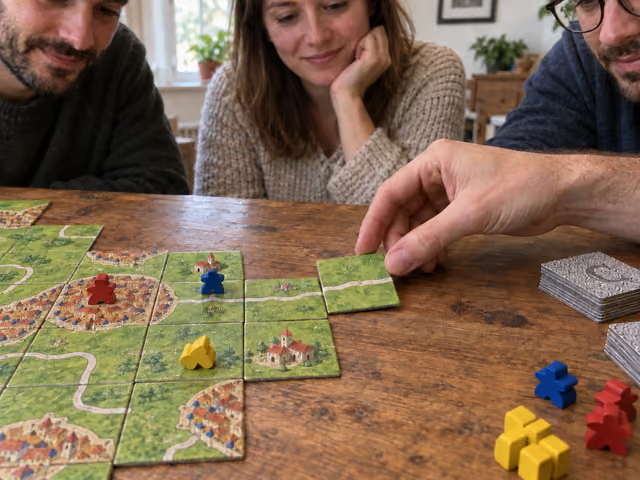
The opening player draws one tile from a face-down stack and turns it face up. Rotate it and attach a full side to at least one tile already on the table. Every touching edge must match: road continues road, city continues city, and field continues field. A corner-only connection is not enough. You may place anywhere that fits, rather than beside your own followers. If a tile cannot legally fit anywhere, return it to the box and draw a replacement; an inconvenient tile is not a reason to redraw.
Claim one feature or keep your supply
You may place one of your available seven followers on the tile you just placed, or place none. Stand it on a road, city or monastery, or lay it down in a field as a farmer. First trace the entire connected feature: you cannot claim it if any follower is already there, including your own. Separate road, city or field segments on the same tile can belong to different features. Choose just one feature, and put the follower clearly inside it. You cannot claim an older tile later, move an existing follower to another feature or take an unfinished follower back in this main format. If your supply is empty, place the tile normally and skip claiming.
Resolve everything the tile completes
After the optional claim, check all features completed by this placement, including another player's features and nearby monasteries. Score them using the next section, advance the relevant score markers, then return every follower on each scored feature to its owner's supply. Unclaimed completed features award no points. You may claim a previously empty feature with the tile that completes it and score immediately. A follower returned during scoring becomes available on a later turn; it cannot be used for a second claim now. Then the next player draws.
Blue claims a short road that is separate from Red's road. A later tile joins those roads. That is legal: nobody placed a follower directly onto an occupied road. If their now-shared road finishes with one follower each, both players receive its full value.
Count features, then return their followers
Roads
A road finishes when both ends terminate at features such as a village, city or monastery, or when it forms a closed loop. A village junction ends each road leading into it; do not count the other branches as the same road. A completed road is worth one point per tile in that road. Count a tile once for the feature being scored. A four-tile road is worth four.
Cities
A city finishes when its walls close all the way around it and there are no missing tiles inside. It scores two points per tile in the city, plus two per coat-of-arms symbol in it. Count each tile once for that city, even if multiple parts of the city are on it. A three-tile city with one coat of arms is worth eight. A completed two-tile city is worth four, plus any coats of arms; there is no reduced small-city score in this edition.
Monasteries
A monastery finishes when all eight spaces around its tile are occupied, including the four diagonal spaces. It scores nine points: the monastery tile plus its eight neighbors. A placement can complete several monasteries, so check each affected one. A normal follower may claim a monastery; the floral garden picture is not a monastery.
Majorities and tied claims
Features that began separately may join and end up holding several followers. For each road or city being scored, count followers by color. Only the color with the most receives the feature's full score. If several colors tie for the most, each receives the full score; never divide it. All followers leave the completed feature, including followers belonging to a player who received zero. Simply laying a tile does not earn its placer points.
Farmers stay for the final count
A farmer occupies one continuous green field. Trace that field across matching tile edges; roads and city walls separate fields, but a field may go around the end of a road. Do not treat every green patch on a tile as connected, jump across a road, or connect two patches merely because their corners touch. Place the farmer lying down on an unoccupied field of your new tile, using your turn's one optional follower placement. You do not need a knight in any neighboring city to place a farmer.
Farmers never score or return during this main game, even when a nearby city finishes. At final scoring, count the distinct completed cities touching each occupied field. Each is worth three points for that field, regardless of city size or coats of arms. An unfinished city gives a field nothing. Count a completed city once in a particular field even if that field touches it in several places; different fields can each score the same city.
Apply the same follower-majority rule to farmers: the color with the most farmers in a field takes its whole value; tied leaders each take the whole value. Fields can acquire several farmers only when separately occupied fields join. For example, a field touches two completed cities and one unfinished city. It is worth six. Red and Blue with one farmer each both score six; if Red has two and Blue one, Red scores six and Blue zero. Score each field once, then remove its farmers to show it is finished.
Use the last tile and settle the result
Finish the last tile's placement, optional claim and normal completed-feature scoring. When the next player cannot draw another tile, the game ends; there is no extra turn to move followers or complete the map. Resolve the followers still on it. An unfinished road scores one per tile. An unfinished city scores one per tile plus one per coat of arms, half its completed value. An unfinished monastery scores one for itself plus one for each surrounding tile already present. Apply the same majority and full-score tie rules to remaining roads and cities.
Then score every occupied field as described above, counting only completed cities. Remove followers as each feature is settled to avoid counting twice. Add these points to the running track totals, including full circuits. Highest total wins; equal highest totals produce joint winners under the official rule. For a rematch, restore all 72 base tiles, shuffle again, reset score markers to zero and rebuild each seven-follower supply.
Show the decisions before the first turn
Before shuffling, use a few tiles for an unscored demonstration: show an edge match, a three-tile city with one coat of arms worth eight, and a field touching two completed cities worth six. Put all demo tiles back before setup. Point out the seven-follower limit and the difference between a standing follower that can return and a farmer committed until the end. On the first real turn, ask the player to show the matching edges and trace their chosen feature before placing a follower.
Explain that joining separately claimed features and making another player's project harder to finish are legal parts of the shared map. Nobody owns a region of the table. Offer rules help, and agree how much strategic advice people want. Some groups enjoy competing for control; others prefer a gentler first game. That preference does not change the occupation or scoring rules.
For a disputed claim, trace the actual road, city or field together before the next draw. Check the printed tile boundaries, not which follower looks closest. Use this suggested house correction policy for teaching: if an illegal placement is spotted before the next draw, return the misplaced follower or move the same drawn tile to a legal spot, then resolve scoring correctly. If the table has been disturbed and its prior layout cannot be agreed, pause and consult the rule sheet; do not invent penalty points or quietly rearrange unrelated tiles. Resolve any necessary reconstruction together before continuing.
Keep drinks and loose objects away from the growing map, and confirm scores before retrieving followers. Reach and clear-table needs depend on the room and group; seated play is not a claim that every table or player can use the setup.
Already know the game?
Ideas & Twists
Choose a variation together before you start.
Carcassonne · See main rules
Official introductory optionFirst game without farmers
Keep the same 72 base tiles and all road, city and monastery rules, but do not place followers in fields or award field points at the end. Leave The River and The Abbot in the box as in the main setup. This is the rulebook's recommended introduction, rather than a different farmer score. Everyone's seven followers can return when their standing features finish. Finish with incomplete-feature scoring and share any top-score tie. Afterward, show how one of the completed map's fields would have scored; restore and shuffle the full set before playing a new game with farmers.
Carcassonne · See main rules
Official mini-expansion · included in the selected boxAdd The Abbot
Give each player the abbot in their color in addition to their seven regular followers. Keep the main setup and farmers. After placing a tile, your one placement may be a regular follower as usual, or your abbot on a monastery or garden printed on that new tile. A regular follower cannot occupy a garden, and an abbot cannot occupy a road, city or field. A claimed monastery cannot take another figure. Completed monasteries and gardens with an abbot score nine and return it. Alternatively, on a later turn after placing a tile, skip placing any figure and retrieve your abbot: score one for its own tile plus one per currently surrounding tile, then resolve any other completed features normally. You cannot retrieve the abbot and place a follower in the same turn. An abbot left at the end scores its monastery or garden by the same occupied-neighbor count. It does not count as a farmer or create a new tiebreak.
About this guide
Uses the standard English box and the v3 main/supplemental rule sheets currently linked by Z-Man, with farmers enabled and The River/The Abbot excluded from the main format. The two variations are official introductory/module options. Demo, advice and the pre-next-draw teaching correction policy are hosting suggestions; that correction policy is a house procedure. The River's included components are accounted for but its rules are not used here. Earlier farmer-scoring systems and other editions are not imported.
Ready for something different?
Find another game →