

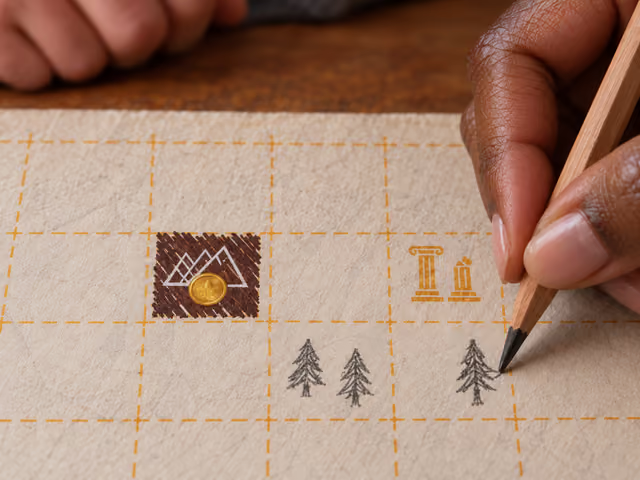
The quick version
Give everyone a map and pencil. Put four scoring goals under edicts A–D and shuffle one ambush into the explore deck. Reveal a card; everyone draws one allowed shape and terrain on their own map. Ruins require covering a ruins square; ambushes send maps to neighbors for monsters. After drawing, check the season's time total. At its limit, score the two active goals, all earned coins, and empty squares beside monsters. Repeat through winter. Highest four-season total wins; ties favor fewer monster penalties, then share victory.
Saved on this device only — clearing your browser's cache or site data removes them (no account backup).
Give everyone a map and choose four goals
Use Thunderworks Games' original English Cartographers: A Roll Player Tale, with the 2019-credit base rulebook. This guide's main game seats 2–8 people together and uses wilderness map side A. Leave Heroes cards, skills and expansion maps in their boxes. Give each person a fresh sheet and pencil; write a name at the top so passed maps return to the right person. The game includes four pencils, so supply more for a larger group. Everyone needs writing space and a view of the shared cards.
Lay out edict cards A, B, C and D in that order. Sort the 16 scoring cards into their four back-design groups, shuffle each group separately, and draw one from each. Put one goal below each edict in any order; return the other goals to the box. Keep these four goals in place for the entire game. Read their scoring conditions aloud before beginning, including whether they reward individual squares, connected clusters or completed lines.
Stack season cards with spring on top, followed by summer, fall and winter. Their time limits are 8, 8, 7 and 6; their scoring pairs are A+B, B+C, C+D and D+A. These numbers measure revealed cards, not minutes. Shuffle the four ambush cards as a separate face-down pile. Shuffle all 13 explore cards, including the two ruins cards, then take one unseen ambush and shuffle it into the explore deck. Put that deck beside the seasons.
A mountain is already filled and cannot be drawn over. A printed ruins symbol marks an otherwise empty square that you may draw over. Shapes need not touch earlier drawings. For scoring, adjacent means sharing a side; diagonal touching does not count. A cluster is one or more same-terrain squares joined through shared sides.
Reveal, draw together, then check the season
Reveal the first card
Choose someone to turn over cards, waiting until everyone finishes each drawing. Reveal the top explore-deck card into a face-up column. Keep every revealed time value visible. If it is a ruins card, reveal again; if both ruins cards appear, keep revealing until there is a drawable card. Everyone uses this same reveal.
Choose and place a shape
For an ordinary terrain card, choose one of its displayed shapes and one of its displayed terrain types, independently of other players. Draw the complete shape inside empty squares on your map and mark every square with that one terrain. You may rotate or mirror the shape. It cannot run off the map or overlap any filled square. There is no requirement to start in a corner or attach it to earlier terrain. Use clear symbols: trees for forest, houses for village, stripes for farm and waves for water; simple marks are enough.
Collect coins as you draw
If you use a displayed shape bearing a coin, fill the next coin on your track. Each mountain also earns one coin when all four squares sharing its sides become filled, including by monsters; collect it once when that happens. Keep earned coins marked for the rest of the game. A forced one-square replacement does not earn the coin from a larger shape you could not use.
Use a replacement only when necessary
If none of the displayed shapes can legally fit, draw one empty square anywhere and choose any terrain except mountain; the base rulebook's choices include monster. You cannot choose this fallback merely because a legal shape is inconvenient. Rift Lands instead directly offers a single square with any terrain shown on that card, subject to ordinary placement rules and any pending ruins requirement.
Check the time after everyone draws
Add the time values of all cards revealed in this season. If the total is below the current season's limit, reveal the next card and repeat. If it reaches or exceeds the limit, score the season immediately. Always complete the drawing that reaches the limit. Do not start a personal stopwatch or stop a player early because their own sheet is crowded.
Imagine a card showing a three-square L and forest terrain. You can draw that whole L in any legal orientation, then put a tree in each of its three squares. You cannot split it, cut a square off, or draw across a mountain. This spoken example explains placement; the actual card controls the real choices.
Handle ruins and pass maps for ambushes
Ruins: When one or both ruins cards appear, the next terrain explore card must be drawn so at least one square of its shape covers an unfilled ruins symbol. Two ruins cards still require only one ruins square, not two. You may cover ruins during an ordinary reveal too. If no offered shape can legally cover an unfilled ruin, or all your ruins are already filled, use the one-square fallback anywhere with any terrain except mountain. It need not cover ruins.
Ambush: Pass every map to the neighbor in the arrow's direction. With two people, swap maps whichever way the arrow points. On the map you receive, draw the entire displayed monster shape in empty squares, rotating or mirroring it if useful. You choose its legal location; it need not cover ruins or touch other monsters. Mark every square as a monster. If that whole shape cannot fit, draw one monster square in an empty square instead. Check whether the new monsters complete any mountain surrounds, so the owner receives those coins.
Return maps to their named owners and remove the revealed ambush from the game. It never goes back into the explore deck. If an ambush appeared after ruins, resolve monsters normally, then carry the ruins requirement to the next terrain explore card; the ambush does not consume that requirement. Continue the usual reveal/draw/check flow.
Monsters remain filled squares for all later placement and scoring. You do not erase or defeat them in this edition. Filling the empty squares alongside them can reduce future penalties. Before passing a map, identify its owner and keep your pencil marks clear enough for that person to score.
Score the whole map each season
At spring's end, evaluate the goals under A and B. Summer scores B and C, fall scores C and D, and winter scores D and A. Score your entire current map according to each active card, including terrain drawn in earlier seasons. Write the two goal totals in the season's boxes. A goal scores twice across the game, so an earlier useful pattern may earn points again.
Then add one point for every coin marked on your track, including coins earned in earlier seasons. Coins are never spent or cleared. Finally subtract one point for each empty square sharing a side with at least one monster square. Count each such empty square once, even if two or more monsters touch it. Count the empty squares, not the monsters; ignore diagonal contact. Add those two goal scores and coins, then subtract the penalty to get that season's total.
For example, goals worth 12 and 9, five marked coins, and four distinct empty squares beside monsters give 12+9+5−4 = 22. Record the monster penalty separately; it is also the final tiebreaker. An untouched ruins square is still empty, while mountains, monsters and side B's wasteland squares count as filled for goals that ask for filled spaces.
Unless this was winter, remove the current season card to expose the next. Gather and reshuffle all explore cards, both revealed and unrevealed. Keep any ambush that was never revealed in the deck. Add one new unseen ambush from the separate pile, then shuffle again. Leave your maps, coins and four goals as they are; clear the previous season's reveal column and start its time count at zero.
After winter's scoring, add all four seasonal totals. Highest total wins. If tied, compare the total points lost to monsters across all four seasons: the smallest loss wins. If still tied, share the victory. The printed numbers in the lower corners of scoring cards are for solo rating; do not subtract them in this multiplayer game. For another game, take fresh sheets and repeat setup.
Keep the map readable and the group together
Before the first reveal, check that everyone can identify the four goals and knows which pair scores first. Focus on spring's A and B without hiding the later goals. Allow soft conversation and rules questions; wait for a clear finished signal before turning the next card. Each player chooses their own drawing, even when discussing possibilities.
Show doubtful shapes before committing pencil marks. Verify the whole shape, any ruins requirement and every covered square. Use the scoring card's diagrams and the rulebook's scoring-card explanations for disputes about that goal; do not change its meaning midway through the game. Connected terrain uses side contact only. Keep patterns and labels readable rather than judging drawing quality.
This guide suggests two house remedies for unusual errors. Correct a clearly mistaken drawing before the next reveal, restoring its terrain and any coin it incorrectly earned. Once later shapes depend on it, agree on a fair repair together rather than silently redesigning a map. If a map has no empty square left, skip its drawing and continue its seasonal scoring while others play; never draw over a filled square. The base rulebook does not specify a fully filled-map procedure.
Ask the group about drawing on one another's sheets before starting. If they would prefer a purely personal mapping puzzle, agree on the no-monsters house variation at setup. Use the same format for everyone throughout the game.
Already know the game?
Ideas & Twists
Choose a variation together before you start.
Cartographers · See main rules
Official base-game optionWastelands map
Everyone starts with fresh map side B instead of A. Its preprinted wasteland squares are already filled: no terrain or monsters may overlap them, and they count as filled for relevant scoring goals and mountain surrounds. Ruins squares remain empty until drawn on. Keep the same four-goal selection, explore and ambush setup, placement rules, four seasonal scores and tiebreaker. Choose the side together before play; do not compare an A map against a B map in the same game.
Cartographers · See main rules
House suggestion · less confrontationNo-monsters mapping
Before setup, return all four ambush cards to the box and add none to the explore deck at the start of any season. Maps stay with their owners. Keep normal terrain, ruins, coin, goal and seasonal time rules. Also exclude monster terrain from forced one-square fallback choices, so no monsters enter the game at all. Every seasonal monster penalty is zero. Highest four-season total wins; tied players share victory. This changes the challenge and is not the publisher's standard game or its official solo rating.
Cartographers · See main rules
Official solo option · one personSolo survey
Use one map and pencil with the same four goals, explore deck, seasons and one new ambush added per season. Leave the title line blank until finishing. For an ambush, keep the displayed monster shape's orientation fixed: do not rotate or mirror it. Start at the map corner marked in the card's small grid and test placements along the perimeter in the arrow's direction, using the first legal fit. If none fits there, test the next perimeter one square inward, starting from the same corner and going in the same direction; repeat inward until it fits or no legal fit exists. If it cannot fit anywhere, discard it without drawing a one-square monster. Return each resolved ambush to the box. Terrain draws, ruins, coins and four seasonal scores otherwise follow the main game. After summing the seasons, subtract the sum of the four scoring cards' lower-corner numbers once to obtain your solo rating. There is no opponent or tie. Use the highest title threshold your adjusted rating reaches: 30 Legendary Cartographer; 20 Master Mapsmith; 10 Journeyman Topographer; 0 Apprentice Surveyor; −5 Amateur Assessor; −10 Inept Assistant; −20 Dimwitted Doodler; −30 Oblivious Inkdrinker. Below −30 reaches no listed title. There is no separate bonus for the title. Do not judge these thresholds using the unadjusted multiplayer total.
About this guide
The original base rulebook supplies the main mechanics, wastelands map and solo option. This guide chooses a 2–8 shared-table hosting range within the publisher's broader player range. Clear-symbol teaching, group pacing, mistake repair and the fully filled-map convention are host suggestions; no-monsters mapping is a house variation. Use the selected physical scoring cards with their rulebook explanations. Heroes, skills and other map packs have additional rules.
Ready for something different?
Find another game →