

The quick version
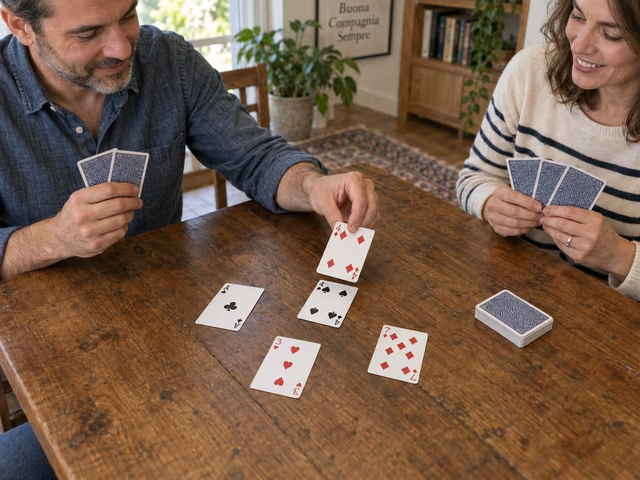
Deal four cards each and four face up on the table. Alternate one-card turns from the nondealer: capture equal values or sums, make or extend a legal build, or leave a card on the table. Aces count one; courts capture only the same rank. When both hands empty, deal four more each without refreshing the table. Continue until the whole deck has been played. Give leftover table cards to the last capturer. Score the cards and play further deals until at least 21, resolving the win after the whole deal.
Saved on this device only — clearing your browser's cache or site data removes them (no account backup).
Leave room to distinguish builds from loose cards
Shuffle all 52 cards and choose a dealer. Deal four to each player and four face up to the table, leaving the rest as a face-down stock. Keep a separate face-down capture pile for each player. Aces have capture value one; numbered cards have their printed value. Jacks, queens and kings are not eleven, twelve and thirteen in the main game.
The nondealer takes the first turn. Each turn uses exactly one card from your hand. You may capture, build or trail, subject to your existing build obligation. You do not draw after a turn. Once both hands are empty, the dealer deals four more each and adds no new table cards. The same nondealer leads each new packet.
Capture, build or leave a card
Capture with a number
Play a numbered card or ace and take any chosen table cards of equal value and any separate groups that add to its value. Each table card can belong to only one group. A five can take a loose five and a two-plus-three together; you need not take every available group. Put your played card and captured cards in your pile. A jack, queen or king may take just one loose card of the same rank.
Create a build you can take
Play a number onto one or more loose number cards so the total equals a capture card you still hold. For example, play a three onto a two and announce a build of five only if you retain a five. Overlap those cards as one unit. Either player can later take that unit with a five. A build may not include a court card.
Make a multiple build
If you retain a five, you can play a five beside a five-build, or play a three with a loose two beside it, and announce two builds of five. Keep the groups visibly separate inside one bundle. One five will capture the whole bundle. Once a bundle contains multiple groups, its capture value cannot be raised.
Raise a single build
You may add your played number to an existing single build if you retain a card matching its new total. Add a two to a single five-build to make seven only while holding a seven. The latest builder owns the obligation. You cannot take cards out of a build, split it, or increase a multiple build.
Respect the build obligation
If you were the last player to make or increase an uncaptured build, you cannot simply trail a card. You may capture or make another legal building play, but must retain a card that can take each build for which you are responsible. You may capture loose cards while keeping that required capture card. If the opponent raises your single build, its new obligation belongs to them.
Trail when free to do so
If you have no unresolved build obligation, you may play one card loose onto the table, even when a capture is possible. That ends your turn. In the main game you cannot trail and build on the same turn.
Score eleven points from the completed deck
After the last packet has been played, the last player who made a capture takes any cards still on the table. Count three points for taking more cards, one for taking more spades, one for each ace, two for the ten of diamonds and one for the two of spades. A tie for most cards awards neither player those three points. A tie for most spades cannot occur with thirteen spades, but an incomplete or miscounted deck must be corrected before scoring. There are normally eleven available points; a 26–26 card tie leaves eight awarded.
The main guide gives no sweep bonus. Add the deal's points to the match totals, alternate dealer and play again. Finish a complete deal before checking the target. If only one player has at least 21, they win. If both do, the higher total wins; if tied, play another complete deal. Do not stop midway through a deal when a captured ace appears to pass the target.
Try a capture and a build before scoring
Show a five capturing a five plus two and three. Then show a three laid on a two while its player retains a five. Those examples distinguish a capture now from a promise to capture later. Say the value of every build aloud, and keep single and multiple builds arranged clearly.
Choose the rules before dealing. Cassino has many table traditions, especially around builds and sweeps. The source is a contributed rules account; this guide selects one consistent set instead of combining every option. Points are simply game scores. For a first learning deal, the no-build variation below lets both players practise captures before adding obligations.
Already know the game?
Ideas & Twists
Skim the ideas, then open a twist for its full rules. Agree on the variation before you start.
No-build first deal
Remove the build action and all build obligations.
How to play this twist
Remove the build action and all build obligations. On a turn, capture under the main rules or trail one loose card. Keep the four-card packets, last-capturer cleanup, scoring and 21-point finish. This makes every table card immediately available for a capture and removes protected bundles.
Cassino · See main rules
Reward a clear table
Score one extra point whenever a capture clears the whole table, except for the very last play of the deal.
How to play this twist
Score one extra point whenever a capture clears the whole table, except for the very last play of the deal. Mark each sweep immediately. Taking leftover cards after the deck ends is not a sweep. Keep ordinary card points and the 21-point complete-deal finish; the number of points available now varies with sweeps.
Cassino · See main rules
Keep a build while trailing
A player responsible for a build may trail instead of capturing or building, provided they still retain a card that can capture that build.
How to play this twist
A player responsible for a build may trail instead of capturing or building, provided they still retain a card that can capture that build. Do not discard or spend the last required capture card on a different capture. This permits waiting for a better moment while leaving the opponent the same chance to steal the build.
Cassino · See main rules
Grow a build with loose cards
When raising a single build, allow loose table cards to join your played card in increasing its value.
How to play this twist
When raising a single build, allow loose table cards to join your played card in increasing its value. For example, add a played ace and a loose two to a single five-build to make eight, provided you retain an eight. The played card must contribute to the increase; you cannot rearrange the table for free. Multiple builds still cannot be raised.
Cassino · See main rules
Use a build inside a capture sum
Treat a single build as one number when capturing a larger sum.
How to play this twist
Treat a single build as one number when capturing a larger sum. A single five-build plus a loose three may be taken with an eight. Take the entire build; never split it. A multiple five-build still requires a five and cannot join an eight-value capture. Retain the main rules for creating and increasing builds.
Cassino · See main rules
Courts become numbers
Give jack value eleven, queen twelve and king thirteen for capture and building as well as matching.
How to play this twist
Give jack value eleven, queen twelve and king thirteen for capture and building as well as matching. A queen may now take a seven plus a five, and a jack may help form a build of thirteen if its player retains a king. Keep ace at one and all main scoring points unchanged. Apply the same whole-build and retained-capturer rules to these larger values.
Cassino · See main rules
About this guide
Main rules and documented variants are selected from Pagat's account, which credits Kim Scarborough, Janet Levy, Scott Grengs and Rachel Hooley. The no-build learning game is an explicit house format. This is evidence of contributed playing practices; it does not establish attendance at a particular gathering or representative demand. Sponsor links and gambling framing on the source page are not activity content.
Ready for something different?
Find another game →