

The quick version
Place two starting settlements and roads, taking resources only from your second settlement. On your turn, roll for everyone's production, resolve any 7, then trade and build in any order. Settlements score 1, cities 2, each bonus tile 2 and hidden Victory Point cards 1 each. Reach 10 or more on your own turn to win immediately.
Saved on this device only — clearing your browser's cache or site data removes them (no account backup).
Check the box and build the island
Use the English 6th-edition base box: 6 sea frame pieces; 19 terrain hexes (3 hills, 4 forests, 4 pastures, 4 fields, 3 mountains and 1 desert); 18 number discs; 95 resource cards (19 each of brick, wood, wool, wheat and ore); 25 development cards (14 Knight, 2 Invention, 2 Monopoly, 2 Road Building and 5 Victory Point); 2 dice; 1 robber; Longest Route and Largest Army bonus tiles; 4 player aids; and 2 card trays. Each of the four colors has 15 roads, 5 settlements and 4 cities. Keep the included rulebook handy.
Clear enough table space for everyone to see the board, reach the supply and keep their cards and spare pieces separate. For the official variable setup, shuffle and connect the six sea frame pieces with the ports visible. Shuffle the terrain hexes and fill the island in rows of 3, 4, 5, 4 and 3 hexes.
Sort the number discs by the letters on their backs, A through R. Starting on a corner hex, place them in alphabetical order around the outside counterclockwise, then spiral inward. Skip the desert without using a disc. Turn the discs number-side up and put the robber on the desert. Do not scatter the numbers randomly: this format uses the publisher's letter sequence.
Sort resource cards into five faceup supply stacks in the trays. Shuffle all development cards into a separate facedown draw stack. Put both bonus tiles beside the island. Each player takes one color's pieces and a player aid; return unused colors to the box.
Place two settlements before the first turn
Choose the opener
Everyone rolls both dice; highest total starts. House tie procedure: tied players reroll until one wins. Play then proceeds clockwise.
Place the first pair
Starting with the opener and going clockwise, each player places one settlement on an empty intersection, where hex corners meet, then one road on an empty edge beside it. Leave at least one empty intersection between every pair of buildings, including your own: settlements must be at least two edges apart. Coastal intersections are allowed.
Reverse the order
The last player places their second settlement and adjacent road immediately, then placement goes counterclockwise back to the opener. For four players the order is A, B, C, D, D, C, B, A; for three it is A, B, C, C, B, A. The second pair need not connect to the first. These starting pieces cost no resources.
Take starting cards
For each productive hex touching your second settlement only, take one matching resource card. The desert and sea give nothing; two touching hexes of the same type give two cards of that type. Keep resources hidden from opponents. Everyone begins with 2 victory points from their two settlements. Give the dice to the opener for the first real turn.
Roll, collect, then trade and build
Before the roll
You may play one eligible development card before rolling. You will not have one on the first turn. Otherwise, roll both dice and announce their sum.
Pay everyone's production
On a total other than 7, every hex showing that number produces, except the hex occupied by the robber. Everyone with a settlement touching a producing hex takes one matching resource per settlement; a city receives two. Hills give brick, forests wood, pastures wool, fields wheat and mountains ore. Check all matching hexes and all players, not just the roller. If the supply cannot pay everyone for a resource type, nobody receives that type; if only one player would receive it, give that player as many as remain. Other resource types still pay normally.
Resolve a 7 completely
No hex produces. Every player with more than seven resource cards chooses and returns half of them to the supply, rounding down: nine cards means discard four. Development cards do not count. Then the roller must move the robber to a different terrain hex, including the desert if desired, and take one random resource card from one opponent with a settlement or city touching that hex. Choose the opponent if several qualify. If nobody there has a card to steal, take nothing. Finish discards and the robber before any trades or builds.
Take the Action phase
Trade, build and play your one eligible development card in any order, repeating trades and builds as your resources and pieces permit. If you played a development card before the roll, you cannot play another action card now. When finished, pass the dice left. Opponents may trade with you on your turn but cannot build, play cards or trade with each other or the supply.
Before starting, point to a numbered hex and explain what that roll would pay each touching settlement. A city gets two of that resource, not two victory points each roll. Do this demonstration without changing anyone's starting hand.
Make a trade everyone understands
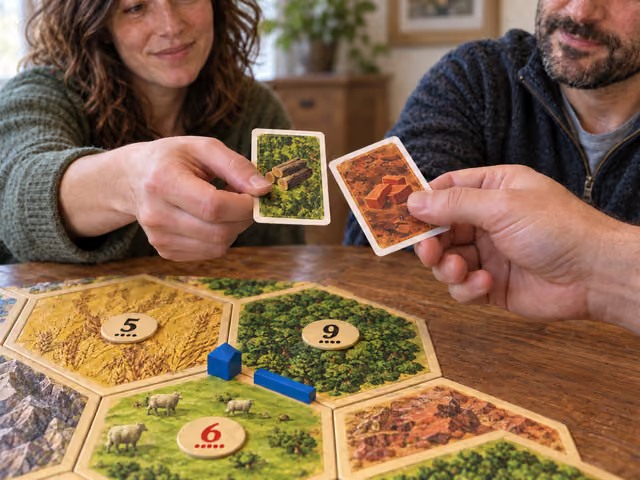
During your Action phase, offer resources you actually hold for different resources you want: for example, one wool for one brick. Players can decline or counteroffer; ratios between players are negotiable. Exchange the agreed cards openly. No gifts, development-card trades, same-type exchanges or resources now for repayment on a later turn.
You can always trade with the supply: return four cards of one resource type for one card of a different type that is available. With your own settlement or city on either intersection marked by a 3:1 port, return three matching cards for one different card. A specific 2:1 port accepts two of the resource shown on it for one different resource. A road beside a port does not activate it, and you cannot use another player's port. You may use a port immediately after building your settlement there.
Announce both sides of an offer before moving cards. A declined trade needs no justification. If you cannot get what you need, keep your cards and pass, or use a supply trade. The robber blocks production on its hex, not trading or building.
Pay the cost and place a legal piece
Road: 1 brick + 1 wood
Return the cards and place one of your spare roads on an empty hex edge connected to your own road, settlement or city. You cannot extend through an opponent's building. A coastal edge is legal. Roads alone score no points.
Settlement: 1 brick + 1 wood + 1 wool + 1 wheat
Place a spare settlement on an empty intersection touching your own road. Keep at least two edges between it and every existing settlement or city. Setup is the only time a new settlement may be placed without an existing connecting road. It scores 1 point and produces on future rolls.
City: 2 wheat + 3 ore
Replace one of your own settlements with a spare city and return the settlement to your supply for reuse. A city scores 2 points total, increasing your score by 1, and produces two resources per touching productive hex. You cannot put a city directly on an empty intersection.
Development card: 1 wool + 1 wheat + 1 ore
Draw the top development card and keep it hidden. Set newly purchased cards apart from older ones so timing is clear. Stop buying when the deck is empty; never reshuffle played cards. You may build only pieces remaining in your personal supply: at most 15 roads, 5 settlements and 4 cities of your color can be on the board at once.
Use development cards at the right time
Play at most one action development card on your own turn, either before the production roll or during the Action phase. It must have been bought on an earlier turn. Reveal it and finish its effect before taking another action. Development cards cannot be stolen by the robber or counted toward the seven-card discard threshold.
- Knight: move the robber to a different hex and steal exactly as above. Nobody discards just because a Knight was played. Keep played Knights faceup so everyone can count your army.
- Invention: take any two available resource cards from the supply, of the same type or two different types.
- Monopoly: name one resource type; every opponent gives you all their resource cards of that type. Their development cards stay with them.
- Road Building: place two free roads, one after the other, following normal connection and placement rules. The second can connect to the first. Use only your available road pieces and legal edges.
- Victory Point: each is worth 1 point. Keep it hidden until you can win on your own turn. You may reveal several to win, including cards bought that turn; this exception does not use the one-action-card allowance.
Keep used cards out of the draw deck. Only played Knights count for Largest Army; Knights still hidden in your hand do not.
Count the bonuses and end immediately
Longest Route: the first player with a continuous route of at least five roads takes this 2-point tile. Count a single continuous trail, using each road piece at most once; do not add every branch of your network together. Loops may form part of that trail. Your own buildings do not break it; an opponent's building does. A challenger must make a strictly longer qualifying route to take the tile. A tie leaves it with the qualifying holder.
If a settlement cuts the holder's route, recount the remaining routes. The holder keeps the tile if still tied for the longest at five or more. Otherwise give it to the unique longest qualifying player; if nobody qualifies, or the remaining leaders tie without a qualifying holder, set it beside the board until one player qualifies alone.
Largest Army: the first player to have played three Knights takes this 2-point tile. Another player takes it only by playing more Knights than the current holder. Equal counts leave it with the holder.
Add 1 for each settlement, 2 for each city, 2 for each bonus tile you currently hold and 1 for each hidden Victory Point card. At any point on your own turn when you have 10 or more, reveal all your Victory Point cards and stop immediately. For example, two cities, three settlements, Longest Route and one Victory Point card total 10. There is no final round or tied-winner playoff. Reaching 10 during someone else's turn means you must wait for your turn; if you still have 10 then, declare victory before rolling. Losing a bonus tile also loses its two points.
Teach the choices and settle close calls
Explain the goal and building costs before placement, then point out the distance rule and demonstrate the first production roll. With two fair dice, 6 and 8 are more likely than 2 and 12; that improves expected production, not a promise about this game's rolls. Encourage players to look at both resources and numbers, with a road leading toward a possible future settlement. Let each person choose their own strategy.
Keep the player aids visible. When someone pays for a build, check cost, connection, distance and spare pieces before confirming the placement. For a road dispute, trace candidate routes together and count each physical road once. A settlement cannot reserve a future site, and existing pieces cannot simply be moved to undo a decision.
Common checks: starting cards come only from the second settlement; exactly seven resources do not trigger a discard; an eight-card hand discards four; development cards stay separate; cities replace settlements; ports work only for their owner on their own turn; a newly bought action card waits until a later turn. Answer resource-hand counts truthfully while keeping card types hidden. If an edge case remains unclear, pause and consult the edition's rulebook and the base-game FAQ before advancing play.
Suggested house procedure for a die off the table or not lying flat: reroll both dice before paying production. Agree to it before starting. For another game, reset pieces, resources and bonuses, reshuffle the complete development deck, and repeat setup. Friends beyond four can play in another game; adding them to this board changes the supported format.
Already know the game?
Ideas & Twists
Choose a variation together before you start.
CATAN · See main rules
Official 6th-edition setup optionFixed beginner layout
Replace variable setup and free starting placement with the complete fixed diagram on pages 4–5 of the included 6th-edition rulebook. Match numbered frame ends, copy its terrain, discs and starting settlements/roads, and put the robber on the desert. With three players leave the white positions empty. Take starting cards from the diagram's marked second settlements, then roll to choose the opener. All turn, scoring and finish rules stay the same. This removes opening-placement decisions while people learn.
CATAN · See main rules
Suggested house variationOpen-hand learning game
Keep resource cards faceup in each player's area so the group can explain production, costs and possible trades. Development cards remain hidden. For robber theft, turn the chosen opponent's resource cards facedown and mix them before drawing randomly, then reveal the remaining resources again. Keep discards, trading restrictions, bonuses and the 10-point finish unchanged. This deliberately removes resource-hand secrecy; it is a teaching game, not the official hidden-hand format.
About this guide
Main mechanics follow the English 6th-edition CN3081 rulebook, including variable setup and its combined Action phase. The publisher's base-game FAQ clarifies ties, ports, hand counts and winning before a roll; legacy expansion answers in that FAQ are not applied here. The archived English almanac clarifies continuous road counting without importing its older setup or phase names. Fixed setup is official and needs the matching edition's diagram. Open hands, opening-roll tie rerolls and off-table/cocked-die rerolls are explicitly house procedures. Hosting advice is suggested, not a rule or guaranteed strategy.
Ready for something different?
Find another game →