

The quick version
For 3–6 players, hide one character, one weapon and one room card in the envelope, then deal the other 18 evidence cards. Keep hands and notes private. On your turn roll, follow any Clue card, and move or stay in a room. Suggest a character, that room and a weapon; the first player to your left who can disprove it secretly shows you one matching card. An accusation is separate: make it on your turn from a room, then check the envelope. All three correct wins; any mistake ends your turns.
Saved on this device only — clearing your browser's cache or site data removes them (no account backup).
Hide the solution and deal the evidence
This guide uses Hasbro's U.S. F6420 Clue edition, with the 2023 copyright and 29 Clue event cards. The main game is individual play for 3–6 people. Its character cards are Miss Scarlett, Colonel Mustard, Mayor Green, Chef White, Solicitor Peacock and Professor Plum. Other Clue editions, Conspiracy, Escape and app modes may change rules; use the booklet supplied with a different set.
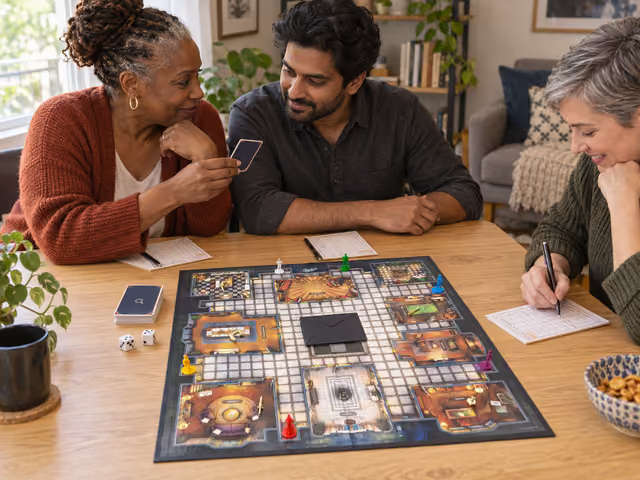
Bring the mansion board, all six character tokens, six miniature weapon tokens, six character cards, six weapon cards, nine room cards, the separate 29-card Clue deck, solve envelope, two supplied dice and one detective sheet and pen for each person. The weapon miniatures represent candlestick, dagger, lead pipe, revolver, rope and wrench; these are game pieces. Leave enough table space for the board, draw deck and private notes.
Place all six characters on their matching colored start spaces, including unchosen characters. Each person chooses a different character. Put the six weapon miniatures in six different randomly chosen rooms. Shuffle the 29 Clue cards and leave that deck facedown beside the board.
Sort the other 21 cards into characters, weapons and rooms. Shuffle each category facedown. Without anyone seeing their faces, put the top card of each category into the solve envelope and close it. Place it in the board's center. Shuffle the other 18 cards together and deal every one; unequal hands are allowed. Nobody looks in the envelope during setup.
Each player privately checks their hand and crosses off those cards on their detective sheet: a card in a hand cannot be in the envelope. Keep both cards and notes hidden. Use a high-roll start: everyone rolls one supplied die, counting a magnifying glass as 1; highest starts and tied high rollers reroll. This high-roll and tie convention is a host suggestion for the rulebook's roll-off. Turns then pass to the left.
Roll, investigate a room and compare cards
Roll and follow the Clue card
Roll both supplied dice on your turn. A magnifying glass counts as 1 for movement. If either die shows that icon, draw one Clue card, read it aloud and carry out its printed instruction; two icons still mean only one card. Return it to the bottom of the deck. Follow the card's directions about who sees any evidence card; a public reveal and a private reveal are different. Mark any card you learn, then return revealed evidence cards to their owners' hands.
Move, use a passage or stay
You may move up to the dice total through corridor squares, horizontally or vertically. Never move diagonally, revisit a square in the same turn, or move through or land on a square occupied by another character, including a blocked doorway. Enter rooms through an unblocked door; the roll need not exactly match the distance. Stop in the room you investigate. If you began the turn in a room, you may stay there to suggest again, or use its printed secret passage to the connected room. A room can hold any number of character and weapon tokens.
Make a suggestion from your room
If you reached or stayed in a room, make one suggestion naming any character, the room you currently occupy and any weapon. For example, in the Kitchen say, 'I suggest Mayor Green, in the Kitchen, with the rope.' Move that character token and weapon miniature into the Kitchen, even if somebody else controls the character. They remain there. You may name yourself, an unchosen character or cards you hold. If you end in a corridor, you cannot make a suggestion.
Ask in order, stopping after one card
The player to your left checks for the three named cards. If they have at least one, they must secretly show you exactly one; when several match, they choose which. Only you see it. If they have none, ask the next player to the left, continuing around the table. Stop at the first person who shows a card; later players do not answer. Mark the card and its owner, then return it. You may receive a card you have seen before. If everyone passes, record that too; it does not itself let you peek in the envelope.
End the turn or accuse
A suggestion gathers information and does not risk elimination. You may finish your turn, or make your separate final accusation now if ready. If the game continues, play passes left. A character moved into a room by another person's suggestion starts its next turn there and can stay to suggest from that room. Everyone can listen and take private notes on other players' suggestions, even when they cannot see the card shown.
If someone shows you the rope card, the rope is ruled out of the envelope. That says nothing definite about Mayor Green or the Kitchen. If another player shows a card to someone else, you know they hold at least one named card, but you do not yet know which.
An accusation is your one final answer
You get one accusation in the entire game. Make it on your own turn while your token is in a room, including immediately after a suggestion. You may name any room in the accusation; it need not be the room your token occupies. Clearly say you are accusing and name one character, one room and one weapon before secretly checking the envelope. Suggestions and accusations may name different combinations.
If all three match, reveal the solution and win immediately. There are no points, tied winners or equal final turns. If even one is wrong, put all three back unseen and keep the solution secret. You take no more turns, movements, suggestions or accusations, but keep your hand and continue showing cards when required by suggestions or Clue cards. You have lost, not joined somebody else's investigation.
The last player still taking turns does not win automatically: they must make a correct accusation. If everybody accuses incorrectly, the game ends with no winner. Reveal the solution together after the game. For a new mystery, collect and reshuffle all evidence by category, hide a fresh solution and reset the pieces and Clue deck.
Make the information clear and keep it private
Before the first turn, explain 'suggest to learn, accuse to finish.' Use the rope example above without revealing anybody's real hand. After each suggestion, pause so each responding player checks all three names. A matching card must be shown; passing to protect it breaks the deduction. The first responder chooses the card, including one previously shown. Do not require a fresh card or let everyone reveal one.
Start with a simple cross-off system. Add each player's initials above a column if you want to track who holds what. Write uncertainties separately from cards you actually saw. Public passes can help you later, but players after the first reveal have not passed and must not be marked as having none. Naming one or two of your own cards can help isolate an unknown card; a suggestion nobody disproves is not necessarily the solution if your own hand contains a named card.
Keep the printed Clue card at hand while resolving it. If its direction reveals a card to everyone, let everyone see and note it; if it directs a private reveal, shield it from others. Keep temporary secret-passage effects exactly as the card instructs. An icon does not give an extra suggestion, an extra turn or permission to look in the envelope.
Check room names, doorway blocks and the booklet before moving a disputed piece. This edition permits repeated suggestions by staying in a room; older remembered rules requiring you to leave are not used here. Give players time to finish notes and keep the envelope closed until a declared accusation. As a house recovery suggestion, if someone exposes a solution card or a missed compulsory reveal makes the evidence unreliable, stop with no winner and deal a fresh mystery. The official booklet does not prescribe that repair.
Soft conversation suits the main game. It requires reading cards, viewing the board and managing private notes; seated play alone is not an accessibility guarantee. Agree on any help with reading or handling pieces before dealing, while protecting private information.
Already know the game?
Ideas & Twists
Choose a variation together before you start.
Clue · See main rules
Official F6420 optionTwo-player investigation
Play with two individual detectives. After hiding the three-card solution, shuffle the other 18 evidence cards. Place four facedown, one in each of four randomly chosen rooms, and deal the other 14 as two hands of seven. For the booklet's speedier placement option, use the four corner rooms. On entering a room with a facedown card, privately inspect it and update your notes before making the usual suggestion; leave it facedown there so the other player can also inspect it later. The other detective still must show one matching card when able. Keep the Clue deck, movement, one-accusation limit and win condition. A wrong accusation still ends that detective's turns; the other must correctly solve to win. This changes the main guide's player count and deal. The booklet also names team play, but team organization is not specified here.
Clue · See main rules
House suggestionEvidence without events
For 3–6 players who want to learn the basic deduction without extra reveals, set aside all 29 Clue cards before dealing. Keep the same hidden solution and 18-card deal. Roll the supplied dice for movement, counting each magnifying glass as 1, but draw no event card. Suggestions, private one-card responses, repeated suggestions by staying in a room, one final accusation and elimination remain unchanged. This removes Clue-card effects for the entire game; it is not the printed F6420 main format.
Clue · See main rules
House suggestionChoose a room directly
For 3–6 players who prefer deduction to corridor travel, set aside the dice and all 29 Clue cards. Use the usual solution and 18-card deal. Agree who goes first and proceed to the left. Each player begins in a different room of their choice, selected in that turn order. On each turn choose any room and move your character directly there, or stay; corridors, doorway blocking and secret passages have no function in this format. Make one suggestion naming that room, then use the ordinary leftward one-card response. Suggested characters and weapons still move into the room. Make an accusation only on your own turn, from any room, with the usual one attempt and immediate result. Notes stay private and a wrong accuser still reveals matching cards but takes no turns. All other deduction and finish rules stay unchanged. This deliberately removes F6420 movement and events, and is not an official mode.
About this guide
The main rules use the physical U.S. F6420 booklet, not legacy Clue or digital rules. Main fit is 3–6 individuals; the official two-player option has its own deal. The high-roll tie convention, exposed-information restart and two other twists are host suggestions. The supplied Clue cards remain necessary for their exact effects. No numeric game-length claim or team-access guarantee is made.
Ready for something different?
Find another game →