

The quick version
Make two teams, each with one spymaster and at least one guesser. Lay out 25 words in a 5×5 grid; only spymasters see the key. Give one word and a number. Guess by touching one card at a time. Your own agent allows another guess; a bystander or enemy agent ends the turn. The first team with all its agents revealed wins. Touching the assassin immediately loses the game.
Saved on this device only — clearing your browser's cache or site data removes them (no account backup).
Set the words and hide the key
Split into red and blue teams as evenly as possible. Four people make two pairs; with an odd number, one team has an extra guesser. Each team chooses one spymaster; everyone else is an operative who discusses and guesses. Sit the two spymasters together opposite the operatives.
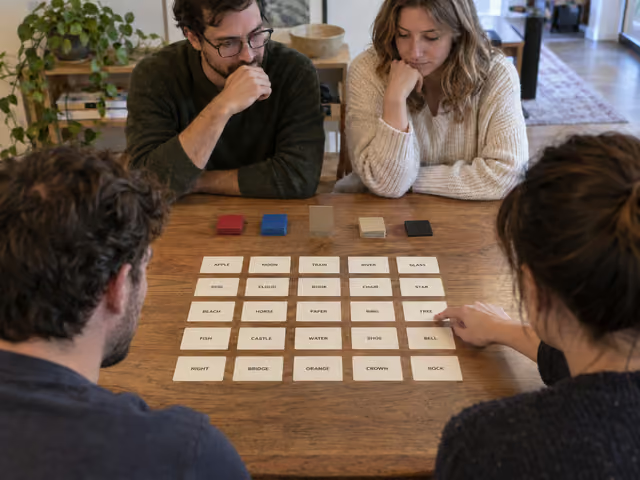
Shuffle the word deck and lay out 25 random cards in five rows of five. Everyone needs a clear view of the words. Draw one random key and put it in the stand between the spymasters, facing them only. Choose its orientation once and keep it fixed: each square corresponds to the word in that position when viewed by the spymasters.
The key's edge triangles show the starting color. That team has nine agents: eight ordinary tiles plus the double-agent tile turned to its color. The other team has eight. Place all agent tiles, seven bystanders and the assassin near the spymasters. Keep the words uncovered until guessed. No score sheet or timer is required.
Give a clue about meaning
The starting spymaster says one clue word and a positive number: the number of their team's words they intend to link. One is allowed. Use the meaning of the words, not their letters, length or position. Do not use an uncovered word, a form of it, or a component of an uncovered compound word. Once covered, that restriction ends.
Use English words, including borrowed words the group normally uses in English. One-word names and ordinary one-word compounds are allowed. Keep sound connections tied to meaning; a rhyme alone is insufficient. Multiword names, titles and abbreviations need group agreement; see the optional variation. If unsure about a clue, quietly ask the opposing spymaster before giving it. Their approval makes it valid. Spell the clue if asked.
Give no extra information through explanations, gestures, singing, accents or reactions. Repeat a clue if asked, but do not remind the team that an earlier clue has unfinished words. A correct guess earns another guess, never another clue.
Discuss, touch and reveal
Commit to one word
Operatives discuss the clue, then one touches a single uncovered card as the team's guess. Do not touch cards while merely considering them. The spymaster consults the key and covers that card with the matching identity tile. Reveal the actual identity even if the guess was unrelated to the intended clue.
Continue or stop
If it is your team's agent, you may guess again or end the turn. You must make at least one guess after a valid clue. With an ordinary numbered clue, you may make at most the number plus one guesses, provided every guess is your color. A clue of 2 permits up to three guesses. Words left over from earlier clues may be guessed at any point, including first.
Handle a wrong identity
A bystander ends your turn. An enemy agent also ends it and remains revealed for the enemy team. The assassin ends the entire game immediately: the team that touched it loses. Keep all revealed cards covered; they cannot be guessed again. If the game continues, the other spymaster gives the next clue.
Finish when the last agent is revealed
A team wins immediately when all nine or eight of its agents are covered, even if the opponent reveals its last agent. There are no running points, equal-turn finish or tie: resolve guesses one at a time. For another game, remove the tiles, flip the words or deal 25 new ones, draw a new key, and choose spymasters again.
Before dealing, say 'Imagine the words SOUP and SALAD. What might lunch, 2 suggest?' Use this spoken example to explain the word-and-number connection; no extra cards are needed. The real grid also contains enemy words, bystanders and one assassin, so a clue must be checked against all 25 words.
Keep decisions and disputes clear
Let every operative offer a thought before one person touches the agreed card. A lone operative can think aloud. Spymasters can prepare their next clue during the other team's turn, checking it against every remaining word, especially the assassin. A simple one-word connection is a useful first clue; ambitious connections can come later.
If an invalid clue is caught at once, that team's turn ends without guesses. The opposing spymaster may cover one of their own agents before giving the next clue; if that was their last agent, they win. The opposing spymaster may instead allow the clue. A clue discovered to be invalid only later stands; do not rewind completed guesses.
Use the key, rather than the intended clue, to settle identity disputes. Spymasters should wait for a committed touch before reaching for a tile. If someone accidentally shows the key or gives away an identity, this guide suggests a house remedy: abandon that game without a winner and redeal with a fresh key. That remedy is not an official penalty.
Change spymasters between games so others can try giving clues. This is a talking, reading and word-association game; a seated setup does not guarantee it suits every group's access or language needs.
Already know the game?
Ideas & Twists
Choose a variation together before you start.
Codenames · See main rules
Official expert optionUnlimited catch-up clue
Replace the number with 'unlimited'. The team does not know how many words the clue links, but may keep guessing without the usual number-plus-one cap. It must still guess at least once; a bystander or enemy agent ends the turn and the assassin still loses. Useful when the team wants to recover several missed words from earlier clues.
Codenames · See main rules
Official expert optionZero clue
Give a clue word with 0 to identify words the team should avoid. This also removes the number-plus-one cap; it does not permit passing without a guess. Operatives must find their agents through earlier clues or other deductions. Correct guesses can continue; wrong identities and the finish work exactly as in the main game.
Codenames · See main rules
Official group-agreed optionNames and abbreviations
Before dealing, agree to permit established multiword names, titles and common abbreviations as a single clue. For example, 'New York' can connect words through that place; it cannot become two unrelated clues joined together. Meaning-based clues, uncovered-word restrictions, the number-plus-one cap and the finish remain unchanged. Use this same agreement for both teams.
About this guide
The physical 2025 English word edition supplies the basic team rules and three optional clue variations. The 4–8 hosting range is this guide's supported fit range; CGE lists 4–8+ and does not impose an eight-player rules maximum. The demonstration, inclusive discussion advice and exposed-key redeal are host suggestions; only the redeal changes a game outcome. App clue permissions, Pictures and Duet are not imported.
Ready for something different?
Find another game →