

The quick version
Seat everyone around the board and choose two neighboring clue givers. They privately choose one entry on a card, place the green question mark on its main category and add picture clues. Other players may guess freely. Clue givers can say only 'Yes' to the group. A correct answer earns its first guesser 2 points and each clue giver 1. Clear the board and pass to the next pair. After 12 cards, most individual points wins; tied leaders share the win.
Saved on this device only — clearing your browser's cache or site data removes them (no account backup).
Put the pictures within everyone's view
This guide uses the physical English Concept base game with Repos Production's linked English US rulebook. That rulebook ends play after 12 cards. Older boxes may describe a different finish; agree to use this version before starting. Concept Kids Animals is a separate game.
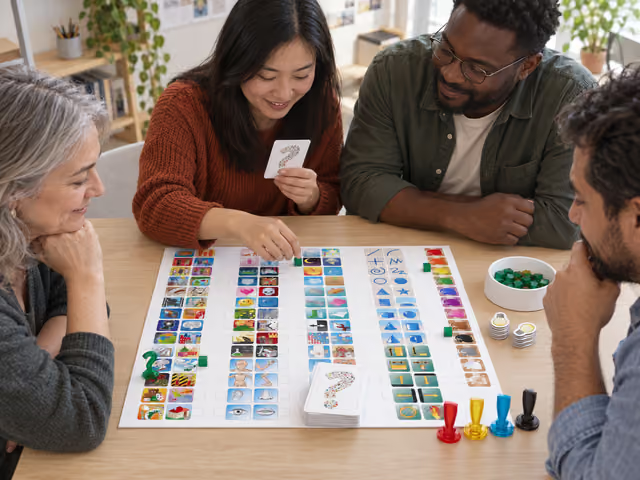
Seat 4–12 people around an indoor table with the icon board in the middle. Everyone needs to see the pictures; the active pair must reach the board. Put the shuffled Concept cards facedown on the board's deck space, point tokens nearby and the plastic pawns and cubes in the bowl. Share the player aids. The current rules list 110 cards, 47 plastic pieces, 60 point tokens, three player aids and an example sheet. No timer or score sheet is needed.
Choose two people sitting beside each other as the first clue-giving pair; everyone else guesses. Scores belong to individuals, not permanent opposing teams. For a simple rotation, this guide suggests taking the next two seats clockwise after each pair, wrapping around the table. With five people A–E, that gives A+B, C+D, E+A, then B+C. This seating order is a host suggestion; the rules allow changing partners.
Keep each completed card in a separate discard pile so you can count the 12 turns, including failed ones. Before scoring starts, show one open example from the supplied example sheet and let everyone find its pictured icons. Then clear those pieces for the real first card.
Build a main idea and related details
The pair draws one card and privately chooses one word, title or expression from it. Cards offer blue easy, red difficult and black most-difficult entries. Either partner can place pieces; quietly agree on the intended answer and your approach without letting guessers see or hear it.
Start with the green question mark on an icon showing the main category. Add green cubes on icons that describe that same idea. For a practice answer such as bee, the main category could be animal, with flying, yellow and black as its details. Cubes can be added gradually; the order of the clues and the number of cubes on an icon can matter.
Use a colored exclamation mark when you need a separate related idea, then use cubes of that same color to describe it. For bee, a red exclamation mark could introduce its connection to food, with red cubes on yellow and liquid to suggest honey. Red details belong to that red sub-concept, rather than saying the animal itself is a liquid. Blue, yellow and black sets can introduce other sub-concepts in the same way.
You may use as many of the supplied pieces as you need. Remove or rearrange pieces when an approach is not working. The aid's icon meanings are suggestions, not a fixed dictionary: a picture may stand for another related idea. Start with a few clear clues rather than covering the board at once.
Guess, score and pass the card
Guess while the clue develops
Everyone outside the pair can say guesses as pieces are placed; there is no guess limit, assigned guessing team or penalty for a wrong answer. The clue givers may say only 'Yes' when someone has the answer or is on the right track. They must not explain icons, say 'No', supply letters, mime or communicate extra hints through gestures or sounds. Discreet discussion within the pair is for choosing and placing pieces, not a spoken clue to the table.
Resolve a correct answer
When someone names the chosen answer, stop the turn. Give the first correct guesser 2 points and each member of the clue-giving team 1 point, using the supplied tokens. Confirm the answer and explain the clue afterward, when the turn is over. A clue giver cannot score as a guesser for an answer they know.
Help a stuck table
First try removing or changing pieces. If the group remains stuck, the rules allow inviting a third person to join the clue team or choosing another entry. Show a helper the secret entry privately; that person stops guessing and helps place pieces. If changing the answer, clear the board and choose another entry on the same card. If the group still cannot solve it, end the turn with no points for anyone. There is no required timer.
Clear and rotate
Put the card in the completed pile, return every pawn and cube to the bowl, and let the next pair draw a fresh card. One completed card counts as one turn even if you changed its entry, brought in help or gave up. Keep earned tokens beside their owners.
Finish at twelve cards
After the twelfth completed card, stop without starting another turn. Each person adds the values of their point tokens. Highest total wins; tied highest totals share the win. There is no official sudden-death tiebreak. For another game, return tokens and pieces, reshuffle the cards and choose a new starting pair.
Clue givers communicate through pieces, but guessers speak. Softly spoken guesses work well if everyone can hear them; Concept does not require shouting or a silent room.
Help people read the same clue
Give newcomers time to look over the icon groups and keep the player aids within reach. Ask the pair to begin with the category before adding several details. After a turn, let them briefly explain how their colored groups connected; that makes the next clue easier to read. Pick familiar entries rather than relying on a reference nobody else knows.
For word forms and names, agree before starting to accept ordinary plurals or an unmistakable full name for the same intended answer. A broad category such as insect is a helpful direction, not the answer to bee. That acceptance convention is a host suggestion. If two people appear to answer together, award the first one you can distinguish. If nobody can distinguish them, this guide suggests sharing the 2 guessing points as 1 each; the clue team still earns its normal points. The split is a house rule, not a printed tie procedure.
The current rulebook says every member of the clue team earns 1 point on success, but does not separately spell out the recruited helper's award. Agree before play to treat the helper as a current team member for that award; once shown the answer they cannot win the guessing points. If an answer is accidentally exposed to guessers, this guide suggests ending that card as a failed turn, awarding no points and passing to the next pair. That remedy is also a house rule.
Let people finish a guess before speaking over them. If speed is shutting someone out, use the guessing-circle variation. If tracking points distracts from the puzzle, use the unscored option. Choose the variation before starting so everyone knows whether a correct answer earns points and when play ends.
Already know the game?
Ideas & Twists
Choose a variation together before you start.
Concept · See main rules
Official option with a fixed host finishUnscored picture puzzles
Leave all point tokens in the box and use the same cards, two-person clues, unlimited spoken guesses and clockwise pair rotation. A solved or abandoned card goes in the completed pile, with no individual or team score. Finish after 12 cards as in the main guide; there is no winner or tie. The rulebook permits playing without points; keeping the 12-card finish makes it easy to know when this session is done. Agree on a further 12-card session if the group wants to continue.
Concept · See main rules
House suggestion for learning the boardBlue entries only
For all 12 cards, the clue pair chooses only among that card's blue easy entries; red and black entries are unavailable. A stuck pair may switch to another blue entry on the same card or recruit a helper as usual. Keep every other clue rule, individual point award, pair rotation and 12-card finish unchanged. Tied leaders still share the win. No extra supplies are needed; the change reduces obscure targets while everyone learns to read the icon groups.
Concept · See main rules
House suggestion for a group with fast callersA guessing circle
Replace free calling out with a clockwise circle among the guessers, starting immediately after the clue pair. Each guesser offers one answer or passes, then the next speaks. The pair can continue placing or changing pieces between guesses and can still say only 'Yes'. After everyone has had one opportunity, start another circuit; there is no limit on circuits. A correct guess ends the turn immediately and earns the usual 2 points; clue givers earn 1 each. If the pair gives up, award no points. Keep the same 12 cards, pair rotation and shared-win finish. No timer, paper or extra equipment is needed.
About this guide
Uses the current US rules linked from the publisher's 2026 download directory: 12 cards, individual scoring and shared victory for tied leaders. The publisher permits unscored play. Clockwise pair scheduling, simultaneous-answer splitting, exposed-answer handling, the explicit helper award, blue-only selection and the guessing circle are host conventions stated where used. Older-box endings and Concept Kids Animals rules are not combined with this format.
Ready for something different?
Find another game →