

The quick version
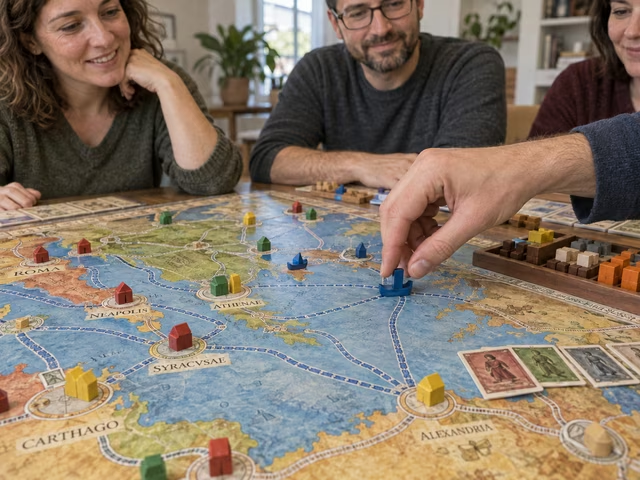
Take clockwise turns playing one personality card from hand onto your personal discard and resolving it. Tribune retrieves all your played cards including itself, pays one coin per retrieved card beyond three, and optionally lets you pay one food plus one tool to place a stored colonist in Roma. Architect gives total movement equal to your colonists on the board, divided as you like. Land colonists use brown routes and ships blue.
Saved on this device only — clearing your browser's cache or site data removes them (no account backup).
Prepare the table
Use Italia for two to four players or Imperium for three to five. Randomly place city tiles on matching lettered cities, omitting D tiles on Italia, then reveal their goods. Give each province the bonus marker for its most valuable city good: brick, food, tool, the wine, then cloth in ascending order. Use its goods face.
Keep card decks I through the player count, shuffle each separately, then stack I on top followed by II and so on. Reveal seven cards in the market. Everyone takes fifteen houses, seven starting personality cards and a storehouse. Place one land and one sea colonist in Roma; two more of each occupy four storehouse spaces. Add two food and one each of the other four goods. First player receives five coins, next six, then seven and so on; last player holds Praefectus Magnus.
Play a turn
Take clockwise turns playing one personality card from hand onto your personal discard and resolving it. Tribune retrieves all your played cards including itself, pays one coin per retrieved card beyond three, and optionally lets you pay one food plus one tool to place a stored colonist in Roma.
Architect gives total movement equal to your colonists on the board, divided as you like. Land colonists use brown routes and ships blue. A step leaves a city for a route, or crosses a city to the next route; pass occupied routes but do not end on one. After movement, build in cities adjacent to any of your colonists. You cannot build in Roma or repeat your own house in a city. A brick city costs one food; other cities cost one brick and one of that city's good. Base coin costs are one through five in the same commodity order. Multiply only the coin cost by the number of houses the city will contain after yours.
Prefect either produces one province whose marker still shows goods, or collects cash. Production flips that marker, gives you its pictured bonus good, and gives every house owner one good for each of their houses there. Cash gives you every visible coin on province markers, then resets all to goods. If you hold Praefectus Magnus when producing, take twice the bonus good and pass the card to your right; house production is unchanged.
Mercator gives the printed coins, then lets you buy or sell any quantities of up to two goods types at the prices on your storehouse. Senator buys up to two market cards, paying both each card's printed cost and its market-position surcharge, then refills and closes gaps. Purchased cards go into your hand. Diplomat copies another player's top discard, except Diplomat or Tribune.
Purchased specialists produce their named good in all your matching houses. Colonist either builds colonists for one food and one tool each in Roma or your cities, or pays five coins plus one per colonist already on the board. Consul buys one market card for its printed cost without the position surcharge. Goods and undeployed colonists each occupy one of twelve storage spaces; never exceed that capacity, and you cannot simply discard stored goods. Keep the printed card and building references available.
Finish and score
Buying the final market card or building your fifteenth house gives you the seven-point Concordia card and ends your turns. Each opponent then gets one final turn. Gather every personality card you own, including discards, and score each printed deity: Vesta gives one point per ten coins of cash plus goods sold at standard prices; Jupiter one per non-brick city with your house; Saturn one per province with your house; Mercurius two per type of good your houses produce; Mars two per deployed colonist; Minerva the printed specialist value per matching house. Apply each card separately, so repeated symbols multiply that category.
Add the Concordia bonus. Highest total wins; tied players use the Praefectus Magnus order, starting with its holder and proceeding in the direction it is passed.
Host the first game
The Reddit discussion highlights that map density changes the feel, especially at two players, and that end-game multipliers can be harder to grasp than individual turns. Use the supported smaller Italia map for two and show one sample score before the opening turn. Province production benefits other owners too, making timing worth watching.
Already know the game?
Ideas & Twists
Choose a variation together before you start.
Concordia · See main rules
Original STUDplay house twistOpen scoring hand
Keep unused personality cards face up in a personal row, with played cards in a separate discard. Choices and card collection become public; playing and retrieving them work normally.
Concordia · See main rules
Original STUDplay house twistEarly expansion fund
Give every player three extra starting coins. Goods, starting order compensation and all card prices remain unchanged.
Concordia · See main rules
Original STUDplay house twistLimited architect
An Architect action may build at most two houses after movement. Movement allowance and house prices remain unchanged.
Concordia · See main rules
Original STUDplay house twistPatient market
During setup put the top three unused market-deck cards face up beside the draw pile as a preview. They cannot be purchased there. Refill the market from the leftmost preview and refill the preview from the deck, preserving card order.
Concordia · See main rules
Original STUDplay house twistFlexible first cargo
Before the first turn, each player may exchange one starting good for another of equal or lower printed sale value. Take from the bank; no coins change hands. This happens once, in turn order.
About this guide
Requires the named physical game and its supplied components. Rules are paraphrased teaching guidance; keep the box's cards and reference diagrams beside the table. Original STUDplay house twists are optional, untested suggestions rather than publisher rules. Agree one before setup; unchanged rules still apply.
Ready for something different?
Find another game →