

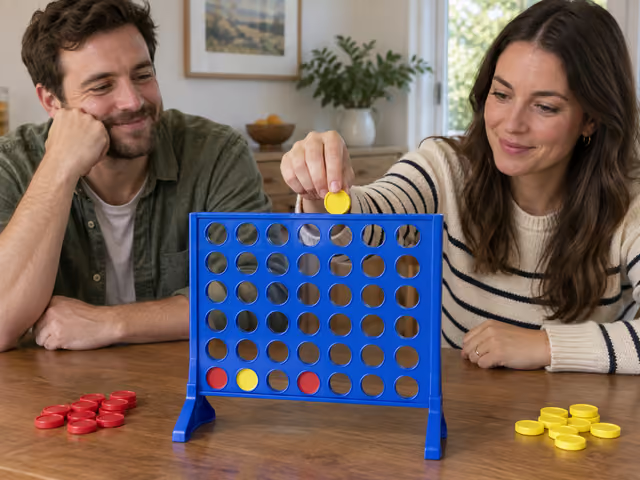
The quick version
Take turns dropping one disc of your color into a column with room. First to four touching discs in a straight horizontal, vertical or diagonal line wins immediately. A full grid with no winning line is a draw.
Saved on this device only — clearing your browser's cache or site data removes them (no account backup).
Stand the grid and choose colors
Use the Classic A5640 set: one grid, two support legs, a slider bar, 21 red discs and 21 yellow discs. Insert the bar along the grid's bottom and fit a leg to each side using the included assembly instructions. Close the bar so it holds the discs. Put the empty grid upright on a stable table where both players can see its face and reach the top slots; leave room to collect released discs.
Each person takes one color and all 21 of its discs. The A5640 sheet gives the youngest player the first turn. If ages are tied, choose an opener by agreement; a coin flip is a suggested house tie-break. Announce colors and opener before dropping anything.
The main game has two players, one disc per turn and no timer or running point score. Connect 4 Spin, Blast, Frenzy and Pop Out use different equipment or mechanics; use their own instructions rather than adding those moves here.
Drop, check and take turns
Make the first drop
The opener releases one disc of their color through any top slot with space below it. It falls to the lowest empty position in that column. You choose the column, not an empty hole halfway up the board.
Give the other player a turn
The opponent drops one disc, then turns alternate. A column holds six discs; once full, choose another. Do not pass, move a settled disc or pull the slider during play. Before releasing, check whether either color can complete a line with its next legal drop.
Check for four after every drop
Four of the same color must touch in one straight line: across a row, up a column, or diagonally in either direction. A gap, bend or intervening opposing color breaks the line. A legal drop that completes a line wins immediately; the opponent does not get a reply. Completing two lines at once is still one game win.
Finish a draw or reset after a win
If all 42 positions fill without a line, the game is a draw. Check the final drop for a win before calling it a draw. Confirm the result together before clearing. The winner slides the bottom bar sideways to release the discs; after a draw, either player can clear it. Sort colors, close the bar and start with an empty grid for another game.
Three yellow discs on a diagonal are not an immediate winning threat if the fourth position has empty space beneath it. A drop lands at the bottom of that space first. Look at the actual landing position before deciding which column blocks a win.
Keep the board and result clear
For a first explanation, make one unscored drop into an empty column, then a second into that same column to show stacking. Clear both and close the bar before the game. Ask each player to point out a horizontal, vertical and diagonal direction. Save spectator move advice until the result, unless both players agreed to a teaching game.
For a disputed line, stop and trace four same-color positions before touching the pieces. Diagonals count in both directions; circles that only appear close do not count across a gap. An attempted drop into a full column has not placed a disc: pick an open column on the same turn. A poor choice that settles legally stays played.
Agree this friendly house remedy before starting: if someone drops out of turn, uses the wrong color or accidentally opens the bar, restore the last agreed legal position and continue with the correct player. Remove or rearrange pieces only to make that correction. If both players cannot reconstruct it, restart the game with the same opener and no result recorded. This is a house recovery policy, not an A5640 penalty rule.
For a standard rematch, use the A5640 youngest-player opener again; alternate starts only if you choose the match variation below. More friends can use separate sets or the partners variation. They do not become extra colors in the two-player game.
Already know the game?
Ideas & Twists
Choose a variation together before you start.
Connect Four · See main rules
Suggested house variationTwo-game match
Play exactly two ordinary games, giving each player the first drop once. Keep colors, empty and close the grid between games, and award one match point for a win or half a point each for a draw. The higher total after game two wins the match; equal totals are a shared match result. This replaces the youngest-player opener and lets both people start.
Connect Four · See main rules
Suggested house variation · adapted from Board Game Arena's pie ruleSwap after the opening drop
After the opener drops one disc, the second player chooses either to keep their color and make the usual next drop, or to exchange colors and the remaining disc piles. If they exchange, the opening disc stays where it landed, and the original opener now drops the other color. The swap itself uses that decision turn; do not add another disc for the player who chose to swap. Continue normal alternating drops, line wins and full-board draws. This option exists only immediately after the first disc.
Connect Four · See main rules
Suggested house variationFour-player partners
Make two pairs, each sharing one color and its 21 discs. Choose a lead player in each pair and choose the opening pair by agreement. If Red opens, turns are Red lead, Yellow lead, Red partner, Yellow partner, then repeat. Teammates may discuss their choice, but only the scheduled player releases the pair's one disc. First line wins for the pair; a full grid without one is a shared draw. For a rematch, clear the grid, let the other pair open and exchange lead roles within both pairs. This needs four people and replaces individual turns and the youngest-player opener; the main guide's people count remains two.
About this guide
Hasbro's current A5640 download supplies the set, assembly, youngest-player opening, alternating single drops, line wins and slider reset. Board Game Arena corroborates gravity and the full-board draw and describes the optional pie opening. Tied-age selection, error recovery, match scoring and partner turns are explicit house choices. The pie rule is a house adaptation for this physical set, not part of its Hasbro rule sheet.
Ready for something different?
Find another game →