

The quick version
Give each singles player 8 discs, or each doubles player 6. Take clockwise turns flicking one disc from your own outer shooting arc. With opponents on the board, your color must hit their color; without opponents, a disc involved in the shot must finish in or touching the inner 15 circle, or sink a 20. Clear invalid shots and collect valid 20s separately. After everyone uses their discs, total each color's surviving discs and 20s. The higher total earns 2 game points; a tied round earns 1 each. Compare game points after four rounds.
Saved on this device only — clearing your browser's cache or site data removes them (no account backup).
Seat the players and count the discs
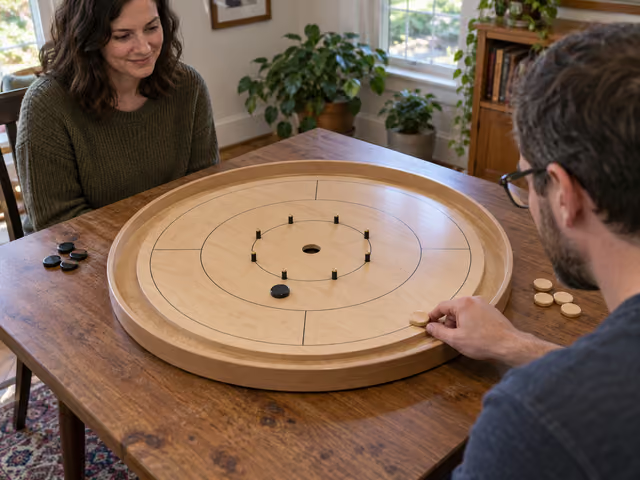
Put the board on a steady, level table with room for everyone to reach their shooting arc. The center hole is worth 20. Moving outward, the scoring regions are 15 inside the peg circle, 10 in the next ring and 5 in the outer ring. The recessed ditch around the playing surface holds eliminated discs. Keep drinks and loose objects away from the board.
For two players, sit opposite each other and take different colors, 8 discs each. For four, make two teams: partners sit opposite, share a color and take 6 discs each. The seats therefore alternate colors around the board. Three players are not covered by this guide's main format. Do not add a fifth active seat.
Leave a separate, visible place beside the board for each color's successful 20s. An optional pair of bowls helps, but separate piles work. Make a paper score sheet with four round rows and one column per side. Choose the first shooter by a mutually agreed chance method, such as drawing one disc from a concealed pair of colors.
This guide uses the National Crokinole Association's finger-shooting format: 8-disc singles, 6-disc-per-person doubles and a four-round game. Crokinole is traditional equipment, not one required branded boxed edition. Other supplied rule sheets can use 12-disc singles or different match scoring; use the labeled traditional variation rather than mixing formats mid-game. Use the board as prepared according to its maker's care guidance. This home guide does not require tournament wax, cue accessories, a timer or an app.
Start a shot from your own arc
Wait until every disc from the preceding turn is still. Set one unused disc flat and stationary, touching the outer boundary circle in your own quadrant. It may touch the quadrant divider as well as that circle. Flick it with one or more fingers; do not push it along, pick it up and throw it, or use a cue. Once the set disc leaves your finger, the shot counts even if it barely moves.
Keep part of your backside on the chair, all chair legs on the floor and the board and chair in place. Only your shooting hand, wrist and forearm may touch the board or table during your shot. Other players keep hands off the table and board and do not position their next disc until the turn is over. Set comfortable seating before the first round; do not tip the chair or shake the table for a better angle.
Let each person try a few unscored flicks. First show a clear board and aim into the inner circle. Then put one opposing disc on the board and demonstrate contacting it. Remove the practice discs and reset everyone's full allocation before the first scored round. This is teaching advice, not an extra scored turn.
Check contact, then clear the shot
Check for an opposing disc
Look before you flick. If any opposing-color disc is in play, one of your color's discs must actually hit an opposing disc. Your new disc can hit it directly, or knock one of your own discs into it. Hitting only your own disc or a peg is insufficient. A valid contact shot does not also need to finish inside the 15 circle; your shooting disc can even go out after making contact.
Use the open-board rule when there is no opponent
If no opposing disc is in play, your new disc or another disc struck in that shot must stop in or touching the 15 circle, or lie flat in the center hole. That includes a shot which bumps your own disc into the inner circle. An open shot stopping only in the 5 or 10 region fails, even if it looked well aimed.
Remove an invalid shot
If the applicable requirement was missed, remove the shooting disc and every other disc struck in that shot, including your own discs moved through a chain of collisions and any 20s made by that shot. Put them in the ditch; they score nothing. Leave untouched discs where they are. Earlier 20s already collected are unaffected. No replacement shot is allowed in the main game.
Resolve a valid shot
After motion stops, remove each disc lying fully flat in the center hole to its color's separate 20 pile. A disc hanging on the hole's lip is not a 20. Clear out-of-play discs to the ditch before the next turn. Discs resting on the outer boundary are out, but inner scoring-line contacts remain in play. Use the rebound exceptions below for discs that briefly travel outside and return.
Give the next player one shot
Continue clockwise, one unused disc per turn. In singles the two players alternate. In doubles all four shoot in seat order, so colors alternate. Do not replay discs from the ditch or the 20 piles. Finish the round only after everyone has used all their allocated discs: 16 shots in singles or 24 in doubles.
Count board points, then game points
After the last shot settles, count both sides before touching surviving discs. Add 20 for each disc in that color's 20 pile, plus 15, 10 or 5 for each disc still on the board. A disc touching a boundary between scoring regions gets the lower value. A disc touching the 15/10 line scores 10, even though that line was enough to make an open shot valid. When judging a flat disc, use its bottom edge against the line, not its apparent upper overhang.
Example: black has two collected 20s and one disc in the 10 ring, totaling 50. Natural wood has one collected 20 and two discs in the 15 region, also totaling 50. That round is tied. Contacting or knocking out an opponent earns no separate points; only the final board and collected 20s determine the total.
The higher board-point total earns 2 game points and the other side earns 0. Equal board-point totals earn 1 game point each. Record these small numbers on the score sheet; do not carry the raw totals forward. Now clear the board and both 20 piles, return the full starting allocation and begin the next round.
In singles, change the starting player each round. In doubles, move the starting seat one player clockwise each round; keep the same partners and seats throughout the game. After four complete rounds, the side with more game points wins. A 4–4 finish is a draw in this home guide. Agree before starting if you want another complete game; there is no unannounced one-shot tiebreak. For a new game, alternate the starting side.
Settle rebounds and help new shooters
A disc crosses the outer circle. Normally it is out. The NCA spinning-disc exception keeps it in play if it returns under its own momentum without hitting anything except the playing surface while at or beyond that line. If it hits the ditch, rim or an eliminated disc and bounces back, remove that returning disc. On an otherwise valid shot, other discs it moved stay in their new positions and other discs it sank still count as 20s. An out-of-play returning disc cannot itself score a 20. These exceptions do not rescue a shot that failed the contact or open-board requirement.
A shot hit your own disc, then the opponent. That is valid contact. If it never reached an opponent, remove the shooting disc and the own-color discs it struck, including newly sunk 20s. A peg rebound can be used, but hitting a peg alone never meets the opposing-disc requirement. In the unscored demonstration, point out the opponent's disc before the learner tries the contact shot.
A disc or the table is accidentally moved. Pause immediately. The NCA page does not supply a complete home remedy for every accident. This guide suggests restoring a position only when everyone agrees on where it was; otherwise restart that round with its same starter and no round points. This is an explicit house remedy, not a tournament ruling.
At four players, pair a new shooter with someone who knows the rules when practical. Under NCA play only that person's partner may coach during the round; singles has no coaching during play. Use the unscored demonstration for instruction before starting. Some groups prefer standard rules from the outset; use the optional retry only if everyone wants it. Change partners between games, rather than during a scored round.
Choose a table everyone can reach comfortably and check that each person can see disc colors and scoring lines. Seated play is not a promise of access for every hand, reach or vision need. Crokinole needs its own board and has audible disc and peg impacts; it is not an equipment-free or silent activity.
Already know the game?
Ideas & Twists
Choose a variation together before you start.
Crokinole · See main rules
Manufacturer-documented scoring formatTraditional race to 100
Before starting, replace the four-round game with cumulative score differences to 100. In singles give each player 12 discs instead of 8; doubles stays at 6 each. Keep this guide's shot legality, turn order, boundary rules and starter rotation. After a full round, combine surviving board points and collected 20s, subtract the lower total from the higher, and add only that difference to the winner's running score. A tied round adds 0 for both. Clear the board and refill discs each round. First side to reach at least 100 after scoring a complete round wins; do not stop at a sunk 20. The differential method lets only one side advance in a round, so no simultaneous finish tie occurs. This uses Woodestic's documented allocation and differential scoring with the NCA shot rules stated here; it does not import every Woodestic optional rule.
Crokinole · See main rules
House teaching optionOne clean-miss retry
Before the game, agree that every player gets one optional retry per round, with no unused retries carried forward. A retry is allowed only after an invalid shot that touched no other disc and changed no other disc's position; touching a peg alone does not disqualify it. Retrieve just that shooting disc, put it back on the same legal starting spot and try once more. The second attempt uses that same disc and consumes the normal turn, whether it succeeds or fails. No retry follows a valid shot or any shot that hit another disc, including your own. Mark a used retry on the score sheet. All other allocations, shot requirements, clearing, scoring and the four-round finish stay unchanged. This is optional help, not an NCA permission or a guarantee that newcomers need a handicap.
Crokinole · See main rules
House cooperative practice challengeTogether against the center
For 2 or 4 people, replace opponent play with a shared target of four sunk 20s in 16 attempts. Start with a clear board. Keep legal shooting arcs and seated finger flicking; take turns clockwise, one attempt each, until the group has made 16 total attempts (8 each for two people, 4 each for four). Remove the shot disc after every attempt, successful or not, so the board is always clear for the next person. Reuse it on a later turn if needed; regular per-round allocations and mandatory opponent contact do not apply. Only a disc flat in the center hole adds one success; the rings add nothing. Keep a paper tally of attempts and successes. Finish all 16 attempts, then compare successes with four: reaching the target is a shared win, otherwise keep the result as the group's score to beat. This changes the game to a practice challenge and is not official match scoring.
About this guide
Main mechanics follow the NCA rules hosted by Tracey Boards, reviewed October 2, 2026. This is home finger play using their 8-disc singles, 6-disc doubles and four-round scoring structure, not a claim of full tournament compliance. Tournament wax, timed-match procedure and event-specific match lengths are outside this format. The draw finish and accident remedy are explicit home choices. Woodestic documents 12-disc singles and differential-to-100 scoring; the traditional twist combines those with the main guide's NCA shot rules. Practice, teaching and retry advice draws on opened community discussions, not representative research. The retry and cooperative target are house suggestions. No purchased brand, price, popularity, whole-game minutes or blanket accessibility claim is made.
Ready for something different?
Find another game →