

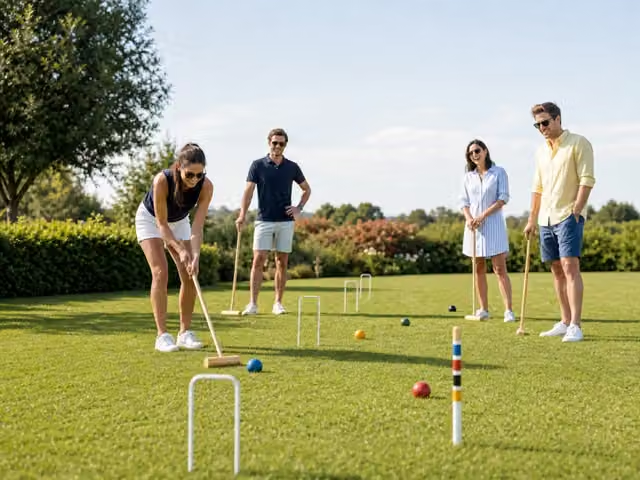
The quick version
Blue and black face red and yellow. Play blue, red, black, yellow repeatedly. First ball through the current hoop in its correct direction scores one for its side; everyone then contests the next hoop. Keep playing until one side has four.
Saved on this device only — clearing your browser's cache or site data removes them (no account backup).
Lay out six hoops
Mark a rectangle four equal units wide and five long. A suggested 3-yard unit makes a 12-by-15-yard garden court. Call the far end north and the right side east.
Measure from the southwest corner in units east, north: hoops 1–6 at (1,1), (1,4), (3,4), (3,1), (2,1.5), (2,3.5); peg at (2,2.5). Openings face north–south. Run 1 and 2 northward, 3 and 4 southward, 5 and 6 northward. Mark numbers and directions.
Singles players control two balls each; doubles players one. Toss a coin to choose first or second; first side gets blue/black. Introduce blue, red, black and yellow from within one yard of the southeast corner in the first four strokes. Aim at hoop 1. First to four wins; at 3–3, contest hoop 1 northward again. The peg is only an obstacle.
One stroke, one shared target
Follow the color order
Play from where each ball lies in blue–red–black–yellow order. Strike your assigned ball with the mallet's end face. Running a hoop or hitting a ball gives no extra stroke. A clean swing that misses can be tried again.
Compete for the current hoop
Approach, block a path or knock another ball away by striking your own ball into it. A hoop scores when the ball has entered from the correct side and no part remains protruding from that side at the end of the turn. A ball can finish passing through over several turns. Knock an opponent's ball through and its side gets the point.
Move on without resetting
After a point, leave all balls where they finished and target the next hoop. Continue with the next color. If two balls run the same hoop in one stroke, the one initially nearer scores it. First side to four wins at the turn's end.
Replace a boundary ball
If any part of a ball crosses the boundary, return it touching the inside edge where it went off before its next stroke. If another ball prevents placement, wait until it moves, or place the returning ball on the boundary touching it if the returning ball must play first. Do not award a point for hitting the peg.
Watch advancing too early
When a hoop scores, a ball more than halfway toward the following hoop may be offside. It is exempt if it got there in that scoring stroke, from an opponent's stroke or contact with an opponent's ball, or from a penalty-area direction. Otherwise the opponent may send it to a one-yard-radius penalty area at the midpoint of either long boundary; play it from there next turn.
Make order and remedies clear
Keep scores visible. Agree this friendly wrong-ball remedy: stop before the next stroke, cancel the error and its points, restore moved balls and play the correct ball.
A faulty stroke ends the turn; the opponent chooses to leave balls or restore them. Only the opponent can score from a fault, if balls are left. Faults include body/clothing contact, mallet contact with another ball, double hits and crushing a ball against a hoop. Keep observers clear of swings. Reset by reintroducing all balls from the starting corner.
Already know the game?
Ideas & Twists
Choose a variation together before you start.
Six-wicket croquet · See main rules
Suggested house variationThree-hoop match
Use the same court but contest only hoops 1, 2 and 3 in their listed directions. First side to two points wins, so there is no tied finish. Keep color order, one stroke, boundary and offside rules. This is a shorter Golf Croquet match, not a race in which each ball completes its own course.
Six-wicket croquet · See main rules
Suggested house variationNo-contact approaches
Keep the seven-point match, but make contact between balls a house fault: restore every ball moved by that stroke, award no hoop point and pass to the next color. You may position your ball to block a path but must aim around others. First to four still wins. This shifts attention from clearance shots to placing and running hoops.
About this guide
Golf Croquet uses this six-hoop layout. Croquet England and WCF rules support the short game and mechanics. Garden dimensions, fixed friendly wrong-ball handling and variations are suggestions. Association and nine-wicket croquet use different rules.
Ready for something different?
Find another game →