

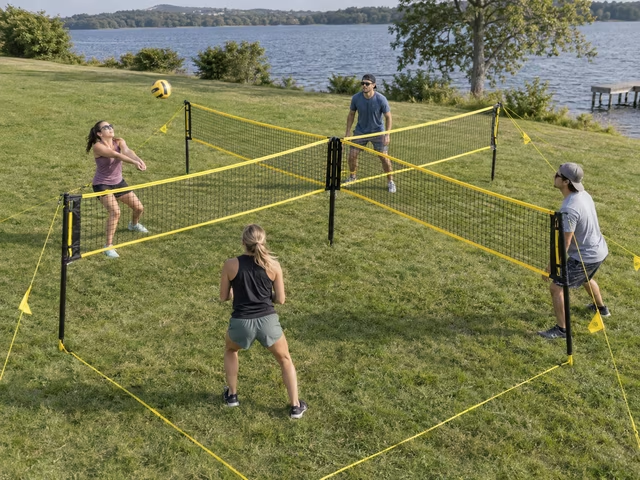
The quick version
Square four serves diagonally to square two. Return the ball over a net to any other square with one hit. The person who lets it land in their square or makes a fault moves to square one; players below their old position move up. Square four earns one whenever someone else loses the rally.
Saved on this device only — clearing your browser's cache or site data removes them (no account backup).
Get the game ready
Assemble the complete set exactly as its instructions specify, including all anchors. Choose a permitted net height everyone can use, then keep it fixed for the game. Make guy lines clearly visible and keep their anchor area outside players’ movement paths. No play on a surface where the set cannot be secured.
Label the four squares 1–4 with 4 diagonally opposite 2. Draw numbers for starting places. Each person begins with zero points and carries that personal score when changing squares. Play controlled hits with no hard spikes or blocking in this beginner house session.
Play the first game
Serve diagonally
The player in four announces all scores and serves underhand from behind their outer boundary into square two. There is one attempt. A failed serve makes the server lose the rally. The receiver returns with a normal hit; no immediate attacking spike.
Use one contact
When the ball enters your square, strike it once over the net into another square. Do not catch, carry or hit twice. Do not reach into someone else’s square to play their ball, cross under the net or touch the net. A boundary line counts in for this house game; an uncertain shared-line landing is replayed.
Name the fault
If the ball lands in a square, its owner loses. If a hit lands outside the whole court, fails to cross over a net or is an illegal contact, its hitter loses. Stop immediately after the fault. If the player in four did not lose, they add one point.
Promote and reset
The losing player moves to one. Only players in lower-numbered squares than that player’s former square move up one; higher-numbered players stay. For example, if three loses, one becomes two, two becomes three and four stays. With all places settled, four serves again.
Eleven points with a two-point lead
The first person to at least eleven and at least two ahead of every other player wins. Otherwise keep playing with scores unchanged by rotations. Pause for a clear score check if a player is close. A rematch begins at zero with newly drawn starting squares.
Help everyone get started
Explain promotion using one pretend fault before the first serve; it prevents the common mistake of rotating everybody. Keep early hits high enough to read. A first-person adult review found that understanding how to rally against the scoring square improved the game, and also flagged hard-to-see support cords; inspect those before play.
Already know the game?
Ideas & Twists
Choose a variation together before you start.
CROSSNET · See main rules
Suggested house variationCatch the first reception
Only square two may catch the serve, then must toss it overhead into another square within three seconds from where it was caught. All later contacts are one-hit volleyball. Use the same promotions and score target; this opens the rally without making every return a catch.
CROSSNET · See main rules
Suggested house variationClockwise circuit
After the diagonal serve to two, the next legal destinations are three, four, one, two, repeating. A hit to any other square loses the rally. Keep the top-square scoring and promotion rules. Players can prepare for the next destination while choosing depth and pace.
CROSSNET · See main rules
Suggested house variationEveryone can score
Every player who survives a rally adds one point, including people who never touched the ball. Promote as usual, but finish when someone reaches fifteen with a two-point lead over all others. Protecting your square now builds a score even before reaching four.
CROSSNET · See main rules
Suggested house variationTwo contacts
Allow each person up to two distinct hits before sending the ball on; catching and carrying remain faults. Use the same service, promotion and eleven-point finish. A first controlled touch creates a deliberate second shot.
About this guide
The main uses the singles instruction booklet, not the three-touch doubles tournament page. Underhand-only serves, no spikes/blocks, boundary clarification and the exact two-point margin over all opponents are explicit house clarifications. All five variations are editorial.
Ready for something different?
Find another game →