

The quick version
Each side starts at 501. Take turns throwing up to three darts and subtracting their total. Finish exactly on zero with a double or the 50-point inner bull. Going below zero, leaving 1, or reaching zero without a double busts the whole visit: restore the score you had before it and stop throwing.
Saved on this device only — clearing your browser's cache or site data removes them (no account backup).
Prepare the board and choose sides
Use a standard numbered 1–20 bristle board and steel-tip darts. Secure the board with its mounting hardware, with 20 at the top and the centre bull 1.73 metres (5 feet 8 inches) above the floor. Follow the board maker's mounting instructions. Light the whole face clearly and protect the wall and floor from misses.
Measure 2.37 metres (7 feet 9¼ inches) horizontally from the board's front face, not the wall. Mark that boundary with floor tape; stand entirely behind its board-facing edge. This taped boundary replaces the DRA's raised oche, or throwing stop. Leave room behind it to stand and beside it to walk back after collecting darts. Keep the lane clear of furniture, door traffic and other people. A cramped room is unsuitable even if a board fits on the wall.
You need three intact steel-tip darts, which everyone may share; personal sets are optional. For a newly installed board, have its mounting hardware, a tape measure and floor tape ready. Put two names or team names on paper, each with 501 underneath. Keep a running record of each visit total and the new remainder. A scorer or extra spectator is optional, not an extra player.
Give each person one unscored practice visit. Point out a single, a double, a treble and both bulls. Flip a coin to choose the opening side. For four players, label that pair A1/A2 and the other pair B1/B2; each pair chooses which partner is 1. Each pair shares one 501 total. Use the fixed order A1, B1, A2, B2, then repeat; each person gets a complete three-dart visit. Do not split one visit between partners. This is the guide's friendly pairs arrangement, not a separate tournament rulebook.
Say the format aloud before the first scored dart: 501, straight in, double out, one leg. Any scoring segment counts from your first throw; you do not need a double to start.
Throw, subtract and check out
Take the first visit
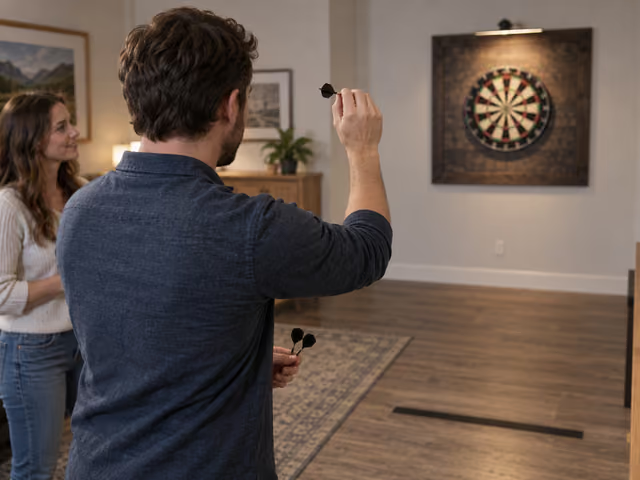
The opener stands behind the line and throws one dart at a time, point toward the board, with an overarm throw. Aim at any scoring segment; you need not announce a target. Throw up to three darts, stopping immediately for a bust or valid finish. Everyone else waits behind the thrower. Leave darts in the board until the visit is scored; touching one during your visit ends that visit.
Read where each point landed
A broad single area scores the printed number. The thin outer ring doubles it; the thin inner ring trebles it. Outer bull is 25; inner bull is 50. Outside the outer double ring is zero. Read the dart's point, not its flight or shaft. A bounce-out or dart that falls before retrieval scores zero and cannot be thrown again. A dart dropped before you begin throwing may be picked up and used.
Record the new remainder
Add the scoring darts and subtract from your side's remaining total. Treble 20, single 20 and single 5 total 85, so 501 becomes 416. Agree the total and subtraction while the darts remain visible, then retrieve them. Wait until the collector has returned behind the line before the other side throws. In pairs, follow the fixed player order and subtract from the shared team total.
Handle a bust immediately
If any dart takes the remainder below zero, leaves exactly 1, or reaches zero on something other than a double or inner bull, stop: the entire visit scores zero. Restore the remainder from before that visit, including points from earlier darts in it. Starting on 32, single 16 leaves 16; another single 16 reaches zero without a double, so the visit busts and you return to 32. You do not keep the first 16 or use your third dart.
Finish on a double
From 40, double 20 wins; from 32, double 16 wins. From 50, inner bull wins, but outer bull leaves 25. Odd remainders need a setup dart: from 17, single 1 leaves 16, then double 8 wins. A missed double that scores zero lets you try again with a dart still available. A single hit changes the target: from 40, single 20 leaves 20, so double 10 now wins. Stop as soon as a valid finishing dart lands; unused darts are not thrown.
From 20, single 20 busts; double 10 wins. Leaving 1 also busts immediately because no double is worth 1. An accidental double that gives the exact required finish still wins.
Confirm the result and settle close calls
The first side to reach exactly zero with a valid double wins the leg. Confirm the finish before removing the darts. There is no equal-turn reply, score tie or win-by-two rule: the other side does not get another visit. A finishing dart that falls out before retrieval does not count; recalculate using the darts that remain. If there are darts left in that visit and it has not otherwise ended, the thrower may continue after the lane is clear.
For close segment calls, pause and inspect the point with both sides before moving anything. A dart whose point never reaches the scoring face is zero, even if it hangs from another dart. A line-fault dart is spent and scores zero. Keep it in place until the visit is scored so retrieving it does not end the visit early. If a player throws out of the agreed order, use this house remedy: stop, remove those darts, leave both scores unchanged and resume with the correct player.
For this friendly format, correct arithmetic before the next visit begins. If an unresolved landing dispute cannot be settled before retrieval, use this house remedy: restore that side's pre-visit score and replay its entire visit. Do not replay agreed misses or busts. These remedies replace formal referee and scoring-appeal procedures. Keep the recorded visit totals so corrections can be checked rather than guessed.
Help with counting between visits and leave the thrower a clear, quiet moment to aim. Extra friends can take over in the next leg; three or five active players are not part of this format. To play another leg, reset both totals to 501 and let the other side open. For a best-of-three match, alternate opening sides and stop when one side has won two legs; at 1–1 the third leg decides it. Change to a variation only between legs, with everyone agreeing first.
Already know the game?
Ideas & Twists
Choose a variation together before you start.
Darts 501 · See main rules
Suggested house variation301 double out
Change each starting total from 501 to 301. Keep straight in, three-dart visits, the same bust rule and double-out finish. Do not add double in just because the starting number changed. This brings the finishing decisions earlier without removing them.
Darts 501 · See main rules
Suggested house variationStraight-out introduction
Keep 501 but allow any scoring segment to make the exact zero finish. Reaching 1 is now legal: a single 1 can finish on a later dart. Only going below zero busts the visit, restoring its starting remainder and ending the turn. Singles, doubles and trebles retain their usual values. Agree this before the leg; it replaces double out rather than relaxing it only after someone struggles.
Darts 501 · See main rules
Suggested house handicap301 against 501
In singles, let the less experienced player start on 301 and the other on 501. Both still use straight in, three-dart visits and double out, with the normal bust rule. Record the unequal starting totals before throwing and keep them for the whole leg. Review the handicap between legs; it is an agreed head start, not a guarantee of an even contest.
About this guide
Scoring and steel-tip play follow DRA Rules 2026, sections 6.2–6.5 and 6.7. This is a friendly one-leg format, not a sanctioned event: a coin flip, taped boundary, paired visit order, prompt arithmetic correction and disputed/out-of-order visit remedies are explicit house arrangements. Variations and practice advice are suggestions. Electronic soft-tip rules are not covered.
Ready for something different?
Find another game →