

The quick version
Set up scenario 1 and secretly read your conditions. Alternate one change to the house, then hear your partner’s positive, negative or neutral reaction. Say when all your conditions are fulfilled. Both fulfilled at once wins. At the end of rounds 15, 20 and 25, each reveals one condition. Stop after round 30 if the house is still unsolved.
Saved on this device only — clearing your browser's cache or site data removes them (no account backup).
Start with the first house
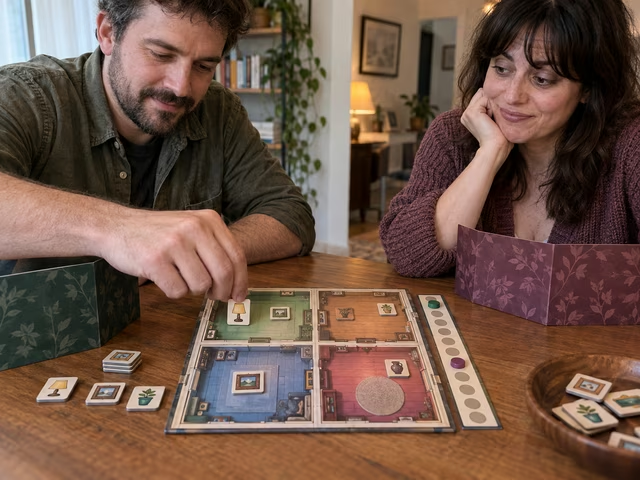
Place the house and object boards between two players. Sort object tokens by their printed type and style and put wall colors nearby. Set the two-player track to round 1 and place three heart tokens face up. Open scenario 1, keep conditions private and copy the setup card’s room colors and objects exactly.
Each room always has one wall color and can hold at most one lamp, one curio and one wall hanging in their marked slots. Objects have type, color and style; walls have only color. Red and yellow are warm; blue and green are cool. Read your own conditions carefully without showing them.
Change one thing and read the reaction
On your turn, do one action: add an object from supply to its empty matching slot; remove one object to supply; replace one object with another of the same type from supply; or repaint one room by replacing its wall-color token. You cannot move an object between rooms or swap two rooms in one action. You may pass only while all your conditions are fulfilled.
After changing the house, announce if you are fulfilled. Your partner reacts positively, negatively or neutrally to the change, but cannot explain a condition, name the desired alternative or coach your next move. All conditions matter together; a seemingly odd change may be testing something. Whenever a later move makes someone unfulfilled, they must say so.
After both players act, advance one round. After rounds 15, 20 and 25, hold a heart-to-heart: each person reads one of their own conditions aloud, then flip one heart face down. Keep the other conditions private. For clarity you may record completed round numbers on paper instead of interpreting the track’s repeated markings.
If both players are fulfilled simultaneously, reveal conditions and verify them: all satisfied means a shared win. Otherwise finish after both turns of round 30 and reveal the unsatisfied conditions. For an optional score, earn 3 per satisfied condition; if every condition is satisfied, add 2 per unused face-up heart. There is no individual winner.
Keep frustration inside the fictional house
Use the printed condition language precisely: “objects” excludes wall colors, while “features” includes them. Ask a neutral rules question when a term is unclear without reading the secret sentence. Reactions concern the puzzle, not the real person. Before the first scheduled heart-to-heart, the rules allow agreeing to advance to it early if stuck; count skipped rounds as spent.
Already know the game?
Ideas & Twists
Choose a variation together before you start.
Décorum · See main rules
House suggestionOne open preference
Before the first turn, each player reveals one condition. It still must be fulfilled, but is no longer secret. Keep the later heart-to-hearts, revealing a different remaining condition when possible. Record this assisted result separately.
Décorum · See main rules
House suggestionExtra meeting
At the end of round 10, each player reveals one condition without spending a heart. Later meetings and the round-30 finish remain. This adds information sooner rather than granting extra turns.
Décorum · See main rules
House suggestionWritten reactions
Write three reusable slips: positive, negative and neutral. After a partner’s action, choose and show exactly one instead of speaking a reaction. Fulfilled/unfulfilled announcements remain spoken. This keeps the feedback consistent and reduces clues from dramatic delivery.
Décorum · See main rules
House suggestionOne undo
Give the pair one shared coin. Before the next player acts, the acting player may spend it to reverse their just-completed change and take a different legal action. The partner reacts again. The turn still counts once, and the coin cannot be recovered.
Décorum · See main rules
House suggestionTwenty-five-round challenge
After round 25, end and check conditions instead of holding the final meeting. Earlier meetings occur normally. Both fulfilled means success; otherwise record partial completion. Use this shorter limit only after solving introductory scenarios.
About this guide
The two-player rules govern the main format. The five changes are original house suggestions. Only two people are advertised here, avoiding incorrect transfer of two-player meetings to the separately ruled three/four-player format. Community giveaway comments are treated as a limited, incentive-biased appeal signal.
Ready for something different?
Find another game →