

The quick version
Make two teams of two to four. Keep each team's four numbered words visible only to that team throughout the game. Each round, rotate cluegivers; both secretly draw a code and prepare three ordered clues. Resolve White's transmission, then Black's. From round two, opponents announce their locked code guess before the cluegiver's teammates announce theirs. Reveal the code, award tokens and record each clue under its actual number. Finish both transmissions before checking the result: two interceptions win, two failed own-team decodings lose. Resolve conflicting results or round eight with the tie rules below.
Saved on this device only — clearing your browser's cache or site data removes them (no account backup).
Give each team its own four words
This guide uses the physical English base game and the publisher's September 2019 English rulebook. It covers the normal four-to-eight-player team game. Three players use the separate official variation below; Laserdrive and other expansion rules are not part of this game.
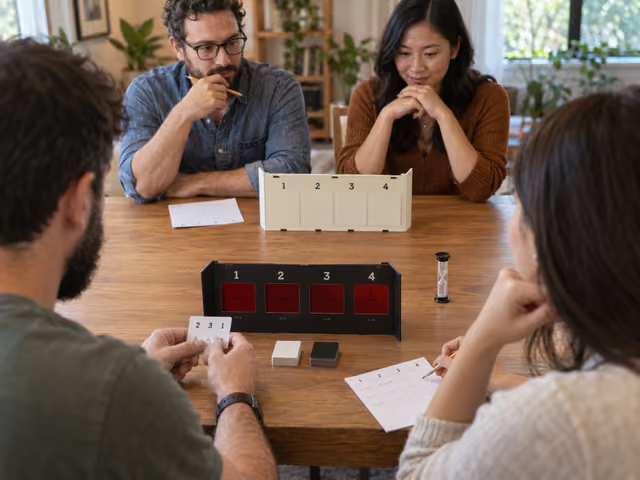
Split as evenly as possible into two teams, each with two to four players. Sit teammates together on opposite sides of the table. Each team takes one screen and the matching black or white deck of 24 code cards. Draw four keyword cards from the top of the keyword deck and insert them into that screen's numbered positions 1–4. Do not browse or shuffle the keyword cards before choosing them. All teammates must see their own four words; opponents must see none. Those words and positions stay fixed for the whole game.
Give each team a double-sided note sheet and a pencil or pen. On both sheets, use the white side for White's clues and the black side for Black's. Each sheet needs space for eight rounds of three clues, guessed codes, revealed codes and four numbered clue-history columns. Use the supplied sheets, publisher's printable sheet or a paper copy of that layout. Put the four interception tokens, four miscommunication tokens and sand timer within reach.
Choose a cluegiver, called the encryptor, for each team and a rotation order. Everyone takes that role in turn. Only that round's encryptor sees their drawn code; the other teammates will decode it. Both teams' words remain visible to their own players, including their encryptor.
Link meanings, not secret signals
Draw one card from your team's code deck and look at it privately. It contains three different digits from 1–4 in order. Write one clearly separated clue for each digit, in that order, on the current round's lines. For a code of 3–1–4, clue the word in position 3, then position 1, then position 4. Keep the card and code hidden until both teams have committed their answers.
Clues may be a word or a sentence. The official rules also allow humming, dancing or mime if the group agrees; the main guide uses spoken, written clues. Each clue must concern the keyword's meaning and publicly available information. Obscure facts are allowed, but personal memories, private nicknames and prearranged secret codes are not. A clue cannot signal the word's spelling, length, pronunciation or position on the screen.
Do not use any keyword from your screen, or its translation, as a clue, even for a different keyword. Do not read out the code. Do not repeat a clue already used in this game. Share every clue and any permitted spelling with both teams, and spell a clue if asked. Once read aloud, a clue cannot be edited, expanded or improved. Stay neutral while others guess: no hints through expressions, corrections or reactions.
Cluegiving is not a conversation with your teammates. Quietly check all three meanings and their order before reading. Your teammates' task is to identify the numbers, not to guess words they can already see.
Lock both guesses, then reveal
Prepare together
At the start of every round, each team's current encryptor privately draws one code card. Both encryptors prepare their three clues at the same time. The rulebook suggests that the first encryptor to finish starts the supplied 30-second timer for the other to finish. This limits clue preparation, not the whole game or guessing discussion; decide before play whether to use that optional timer.
Hear White's clues
White's encryptor reads the three clues in order and passes their sheet to their teammates. Black writes those exact clues on its sheet's white side. White's non-encryptors work out the code using their visible words; Black works from prior clues and the current clues. Teams discuss discreetly, keeping White's keyword identities out of the opposing team's hearing. The encryptor does not join the discussion.
Write, announce, reveal
Both teams write their final three-number guesses before either announces one. From round two onward, Black announces its interception guess first; White then announces its own decoding guess. In round one, skip the interception guess entirely, but record the clues and reveal the code normally. White's encryptor now shows the true code to everyone.
Award tokens independently
A correct interception earns the opposing team one interception token; an incorrect interception has no penalty. If the encryptor's own team gets any digit or its order wrong, that team receives one miscommunication token. A correct own-team decoding earns no token. Both an interception and a miscommunication can happen on the same transmission. Only the complete ordered code counts; one or two correct digits earn nothing.
Build the history
On both sheets, keep the guessed code distinct from the revealed code. Put every clue in the history column for its actual keyword number, even when either guess was wrong. For example, a clue revealed as number 3 goes in column 3. Never file clues under the guessed numbers. Black can then compare later clues with those confirmed associations without knowing White's words.
Resolve Black, then check the round
Repeat the same sequence for Black's prepared clues, using each sheet's black side: White is now the interceptor and Black decodes its own message. Finish this transmission even if White's transmission already gave a team its second token. Only after both transmissions do you check the result below. If continuing, return both drawn cards to their own decks, shuffle both decks and rotate encryptors. The same code can therefore appear again. Keep the keyword cards and full clue histories.
Imagine your screen reads 1 RIVER, 2 PLANET, 3 BOTTLE, 4 CHAIR. A code of 2–4–1 could be sent as 'orbit', 'furniture', 'current'. Your partner maps these to 2–4–1. After revelation, opponents know orbit belongs to number 2; later, 'Mars' may let them recognize number 2 without seeing PLANET. These are teaching examples, not prepared clues for the real game. Changing the angle of an association helps protect the code.
Finish the whole round and settle ties
After both teams have transmitted, a team with two interception tokens wins, or a team with two miscommunication tokens loses. If only one clear outcome applies, announce that result. Do not end halfway through the round: the other transmission can change the outcome.
Use the tiebreak procedure if one team has both two interceptions and two miscommunications, both teams reach their second interception in the same round, both reach their second miscommunication in the same round, or neither has won or lost after round eight. For each team, score one point per interception token minus one point per miscommunication token. The higher total wins.
If those totals tie, each team commits to four guesses for the opposing team's four keywords before the words are revealed. The team that correctly identifies more keywords wins; if the counts still tie, share the victory. Use the actual keywords rather than broad categories. Agree before play how to treat an equivalent grammatical form in this rare word-guessing tie, since the rulebook does not define that detail.
For another game, deal fresh keyword cards, clear both histories, return all tokens to the center and shuffle the two code decks separately. Choose starting encryptors again. Changing the keywords between games resets the information opponents learned.
Help the table follow the information
Teach one transmission with the spoken example, then point out the four clue-history columns. Explain that opponents normally guess numbers; guessing the hidden words is only a late tiebreak. Before starting, let each person see where to write a guess and where to record the true answer. New players may prefer an unscored demonstration round using a separate set of words; if you do that, discard those words, clear the notes and reset tokens before the scored game. This is a host suggestion, not an extra official round.
Give every non-encryptor a chance to suggest a mapping before choosing the team's answer. Someone may record the sheet for a teammate, provided that does not reveal keywords or feed the encryptor's answer into the discussion. Keep tables and screens positioned so nobody has to lean across to read or accidentally see an opposing screen. Reading, writing, hearing clues and shared vocabulary matter here; a seated game does not guarantee it suits every group's access or language needs.
Check clue disagreements against the meaning and public-information rules. A sentence is legal; a private story or a sound-only link is not. The cited rulebook gives no general illegal-clue penalty. A usable house agreement is to treat an illegal clue as a failed transmission: the offending team takes at most one miscommunication token for that transmission, while opponents may still attempt an interception and both teams record the revealed code normally. Agree to this before the first card is drawn; do not present it as an official penalty. If a keyword screen is exposed, a separate house remedy is to restart with new words and cleared scores rather than pretend the information can be forgotten.
Do not let either team revise a written guess after hearing the other's answer. Read all three clues before discussing; do not reveal the code until both guesses are locked. Maintain an accurate history even when the code repeats. At the end, let the encryptors explain their associations after the hidden words are revealed; during play those explanations would leak information.
Already know the game?
Ideas & Twists
Choose a variation together before you start.
Decrypto · See main rules
Official separate format · exactly three peopleThree-player interceptor
Replace the two-team game with two encryptors working against one interceptor. Use one screen with four keywords and one code deck for the duo; give the duo and interceptor a note sheet each. The duo's players alternate giving clues to each other; the interceptor never sees the keywords, gives no clues and draws no code. Each round has only the duo's transmission. The interceptor cannot intercept in round one. From round two, lock both guesses, announce the interceptor's first, then the partner's, and reveal. Award the interceptor one interception token for a correct interception and one whenever the duo fails to decode; both awards can apply to the same transmission. Do not give the duo miscommunication tokens. Record true clue-number links and return/shuffle the drawn code between rounds. The interceptor wins upon collecting two interception tokens within the five-round game; otherwise the duo wins after round five. No eight-round or standard team tiebreak applies. Use all normal clue restrictions.
Decrypto · See main rules
House suggestion · concise clue challengeOne-word transmissions
Before dealing, agree that every clue must be one spoken and written word. Exclude multiword names, sentences, abbreviations and invented joined-up phrases for this version. Otherwise use the same two teams, fixed keywords, three ordered clues, code decks, clue histories, token awards and end-of-round result. The same clue still cannot be reused, and meaning/public-information rules still apply. Play an entire game with this rule; do not switch midway after one team has used sentences. This makes histories easier to compare while removing the sentence-clue tools permitted by the base rules.
Decrypto · See main rules
Official permitted clue form · group-agreed formatMime the transmission
Before dealing, agree that all three clues will be separate mimes instead of spoken word or sentence clues. Prepare each action privately and perform them in code order, visibly separating first, second and third. Both teams must have the same view. Give each mime a brief neutral written description on both note sheets so its revealed number can enter the normal history; do not add an explanation of its meaning or the keyword. If a mime cannot be recorded consistently, use spoken clues instead. Actions must concern meanings and public information, never signal a position or digit. Do not repeat a prior mime or reveal keywords. Remove the optional clue-preparation timer for this group-agreed version. Teams still lock three-number guesses, opponents intercept only from round two, both transmissions finish, and all ordinary scoring/tie rules remain. The rulebook permits mime; the all-mime restriction, recording convention and untimed preparation are hosting agreements.
About this guide
Original explanation of the physical English base game, checked against the publisher's September 2019 rulebook: printed pages 1–5 and 12 for the normal team game, page 10 for the separate three-player format. The main guide supports 4–8 players in two teams of 2–4; the box's 3–8 range includes that separate variant. Demonstration/reset, discussion and recording advice, equivalent-word agreement, illegal-clue remedy, screen-exposure restart and one-word restriction are host suggestions. Mime is publisher-permitted; its all-mime and note-taking conventions are group agreements. No expansion, digital implementation, fixed total minutes or universal accessibility is promised.
Ready for something different?
Find another game →