

The quick version
A direct hit puts you out unless you catch that same ball before it dies. A clean catch puts the thrower out and returns your first waiting teammate. Head or face hits do not count. Eliminate the opposing six to win a round; first to two round wins wins the match.
Saved on this device only — clearing your browser's cache or site data removes them (no account backup).
Mark the court and explain the house rules
Book a gym that permits dodgeball. Use a dry, level 18 m by 9 m court, with at least 1 m of unobstructed space outside its edges and clear space overhead. Keep bags, chairs and spectators outside that runoff space. Follow the facility's footwear and equipment requirements; use purpose-made coated-foam balls, not basketballs, tennis balls or hard playground balls.
Mark the center across the court. Add a line 1 m to either side of center to make a 2 m empty strip. Each team stays between its own nearer strip line, back line and sidelines. Nobody enters the strip or the other team's half, even to retrieve a ball. This strip and the no-rush start are house changes, not an official foam neutral zone.
Make two balanced teams of six. Designate one host, who may be one of the twelve, to announce starts, stops, counts and scores. Players call their own hits; an extra non-playing referee is helpful but not required. Put each team's waiting queue outside its sideline near its back corner, beyond the runoff space. Explain where people leave and re-enter.
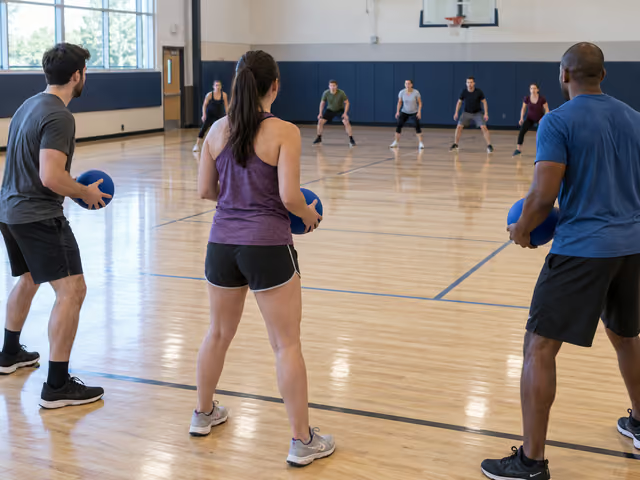
Give each side three balls. Begin behind your own back line with the balls in hand; on the host's “Ready, go,” step onto your side. Each player becomes live when fully inside and may then throw. There is no center rush or activation run. Toss a coin before round one to choose which team has the first throw count if everything is equal; alternate that initial count team each round.
Say these house differences aloud: no ball shielding, one potentially eliminated player per thrown ball, no teammate ricochet saves, no head/face eliminations, and first to two round wins. Try an unscored gentle throw, a bounce and a catch before starting.
Throw, dodge, catch and return
Play continuously after the signal
There are no alternating turns. Move within your own marked area, collect loose balls there, pass to teammates and throw by hand toward opponents below shoulder height. Do not kick or spike balls or make player-to-player contact. Opposing throws are live until they hit the floor, wall, ceiling, an airborne or loose ball, or an out player. A held ball is the no-shield exception explained below. A bounce cannot put anyone out; a teammate's pass cannot put you out or earn a return.
Resolve the first person a ball touches
A live opposing throw touching your body or clothing is a hit. You may still catch that same ball before it touches a dead surface, another ball or another person. If you secure it yourself, treat it as a catch; otherwise you are out. After that first person's contact, the ball cannot eliminate anyone else and a teammate cannot save them by catching the rebound. While resolving your hit, do not throw or catch a different ball. This single-player resolution is a house simplification.
Make a catch count
Secure the opposing ball without trapping it against the floor, wall or another person, with both feet inside your area when control is established. A bobble is not yet a catch. A valid catch eliminates its thrower and returns the first teammate already waiting in your queue. If the queue is empty, nobody returns. The returning player carries no ball, walks around outside the court to the back line, and becomes live on stepping fully inside. They may then collect and throw. Only the six who began this round may return.
Leave cleanly when out
Put down any held balls, raise a hand, exit by the nearest sideline without crossing a throw, and join the back of your team's queue. Do not throw after being hit or help from the sidelines. Touching a sideline, back line or your strip line during live play puts you out; a catch return is the exception for crossing your own back line. Keeping a ball in your hands does not protect you: an incoming throw hitting that held ball is treated as a hit on you. You may release your own ball to catch the incoming one. Simply dropping a ball is not an out.
Keep the balls moving
The team with more balls on its side, held or loose, must attempt a throw within ten seconds. If balls are equal, use more live players; if those are equal, use the team that did not make the last valid throw. At the start, use the selected initial count team. The host announces the team and counts the final five seconds aloud. Any valid throw resets the count; tossing a ball away or rolling it across does not. If the count reaches zero without an attempt, call Stop, give that side's balls to the other team, return the remaining live players to their back lines and restart. Nobody is eliminated by this turnover. This is the house version of the throw clock.
If your team has three players on court and a teammate waiting, your catch makes four of you live and removes the opposing thrower. Catching a ground bounce changes neither team. A teammate catching the rebound off you does not save you in this house format.
Finish a round and the match
A round ends when one team has no live players after all throws released by live players have been resolved. The other team earns one round win. Do not stop at the first apparent final hit while another valid throw or catch is still unresolved.
If the final opponents eliminate each other with separate throws released before either was hit, both teams have no players: score no round win and replay the round with all twelve and three balls each. In a close hit-versus-catch involving different balls, use the observed order. If the order cannot be separated, apply both outcomes: the catcher leaves, the caught thrower leaves, and a teammate who was already queued returns.
After a round, call the match score aloud, bring all six on each team back, swap court ends, redistribute three balls each and start again. First to two round wins ends the match. A 1–1 score needs the deciding round; there is no timed tiebreak in the main format. Take breaks between rounds and agree before another match. Extra friends rotate between matches rather than joining a live round.
Settle calls without losing the game
Head and face contact: aim below the shoulders. A head/face-first hit never eliminates the person hit, even while ducking. It makes that ball dead; it earns no catch or return. Call Stop immediately, check that the person wants to continue, retain completed calls from before the stop, redistribute three balls per side and restart the remaining players from their back lines. Do not use this reset to return eliminated players. Repeated reckless or deliberate high throws end that person's participation; pause and rebalance before beginning a fresh round. Foam equipment and these rules do not guarantee injury-free play.
Loose balls: live players may pick up only balls wholly inside their own area. When balls are stranded in the empty strip or outside the court and cannot be returned by a non-playing helper, call Stop. Nobody throws while the host collects them. Return an off-court ball to the side where it exited; split strip balls evenly, with an odd remaining ball going to the side that currently has fewer balls, or the initial count team if equal. Restart the same live players at the back lines with that allocation. An out player may return an off-court ball underhand only during this stop.
Close calls: call your own clear hits, including clothing grazes. Let the host hear each side once during a stop. If a hit, catch or thrower cannot be established, cancel that disputed ball's result rather than choosing an arbitrary player to remove. Restore anyone removed solely by that disputed result, redistribute three balls each and restart the remaining players. Agree the ruling before play resumes; discuss recurring interpretations between rounds.
Stop for a fall, injury, unsafe floor or person entering the court. If someone cannot continue, end that round without a point and pause the match; resume six-a-side only with a willing replacement or end the match with the completed round score. Do not treat the guide as permission to keep playing through a problem.
Already know the game?
Ideas & Twists
Choose a variation together before you start.
Dodgeball · See main rules
Suggested house variationThree-ball round
Use three matching foam balls instead of six for fewer simultaneous throws. Give two to the initial count team and one to the other at the start; alternate that advantage each round. On resets that normally split balls three each, use the same two-and-one allocation. Keep the same twelve players, court, catches, queue, throw count and first-to-two finish.
Dodgeball · See main rules
Suggested house variation · add a timer, paper and pencilEveryone stays in
Replace elimination and catch returns with points for three rounds of three minutes each. Use six balls and all twelve people throughout. A valid body hit scores one for the throwing team; a valid catch scores one for the catching team. Keep the one-person-per-ball resolution, head/face reset and no shielding. A boundary fault also gives the other team one point; the player steps back inside without leaving. Announce each point; if unclear, pause to confirm it. Stop the clock during every stoppage. At the horn resolve throws already released, then award one round win to the higher point total; a tied round gives neither side a win. Reset points, swap ends and play the next round. More round wins after three rounds wins the match; equal round wins is a shared result. These are rule clocks, not a promise about the total outing length.
About this guide
All operative instructions here form a stated recreational house game. Federation sources establish the foam equipment, six-a-side basis, catch/queue concept and throw-clock principle. The no-rush start, empty strip, no shielding from the start, single-player hit resolution without teammate saves, all-head/face exemption, resets, first-to-two match and variations are explicit house choices. Official WDBF uses different rush, ball activation, hit sequences, timing and officiating; USA and Seattle rules also differ. Follow the organizer's actual rules when joining a league.
- World Dodgeball Federation · Foam Rules 2026, revised May 2026 ↗
- World Dodgeball Federation · Adult Foam Quick Start, 2026 ↗
- World Dodgeball Federation · Grassroots Foam Adaptations, June 2026 ↗
- USA Dodgeball · 2026 rules update ↗
- Connecticut Dodgeball · 2026 recreational rules ↗
- Dodgeball Seattle · Recreational Foam Rules ↗
- Baden Sports · 7-inch foam dodgeball construction ↗
Ready for something different?
Find another game →