

The quick version
Give each player seven Coppers and three Estates, shuffle separately and draw five. Set out the seven basic Supply piles and ten Kingdom piles listed below. Each turn: play Actions, play Treasures and buy, then discard your hand and played cards and draw five. Purchased cards normally go to your discard pile. At the end of a turn, an empty Province pile or any three empty Supply piles ends the game. Count all owned victory points; highest total wins, with fewer turns breaking a tie.
Saved on this device only — clearing your browser's cache or site data removes them (no account backup).
Make the supply and your starting decks
This guide uses Rio Grande Games' English Dominion Second Edition base game, with 2–4 individual players. The standalone base game supplies the necessary cards. An expansion, a Second Edition Update Pack or a Base Cards pack alone is not this complete set. First Edition has different Kingdom choices; online and expansion mechanics are outside this format.
Give each player seven Coppers and three Estates. These starting Estates are separate from the Estate Supply pile. Everyone shuffles their own ten cards into a face-down deck, leaving space for a face-up discard pile and a separate area for played cards. Draw five cards and keep the hand private.
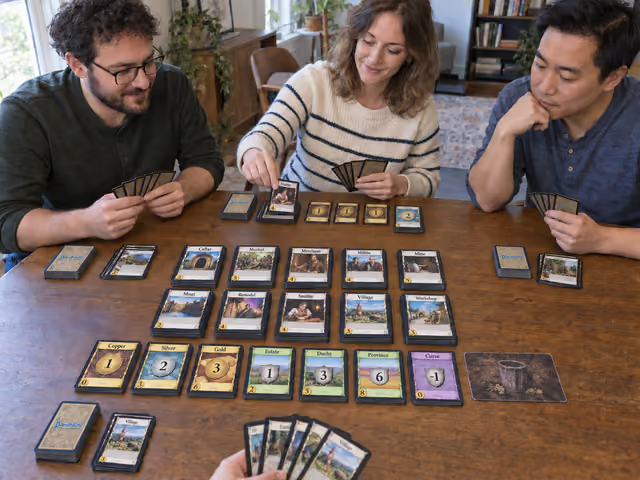
Build seven face-up basic Supply piles: Copper, Silver, Gold, Estate, Duchy, Province and Curse. Use all remaining Copper and all 40 Silvers and 30 Golds. For two players, put eight Estates, eight Duchies, eight Provinces and ten Curses in the Supply. For three players, use twelve of each basic Victory card and twenty Curses. For four players, use twelve of each basic Victory card and thirty Curses. Return unused cards to the box.
Use the publisher's First Game Kingdom: Cellar, Market, Merchant, Militia, Mine, Moat, Remodel, Smithy, Village and Workshop. Place ten copies of each in its own face-up pile. Keep the blue-backed randomizer cards out of the playing piles. This makes seventeen Supply piles altogether; leave each distinct and readable. Put the Trash mat nearby, outside the Supply.
Choose a starting player randomly and go clockwise. After a completed game with one winner, the previous winner goes last in the next game. No separate score sheet, physical coins, ordinary playing cards or digital device is needed. You need enough table space to read the shared card text and keep everyone's piles separate.
Take an Action, Buy and Clean-up turn
Start fresh
Begin every turn with one Action, one Buy and zero coins. Your first turn has no Action cards, so move straight to buying. Estate, Duchy and Province cards stay in your hand until Clean-up; they do not produce coins or Actions.
Play Actions one at a time
You may spend an Action to move an Action card from your hand to your play area. Carry out its instructions from top to bottom, doing as much as possible. Finish that card before starting another. Add any extra Actions it grants to your remaining allowance. Drawing an Action card does not grant permission to play it. You may stop your Action phase even with Actions left.
Play Treasures, then buy
When you move to the Buy phase, play any Treasures you want from your hand: each Copper gives one coin, Silver two and Gold three. Add coins supplied by Actions. Then spend a Buy and the listed cost to take one available card from the Supply into your discard pile. Each extra Buy permits another purchase, but all purchases share the same coin total. In this base game, finish playing Treasures before your first purchase; you cannot return to Actions or play more Treasures after buying.
Keep what you paid with
Treasures remain yours: paying uses their coin income, not the physical cards. Bought cards do not go straight to your hand or into play. You may skip buying, leave coins unspent, or use a Buy to take a zero-cost Copper. Coins are not saved between turns.
Clean up and draw the next hand now
Discard all played cards and everything still in your hand, including unplayed Actions and Victory cards. Draw five for your next turn now, before passing play clockwise. If the deck cannot supply a required draw, shuffle the discard pile and place it beneath any cards remaining in the deck, then draw as many as possible. Cards currently in your hand or play area are not included in that shuffle. Do not reshuffle merely because the deck has just become empty.
Check whether the game ends
At the end of the current turn, stop if the Province pile is empty or any three or more Supply piles are empty. Any basic or Kingdom Supply pile counts, including Curse or Copper. Finish the turn that caused the ending; do not give everyone an equalizing turn. Otherwise the next player begins with a fresh allowance.
Suppose your opening hand is three Coppers and two Estates. Skip Actions, play the three Coppers, buy a Silver costing three and put it in your discard pile. Discard the five opening cards and draw the five still in your deck. The bought Silver can appear only after a later shuffle. This is an example hand, not a hand players should arrange before the real game.
Understand the ten First Game cards
Costs are printed at the lower left; coin income and point value are different things. Read the actual card before resolving it. The following reminders cover this Kingdom.
- Cellar, cost 2: regain one Action, discard any number of cards from your hand together, then draw that many replacements. Discarding does not remove those cards from your deck permanently.
- Moat, cost 2: as your Action, draw two; it grants no extra Action. When an opponent plays an Attack, you may instead reveal a Moat already in your hand before the Attack affects you. Keep it in hand; that Attack cannot affect you, but its other effects still happen. You may reveal the same Moat against later Attacks.
- Merchant, cost 3: draw one and regain one Action. The first Silver you play later this turn gives one additional coin for each Merchant you played. Later Silvers do not repeat that bonus.
- Village, cost 3: draw one and add two Actions. Because playing it used one Action, it increases your remaining allowance by one overall. It helps you play several Actions; it does not itself generate coins.
- Workshop, cost 3: gain one Supply card costing four or less into your discard pile. This is a free gain: it spends no coins or Buy and gives no extra Action.
- Militia, cost 4: add two coins; each other player chooses cards to discard until their hand has three. Those already holding three or fewer discard nothing. Give opponents a chance to reveal Moat first. This never makes them discard to fewer than three.
- Remodel, cost 4: trash one card from your hand and gain a Supply card costing at most two more than that card into your discard pile. For example, an Estate costing two can become a Smithy costing four. You cannot trash the Remodel you just played; it is no longer in your hand.
- Smithy, cost 4: draw three. It adds no Actions; playing it as your only Action does not let you play newly drawn Actions.
- Market, cost 5: draw one and add one Action, one Buy and one coin. The extra coin is income for this turn, not a Copper to take from the Supply.
- Mine, cost 5: you may trash a Treasure from your hand, then gain a Treasure costing up to three more into your hand. Copper can become Silver and Silver can become Gold; the gained Treasure can be played in the upcoming Buy phase. If you trash no Treasure, you gain none.
Gain normally means take from the Supply to your discard pile; Mine explicitly changes the destination. Trash means put on the shared Trash mat: that card leaves your collection and will not return in your shuffle. No one can discard or trash unwanted cards whenever they like; a card effect must permit it.
Count the whole collection
Gather every card you own, including your deck, discard pile, hand and any cards still in your play area. Each Estate scores one point, each Duchy three and each Province six; each Curse subtracts one. Other cards in the First Game Kingdom score zero. Starting Estates still count if you kept them; trashed cards do not.
The highest total wins. Among players tied for that total, the player who took fewer turns wins. If they also took the same number of turns, they share the victory. There is no sudden-death extra turn. Keep track of who started and where the ending occurred so unequal turn counts can be settled.
Province costs eight coins, Duchy five and Estate two. Silver costs three and Gold six. Stronger Treasures and useful Actions help you reach those purchases, while Victory cards use space in your future hands. A large deck is not automatically a good deck. Watch the Province pile and all nearly empty piles: someone can end the game before your planned next turn.
Teach decisions and settle mistakes
Before starting, point out everyone's deck, hand, discard pile and play area, then the shared Supply and Trash. Explain that the deck is being built during play. Read each of the ten Kingdom cards together. On early turns, announce Actions remaining, Buys remaining and coins available. Avoid taking over another person's purchases; ask whether they want strategy advice.
For a first lesson, demonstrate Village followed by Smithy using visible cards, then put them back before dealing. Village leaves two Actions; Smithy uses one, leaving one. Smithy alone leaves none. This spoken or card demonstration is unscored and does not alter starting decks. Buying many Action cards without enough ways to play them can leave useful cards stranded in hand; make that consequence clear without prescribing one winning strategy.
Resolve disputes using the printed Second Edition card and the linked rulebook. A gain from Workshop does not use your Buy; Remodel gains to discard, Mine gains to hand; Militia discards down to three rather than discarding three. Reveal Moat before resolving the Attack against its owner. If a gain pile is empty, it supplies no card; never substitute a different pile unless the effect permits another choice.
For a just-noticed mistake before new hidden cards are seen, this guide suggests agreeing to undo it exactly. Once draws or shuffles reveal new information, avoid reconstructing a favorable alternative: agree a consistent remedy together, consulting the card notes, or restart an unscored learning game. These are house remedies, not official penalties. Do not award invented points or make someone skip a turn.
The game involves reading, holding cards, shuffling and tracking allowances. Check seating, reach and print legibility with the group; a seated format is not an accessibility guarantee. Players remain in the same game until its finish. Five or six players require extra basic cards and different ending rules, so they are not covered by this guide's fit range.
Already know the game?
Ideas & Twists
Choose a variation together before you start.
Dominion · See main rules
House teaching suggestionOpen-hand learning game
Keep everyone's current hand face up for the whole game and announce every phase, effect and purchase. Deck order remains hidden; show only hands and the cards the rules normally reveal. Use the same First Game Supply, starting decks, headcounts, turn rules, ending and scoring. Ask before offering purchase advice. This changes the information available and is a learning format; return to private hands in a fresh game once everyone can run a turn.
Dominion · See main rules
House Kingdom selectionBuild in peace
Before dealing, replace the entire Militia pile with ten Laboratory cards from the same Second Edition box. Keep the other nine First Game Kingdom piles and all seven basic piles. Laboratory costs five; playing it draws two cards and grants one Action. There are now no Attack cards in this Kingdom, so Moat's reaction has no trigger, though playing Moat still draws two. All starting decks, buys, point values, pile counts and ending rules remain the same. This lets a group explore drawing and deck construction before managing attacks.
Dominion · See main rules
House Kingdom selectionLearn to let cards go
In a fresh game, replace the ten Mine cards with ten Chapel cards; leave the other nine First Game piles unchanged. Chapel costs two. Spend an Action to play it, then choose up to four cards still in your hand to trash, including zero if you wish. Those cards leave your deck permanently; Chapel itself is already in play and cannot be one of them. It gives no replacement card, coins or extra Action. Explain the tradeoff together before dealing: thinning weak cards may improve future hands, but trashing too much buying power can stall a deck. Keep the normal setup counts, private hands, scoring, finish and ties. This is a lesson choice, not a promise of a stronger deck.
About this guide
Main mechanics and the ten-card First Game Kingdom follow the publisher's English Second Edition rulebook, including its revised Mine wording and end-of-turn finish. The exact supported format is 2–4, with one complete physical base game. Expansion, app, solo and extra-card 5–6-player rules are not imported. The open-hand format, two selected Kingdom substitutions, teaching demonstrations and mistake remedies are explicit house suggestions. Community conversations informed teaching choices rather than overriding the rulebook.
Ready for something different?
Find another game →