

The quick version
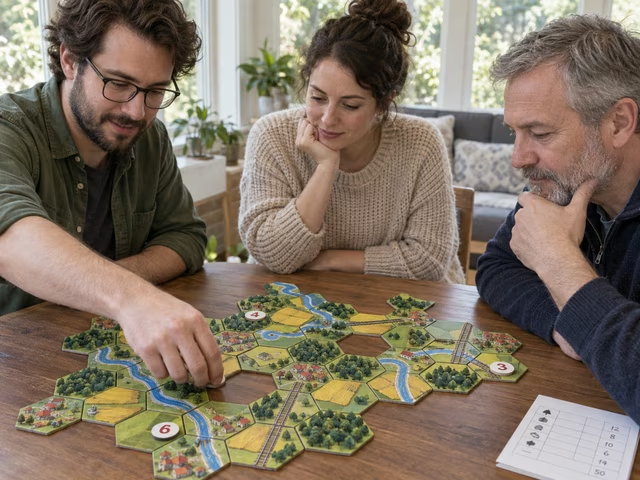
Take clockwise turns. On each of the first three turns draw a task tile, reveal a matching type of task marker and place them together. Thereafter, if fewer than three unresolved task markers remain on the map, draw another task tile; otherwise draw a landscape tile.
Saved on this device only — clearing your browser's cache or site data removes them (no account backup).
Prepare the table
This is the cooperative original board game, not The Duel, Sakura or the video game. For a fresh campaign keep all five unlock boxes closed. Shuffle the twenty-five task tiles face down. Separately shuffle the forty-eight landscape tiles, secretly remove three, and stack the remaining forty-five. Sort and shuffle task markers face down by their five types. Choose a starting player and keep the score and campaign sheets nearby.
For an existing campaign, include its recorded unlocked components and read their cards before starting. Remove the three ordinary landscape tiles before adding unlocked special tiles. The instructions below teach the initial game; component cards govern later additions.
Play a turn
Take clockwise turns. On each of the first three turns draw a task tile, reveal a matching type of task marker and place them together. Thereafter, if fewer than three unresolved task markers remain on the map, draw another task tile; otherwise draw a landscape tile. If task tiles are exhausted use landscapes. Discuss placement, but the active player makes the final decision.
Every new hex must share at least one full edge with the existing map. Rotate it freely. Rail and stream edges must match their own type across every adjoining edge. Forest, grain, village and meadow edges may mismatch. A connected territory follows matching edges of its own type.
A task's number is the exact count of tiles required in its connected territory, track or stream. On reaching that count, move the marker to the completed-task area; the tile stays and may continue growing. A new task cannot be placed already over its target or closed off below its target. An ordinary tile may overshoot or close an existing task below target, but discard that failed marker. One placement may resolve several tasks. Restore fewer than three active tasks on subsequent turns, one tile per turn.
Finish and score
End immediately when you must draw a landscape and none remains. If the last landscape completes or fails a task, continue placing the required task tiles until a landscape would again be needed. Sum the numbers on completed task markers. Each flag in a fully enclosed matching territory adds that territory's tile count; an open territory's flag scores zero. Add one per tile in the longest continuous track and one per tile in the longest stream. Add any unlocked scoring prescribed by its cards.
This is one team score. Enter it on the campaign sheet at the highest threshold you reached; mark the corresponding number of adjacent white progress circles, starting at the hiker. Green hexes cost no circle and unlock the named box or card. Record unlocked components, read their instructions and use them in later campaign games. Compare this score with earlier games at the same unlock stage.
Host the first game
Keep completed and failed markers in different places. A recent Reddit Dorfromantik discussion describes the appeal as relaxed collaborative placement and gradual unlocks; the task owner still chooses the final placement so a louder planner does not take every turn. Plan table space before the map reaches an edge.
Already know the game?
Ideas & Twists
Choose a variation together before you start.
Dorfromantik: The Board Game · See main rules
Original STUDplay house twistSurveyed landscape
For a standalone game, keep the next landscape tile face up beside its stack. Place it only when a landscape is required, then reveal its replacement. Task draws remain hidden until required. Play this as a standalone session; do not record its score for campaign progression.
Dorfromantik: The Board Game · See main rules
Original STUDplay house twistOne reserve tile
For a standalone game, the team may once set a drawn landscape aside and draw its replacement. On a later landscape turn, choose the reserve instead of drawing. The game cannot end while that reserve remains; use it when a landscape is required and the stack is empty. Play this as a standalone session; do not record its score for campaign progression.
Dorfromantik: The Board Game · See main rules
Original STUDplay house twistNeighboring proposals
Before the active player places a tile, only the player to their left may suggest a position. Everyone may still point out illegal placements or scoring errors. The active player may choose any legal position. Rotate that advisory role naturally with the turn. Play this as a standalone session; do not record its score for campaign progression.
Dorfromantik: The Board Game · See main rules
Original STUDplay house twistExact-match bonus
In a standalone game, earn one extra point whenever a placed tile matches every existing neighboring terrain edge and touches at least two tiles. Count meadow as a type. Record bonuses on paper when placed; task and route scoring remains normal. Play this as a standalone session; do not record its score for campaign progression.
Dorfromantik: The Board Game · See main rules
Original STUDplay house twistTown-planning repair
In a standalone game, give the team one paper token. Before drawing, spend it to rotate one placed tile in place. Its new orientation must obey all placement restrictions, and it cannot contain a task marker or change any territory containing an unresolved marker. Immediately resolve any resulting normal scoring conditions. Do not remove already completed task points. Play this as a standalone session; do not record its score for campaign progression.
About this guide
Requires the named physical game and its supplied components. Rules are paraphrased teaching guidance; keep the box's cards and reference diagrams beside the table. Original STUDplay house twists are optional, untested suggestions rather than publisher rules. Agree one before setup; unchanged rules still apply. Play house twists as standalone sessions with no campaign unlocks; altered scores are not comparable with the published campaign.
Ready for something different?
Find another game →