

The quick version
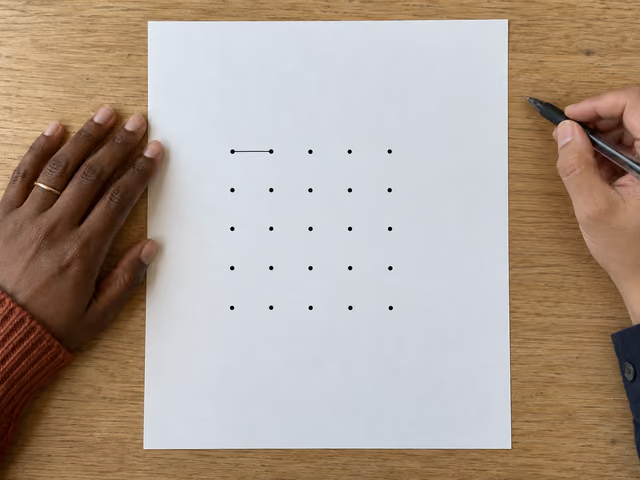
Draw five rows of five dots. Take turns adding one horizontal or vertical line between neighboring dots. Closing a small box earns one point: mark it with your initial and draw another line. Keep moving after every scoring line; hand over after a line that scores nothing. When every line is drawn, count the 16 boxes. More boxes wins; 8–8 is a tie.
Saved on this device only — clearing your browser's cache or site data removes them (no account backup).
Make a grid with 16 spaces to claim
Choose an indoor table or desk and sit where both players can see and reach one sheet on a steady writing surface. Draw five evenly spaced rows of five dots, lined up into five columns. Leave enough room between dots to write a small initial. These 25 dots make four rows of four possible boxes: 16 in total. Start with dots only; leave the outer boundary and all inner lines undrawn.
This guide uses standard two-player pencil-and-paper rules on that 5×5-dot board. A board described elsewhere as 5×5 boxes would need six rows of six dots. Count dots here, rather than assuming the two sizes are the same.
Choose different initials or simple marks, such as A and B, for ownership. One shared pen works; separate pens or two colors are convenient. A line's color does not decide who owns a box. Only the person drawing its final missing side claims it.
Choose who starts by mutual agreement. The other person can start the next board. Before playing, agree on the key rule: completing a box makes you draw again, but you may choose a legal line elsewhere instead of taking an available box.
Draw, claim and continue
Draw the first line
The starter joins any two neighboring dots in the same row or column with one straight segment. The dots must be immediately next to each other: do not skip a dot, draw a diagonal or redraw an occupied edge. Each move adds exactly one segment. An opening line closes no box, so the other player moves next.
Check both sides of your line
If your line adds the fourth side of an elementary box between adjacent rows and columns, write your mark inside that box and score one point. Larger outlines spanning several boxes do not score by themselves. An interior line may close two neighboring boxes at once: claim both and score two points.
Keep your turn after scoring
After a line closes one or two boxes, you must draw another legal line if any remain. That line can be anywhere on the board. If it also closes a box, claim it and draw again; keep going for as long as your lines score. As soon as you draw a line that closes no box, your turn ends. Two boxes closed by one line do not bank two later turns. There is no passing.
Finish the whole board
Stop when all possible edges have been drawn; the last scoring line needs no extra move because none remains. Count each player's marked boxes, one point each. The two totals must add to 16. The higher score wins, regardless of who drew the final line. A score of 8–8 is a shared tie; another board is optional, with the starter switched.
On a spare corner of the same sheet, draw two rows of three dots and three sides of the left-hand square. Let the newcomer add its missing side and mark the box, then draw the top edge of the right-hand square. That next line closes no box, so it ends their turn. This demonstration is unscored and sits outside the real grid.
Make ownership and choices easy to follow
Mark newly closed boxes before adding your next line, and check both sides of every interior edge. If a completed box was left unmarked, give it to the player who drew its final side when both remember that move; the color of its other sides is irrelevant. Count marks row by row at the finish. If an earlier ownership mistake cannot be reconstructed together, replay on a fresh grid rather than guessing a winner.
Use short, clear lines so an almost-touching stroke is not mistaken for a missing edge. If a line accidentally runs past its intended neighboring dot or goes diagonally, agree on the intended legal segment before the next move and cancel the extra stroke with a small cross. For an unrecoverably confusing sheet, start a new board. These drawing-error remedies are house suggestions.
Early on, look for a line that leaves every adjacent unfinished box with fewer than three sides. A third side offers an easy point. Later, check whether taking one box opens another, producing a chain of scoring moves. You may deliberately leave a box available and play elsewhere; taking every available box is not compulsory. This can matter when choosing who must open the next chain.
Keep the first game small and explain extra turns before they happen. If one player knows chain tactics, offer an unscored teaching board where both discuss choices, then begin a fresh scored game when both are ready. Quiet conversation is enough; the board holds the scores and there is no need to call them aloud after every move.
Already know the game?
Ideas & Twists
Choose a variation together before you start.
Dots and boxes · See main rules
House match formatTwo-board match
Play two fresh 5×5-dot boards, with each player starting one. Finish each board under the main rules and write both scores beside it. Add each player's boxes across the two boards; the higher total out of 32 wins. A 16–16 total is a tied match. Do not stop because someone won the first board, and do not carry drawn lines into the second. This gives both players a start while keeping one shared sheet or successive sheets.
Dots and boxes · See main rules
Misère scoring variationFewest boxes wins
Use the same blank 5×5-dot grid, but announce before the first move that the lower box total wins. You still claim every box you close and must draw again after every scoring line; you cannot pass, erase an edge or give your completed box to the opponent. You may choose a non-scoring edge when one remains. Fill the whole board, then compare totals out of 16: fewer wins and 8–8 ties. The objective changes, so use a fresh board rather than switching midway.
About this guide
NRICH supplies the basic paper game. Buzzard and Ciere clarify that taking an available box is optional and moving again after a capture is compulsory; West confirms that a line can score multiple boxes. The selected 5×5-dot size, start agreement, demonstration, teaching board, drawing-error remedies and two-board match are hosting suggestions. The misère paper supports fewest-boxes scoring and ties; its narrow-board strategy results are not claims about this 16-box board.
Ready for something different?
Find another game →