

The quick version
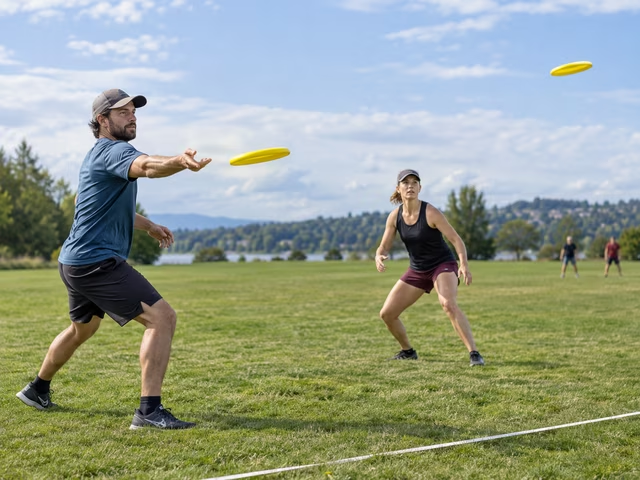
Two pairs defend 13 m squares separated by 17 m. Serve one disc from each court at the same time. Catch and return toward the opposing square without holding both discs on your team at once. An in-court landing or an opponent’s out throw earns one; simultaneous team contact with both discs earns opponents two.
Saved on this device only — clearing your browser's cache or site data removes them (no account backup).
Get the game ready
Mark two 13 m squares with 17 m between their facing edges. Lines are out. Leave clear run-off behind and beside both squares; the layout alone is 43 m long. Use flat markings and suitable light DDC discs, not heavy disc-golf discs. Choose calm conditions.
Each pair shares one square, with its partners choosing front and rear coverage. The opposing pair uses the other square. Start each exchange with one disc on each side. The teams nominate one server each, alternating the server within each pair after every exchange. One calls ready, two, one, throw; both release on throw. Replay a mistimed start.
Play the first game
Throw for placement
Send your disc toward open ground inside the other square. Use gentle, mostly flat flights; no hard throws at people or steep spikes. After a catch, establish a planted pivot where you caught it and release from there. You may pivot but may not run with the disc.
Coordinate the two discs
Either partner may catch either incoming disc. Call yours early and warn your partner when the other is arriving. Your team must release its held disc before either teammate touches the other. In this beginner house format, do not tip or bobble a disc deliberately to buy time.
Stop at the first scoring event
A disc that lands and remains wholly in the opponents’ square earns its throwers one. An uncaught disc that touches a line or ground outside gives the receiving team one. A dropped catch in your court gives opponents one. If your team touches both discs simultaneously, opponents receive two and the exchange ends immediately.
Resolve close timing
This house version stops both discs at the first completed scoring event. Do not launch another attack after stop. If opposing scoring events cannot be separated in time, replay with no score; if the same team earns simultaneous events, award only the larger single result. Retrieve only after both discs are down and everyone has stopped.
First to fifteen, win by two
Keep one team score. First to at least fifteen with a two-point margin wins. Swap courts after every five exchanges, keeping the score and next-server order. Replay an interrupted exchange with the same servers. The shortened target and first-event scoring are house choices.
Help everyone get started
Before starting, rehearse a slow two-disc exchange and deliberately show what simultaneous team contact means. The challenge is timing rather than power. Agree that a dangerous throw stops play for a replay and an explanation. This activity needs much more space than a casual throwing circle.
Already know the game?
Ideas & Twists
Choose a variation together before you start.
Double disc court · See main rules
Suggested house variationOne-disc opening
Begin with one disc and alternate which team serves each exchange. Score in-court landings, drops and out throws as in the main game, with no double available. First to eleven wins by two. Partners still divide court coverage, but can concentrate on placement before adding the second flight.
Double disc court · See main rules
Suggested house variationAnnounced lead disc
At each simultaneous serve, designate one team’s disc as the lead, alternating each exchange. That server must use a clearly higher, slower arc; the other serves a flatter flight. After the opening, use normal play and scoring. Replay a start that does not establish those two visible flights.
Double disc court · See main rules
Suggested house variationDoubles-only points
Only simultaneous team contact with both discs earns points, worth two. Other main-game faults end the exchange without a score. Play twenty exchanges, changing ends after ten; highest score wins and ties stand. Teams can risk open landing space to set up the harder two-disc trap.
Double disc court · See main rules
Suggested house variationPartner alternation
Within each team, alternate who catches each new incoming disc, including the opening serve. Announce the starting catcher before each exchange. A wrong-player catch loses one point; a double still loses two. Keep the first-event finish and play to fifteen, win by two.
About this guide
The governing-site PDF returned 403, so the same 2016 WFDF text was opened on the DDC community site. The first-event scoring, no intentional tips, shortened target and five twists are editorial house formats. The community discussion is not a current popularity estimate.
Ready for something different?
Find another game →