

The quick version
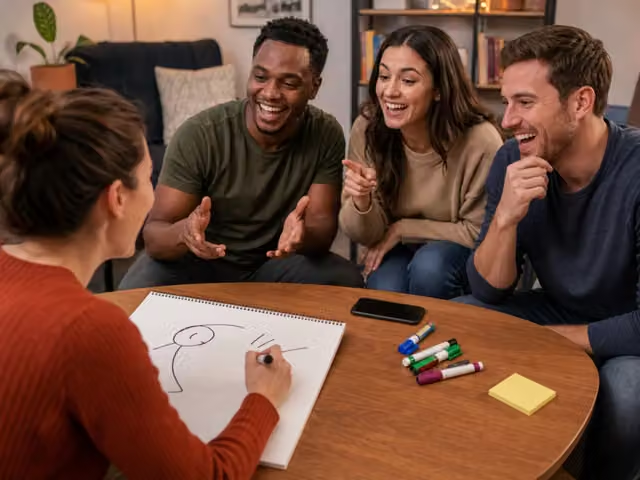
Two teams alternate 60-second drawing turns. One drawer sketches one hidden prompt while teammates guess. A correct whole answer earns one point. After six turns each, the higher total wins; ties are shared.
Saved on this device only — clearing your browser's cache or site data removes them (no account backup).
Make two secret prompt sets
Split into two teams, each with at least two people and one willing drawer. Give each a drawing surface large enough for its guessers to see. For an erasable board, use its intended marker and keep an eraser nearby. Test it before writing your first clue.
Each team writes six prompts plus six separately kept spares for the opposing team. Fold them and keep the two teams' sets separate. Mix concrete objects, actions and familiar places. Avoid prompts whose entire joke depends on spelling. Name willing drawers in a rotation; guessing or timekeeping can be someone's preferred role.
Choose the starting team by a fair draw. Agree that an obvious singular/plural difference is acceptable but a related object is not: a guess must identify the intended thing. All counts and timings below are suggested house rules. This format does not use Pictionary's commercial board, movement or edition-specific scoring.
Start with drawable things: a ladder, lighthouse, tent, hot-air balloon, watering can or roller coaster gives the drawer recognizable shapes to work with. Each team prepares its own secret six prompts and six spares for the other team. Use these examples as models; avoid answers that need written labels to make sense.
Sketch, score and finish
Take a prompt
The starting drawer privately reads a prompt written by the other team. One replacement is allowed before the clock starts; put the original aside and use an opposing-team spare. Start 60 seconds when the drawer is ready, before the first mark.
Make clues on the page
Draw shapes, arrows and pictures, adding or erasing as needed. Do not write letters, words, digits or blank dashes standing for letters. Do not talk, mouth an answer, use sound effects or act it out with your body. Pointing to a part of your drawing is allowed. Teammates can call unlimited guesses.
Resolve the turn
A correct whole answer before the alarm scores one point and ends the turn. Reveal the prompt. An unanswered prompt, an active-turn pass or a clue-rule breach scores zero and ends the turn. The other team cannot steal. Set the slip aside and clear the surface.
Rotate and finish
The other team draws next. Keep alternating; each willing drawer gets a turn before anyone repeats. After six turns per team, add the points and share a tied result. For another game, clear scores, write fresh prompt sets and change the starting team.
Useful pictures beat beautiful pictures
Try one together: use “kite” for an unscored demonstration outside the prompt sets. Draw a diamond, add a tail and connect it by a line to a hand. Let the room guess; do not write the answer or any letters. Simple recognizable shapes are enough. Showing the relationship between objects often helps more than perfect detail. Keep the paper facing the team; someone leaning over the drawing can accidentally block the very clue they are trying to read.
If a phrase is disputed, apply the agreed answer standard to both teams. Replace a genuinely ambiguous prompt with a fresh turn using the same drawer. Do not accept part of a long answer for one team and require every word from the other.
Already know the game?
Ideas & Twists
Choose a variation together before you start.
Draw and guess · See main rules
Suggested house variationOne line
After the pen touches the page, keep it in contact until the turn ends; no erasing. Plan how shapes connect as one continuous line. Everything else, including prohibited written clues, stays the same. Use six turns per team, one point per correct answer and a shared tie.
Draw and guess · See main rules
Suggested house variationDrawing relay
Two teammates read each prompt. The first draws for 30 seconds, then hands the same page to the second, who adds to it for the remaining 30 seconds. Neither gives spoken clues; any other teammates guess. Use this with at least three players per team. Rotate the drawing pairs, then compare the usual six-turn totals and share ties.
About this guide
A paper house game, not an instruction sheet for a branded Pictionary edition. Mattel's Pictionary Man rules were consulted for drawing restrictions and deciding answer precision. The equal-turn finish, paper prompts and variations here are house choices; owners of a commercial set should use its own rules when playing that set.
Ready for something different?
Find another game →