

The quick version
Confirm a suitable room and book all four players into the same private session. Arrive at the operator's requested check-in time. Listen to the mission, handling rules, hint method and exit instructions. When staff starts play, walk through allowed areas, announce discoveries and connect clues with puzzles. Ask the game master for help when progress stalls. Finish when staff confirms the mission is complete, the time expires or the session is stopped. Everyone shares the team result; there is no individual score.
Saved on this device only — clearing your browser's cache or site data removes them (no account backup).
Choose and book the actual room
Ask the operator whether the specific room accepts four players and is suitable for first-timers. A venue's maximum capacity is not a recommendation or a universal escape-room rule. This guide supports exactly four as a hosting choice; rooms with other counts need their own booking plan.
Agree a theme everyone wants to enter. For this first outing, choose a non-horror indoor room and ask about live performers, surprise effects, confinement, stairs, crawling, standing, reach, reading, hearing, lighting and color-dependent tasks. Tell the operator what the group needs and confirm the actual room's arrangements before paying. A friend may decline the outing; choose another activity if the room cannot accommodate the group.
Reserve one private session for all four, confirm the full cost and cancellation or change policy, and share the address, room name, arrival instructions and confirmation. Allow for travel, check-in, briefing and wrap-up as well as the playing window. Follow the operator's arrival deadline rather than assuming the start time is the check-in time.
The venue supplies the puzzles and game props. Bring the confirmation, any required identification or completed waiver, and clothes and footwear appropriate to the confirmed movements. Check storage and personal-item rules. Do not assume phones, cameras, flashlights, paper, pens or outside tools are permitted; ask about needed accommodations in advance.
Know the mission, hints and exit before starting
The game master is the venue staff member overseeing your session. Listen together to the story and exact objective: the finish may be recovering an object or completing a mission rather than unlocking an exit. Ask what confirms completion and what happens when the clock ends.
Confirm the time limit, how to request a hint, whether hints are limited or affect the result, and whether staff may send unsolicited help. Ask which objects or areas are out of play, how to use unfamiliar locks or controls, whether used clues can be needed again, and where movable finds may be gathered. There is no universal hint allowance or single-use-clue rule.
Have staff show how to leave and how to contact them during play. Agree that anyone can ask to stop or leave; nobody must stay to protect a result. The operator decides whether leaving, re-entry, a technical fault or a stopped session affects the clock or booking. Safety instructions take priority over solving the story.
Search, connect and solve together
Begin on the staff signal
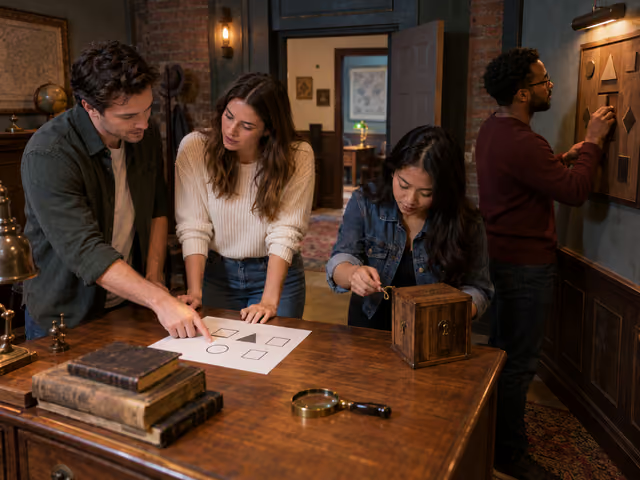
Once staff starts the session, walk through the permitted space and look at the available objects and clues. Spread out enough to explore different areas while staying able to communicate. Search only where the briefing allows. There is no first player or alternating turn; the group works together as puzzles become available.
Make discoveries shared
Say what you found and where it is: 'This box takes four digits' is more useful than 'I found something.' Show teammates the clue. Keep permitted movable finds in the agreed visible area rather than a pocket, and say when a puzzle has been solved. Leave fixed objects in place. Keep used clues available until staff confirms they will not be needed again.
Connect evidence to an input
Compare the type of answer a puzzle seems to produce with the available lock or control. Explain the proposed connection, then let one person make the agreed attempt using the method in the briefing. A matching answer length alone is not proof. Read any room instructions and follow evidence rather than repeatedly entering random combinations.
Notice what changed
A solution may open a container, reveal information or activate another part of the room. Tell the whole group what happened and look for the new clue or task. If several puzzles are available, work in small groups and report progress; if only one is available, share observations around that puzzle instead of inventing parallel tasks.
Get unstuck
When you repeat an idea without new evidence, stop and hear everyone's discoveries. Let someone else examine the puzzle or make a careful second attempt. If the group is still stuck or frustrated, use the agreed hint channel, naming the puzzle and what you have tried. Share the hint aloud and apply it together. Suspected broken equipment goes to staff, not stronger force.
Finish with the operator's result
Continue until the game master confirms completion, calls time or stops the session. Stop handling puzzles when asked and follow the exit instructions. Completing the announced objective within its conditions is the team success; otherwise the mission remains incomplete unless the operator describes a different result. This guide adds no points, fastest-player award, equal-turn extension or tiebreaker. Four friends share one outcome.
For example, one friend notices a four-digit lock while another finds a numbered diagram. Announcing both lets the team investigate a connection. This is an illustration of communication, not a solution promised in your booked room.
Keep all four involved and respect the room
The friend who made the booking coordinates the visit; staff runs the game. Before a committed attempt, invite a quieter teammate's observation. If an experienced player recognizes a puzzle, let a willing newcomer explain or try the idea. Do not turn every discovery into a race to grab the prop. Anyone may contribute, ask for help or pass on an action they do not want to do.
Walk rather than run. Do not climb furniture, shift heavy fixtures, pry open locks, dismantle fittings or touch electrical and emergency equipment as a puzzle. Respect out-of-play marks. If a permitted item will not operate gently as instructed, ask staff. The precise room's handling rules take precedence over generic tips.
Disagree about a theory by testing it against clues, not by arguing over who is cleverest. Have one person operate a lock or control at a time. Ask the game master to clarify handling, hint rules or a suspected fault. Do not award yourself extra time or announce a replay or refund; staff governs those decisions.
After play, ask whether the group wants an explanation of unfinished puzzles or would rather preserve the mystery. Leave props in the room as directed and check that nobody is carrying a clue away. Share a favorite contribution from each friend. Take a group photo only where staff permits and with everyone's consent; keep puzzle answers, codes and revealing room images out of public shares. A future visit needs a fresh booking and preferably an unseen room, since remembered solutions change the experience.
Already know the game?
Ideas & Twists
Choose a variation together before you start.
Escape room · See main rules
Suggested group variation · four playersNewcomer takes the next attempt
Before play, agree that after each solved puzzle, a different willing friend gets first opportunity to explain and operate the next available puzzle. Rotate around the four names; a person can pass, then offer the opportunity to the next. Everyone can still search, suggest ideas and help. With parallel puzzles, announce who takes each opportunity rather than claiming every object. Staff-required simultaneous actions still use everyone needed. This changes who gets the first hands-on try, not access to clues, hint rules, the clock or the shared finish. Drop the rotation if it obstructs the room's required sequence.
Escape room · See main rules
Suggested group variation · four playersFresh-eyes handoff
When a solver is repeating an unsuccessful approach, pause that puzzle and hand it to a teammate who has not led it yet. The outgoing solver explains the goal, evidence and tried approaches, then listens while the new solver offers a fresh theory before adding advice. Nobody removes clues or works secretly. Other available puzzles can continue. If all four have had a look and the group remains stuck, discuss requesting a hint under the venue policy. This replaces digging in on one theory with an explicit handoff; there is no added timer, penalty or solo credit. The operator's result still ends the session.
Escape room · See main rules
Suggested group variation · four playersAgree the hint request
Before starting, choose one friend as the hint caller and agree this process: anyone can say the group needs help; each friend gets a brief chance to share a missing observation; if no usable next step emerges, the caller requests a hint and repeats it to everyone. The role organizes requests and gives no veto over a frustrated player's need for help. Another friend takes over if the caller is unavailable. Safety questions and technical faults go straight to staff at any time. Venue hint limits, penalties and unsolicited help remain in effect; this adds no no-hint challenge or score. Finish with the same shared venue result.
About this guide
Operator sources reviewed October 2, 2026 support the venue workflow and show that capacities, hints, exits, equipment policies and access differ. This is an original four-friend private indoor outing plan, not a purchased tabletop edition or a universal room rulebook. The booked room's briefing controls all puzzle rules, timing, handling, hints and results. Communication, participation and the three collaboration variations are host suggestions informed by community discussions. No puzzle solution, price, availability, access arrangement or total visit length is promised.
- Escapology · operator guide to booking, play and hints ↗
- Edge Escape Room · room handling and exit rules ↗
- The Escape Game Swansea · room-specific capacities and access differences ↗
- Escape Games Canada · different group and personal-device policies ↗
- The Escape Game Chicago · an example of unlimited, unpenalized hints ↗
Ready for something different?
Find another game →