

The quick version
Deal five each and turn up one card. Players first accept its suit as trump or pass; if everyone passes, choose a different suit in a second round. Follow suit, counting the same-color jack as trump. The makers need three of five tricks; otherwise the defenders earn two points.
Saved on this device only — clearing your browser's cache or site data removes them (no account backup).
Make the deck and seat partners
Keep only A, K, Q, J, 10 and 9 of all four suits: 24 cards total. Put every other card and all jokers away. Seat partners opposite each other, with opponents on either side. Make two team columns on paper, starting at zero, and leave room to write the current trump suit.
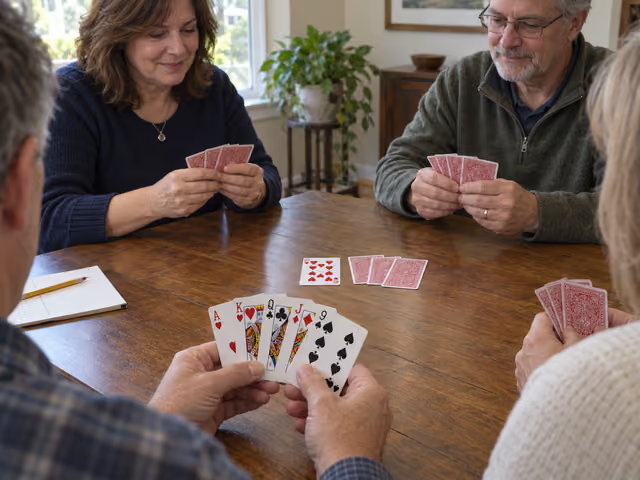
To choose the first dealer, shuffle and deal face-up cards clockwise until someone receives a jack. That person deals; gather and reshuffle all 24 cards. Offer a cut to the player on the dealer's right. Starting on the dealer's left, deal clockwise in one round of two cards each, then one round of three cards each. Everyone has five. Set the four undealt cards in the center and turn only their top card face up. The other three remain hidden.
State the table rules: target 10 or more, no win-by-two requirement, no joker, no weak-hand exchanges, no no-trump bids, no partner card exchange and no defending alone. The dealer's partner may order up and still play with the dealer. Nobody needs to hold trump to call it. Stick-the-dealer is an optional variation below.
Learn the two bowers before bidding
Trump is the suit that beats the other suits for this hand. From strongest to weakest it ranks: jack of trump (right bower), jack of the other suit of the same color (left bower), then A, K, Q, 10, 9 of trump. Red pairs are hearts and diamonds; black pairs are clubs and spades. The other suits rank A, K, Q, J, 10, 9, except that the left bower has left its printed suit.
For hearts trump, J hearts is highest and J diamonds is second highest. J diamonds is a heart for every play and follow-suit decision. If diamonds are led and your only printed diamond is J diamonds, you have no diamonds and may play any card. If hearts are led and J diamonds is your only trump, you must play it. Leading J diamonds means leading hearts. A 9 of hearts beats any non-trump card, even an ace.
Choose trump, or pass the deal
Ask each player in order
Start with the player on the dealer's left and continue clockwise, dealer last. Each says Pass or Pick it up. The first acceptance ends bidding: the face-up card's suit is trump, and that caller's team becomes the makers, responsible for winning at least three tricks. The other team defends.
Complete the pickup
When anyone accepts in round one, the dealer adds the face-up card to their hand and discards any one card face down, returning to five. This happens even if an opponent called trump. Keep the discard and three hidden cards out of play; nobody inspects them. The caller does not receive the up-card unless they are the dealer.
Try a different suit
If all four pass, turn the up-card face down. Starting again on the dealer's left, each may pass or name any suit except the rejected suit. The first named suit ends bidding; that caller's team is the makers. There is no pickup or discard in round two. If all four pass again, gather and shuffle without scoring; move the deal one seat clockwise.
Declare a lone attempt with the call
Only the player who makes trump may announce Alone, at the same time as accepting or naming the suit. Their partner places all five cards face down and takes no part in that hand. No cards or advice pass between partners. A first-round dealer still completes the pickup and discard, even if that dealer will sit out. Three active players play all five tricks; the caller still needs at least three to score.
Lead, follow suit and collect five tricks
Make the first play
Write the trump suit where everyone can see it. The first active player clockwise from the dealer leads one card face up. Normally this is the player on the dealer's left; if that person sits out for a loner, skip them. Any card may be led, including trump on the first trick. There is no rule requiring trump to be broken.
Follow the led suit
Moving clockwise, each active player places one card. If you hold the led suit, you must play it, even when it cannot win. If you have none, play any card: you may trump, but do not have to. Apply the left bower's trump suit rather than its printed suit. A trick is this complete round of four cards, or three during a loner.
Find the winner and lead again
If any trump was played, the highest trump wins. Otherwise the highest card of the led suit wins; a different non-trump suit cannot win. The winner collects the trick face down in a separate packet in front of them and leads the next trick. Count both partners' won tricks together. Keep playing until all five tricks are complete; a loner's inactive partner plays no cards.
With hearts trump and spades led, A spades beats K spades. But a player who has no spades can play 9 hearts and win, unless another player legally plays a higher heart or either bower. J diamonds is a higher heart, not a diamond.
Score the makers' result and finish
After five tricks, award points to only one team. Makers playing together earn 1 for three or four tricks, or 2 for all five. A lone maker earns 1 for three or four, or 4 for all five. If the makers take zero, one or two tricks, they are euchred: the defenders earn 2 and the makers earn nothing, including when the maker went alone. Defenders taking all five still earn only 2 in this format.
For example, makers taking four tricks adds 1 to their running total; defenders do not also score their one trick. If a lone maker takes only two, the defenders add 2, not 4. Do not subtract points from the makers.
Check the running score after awarding the hand. First team to reach or pass 10 wins immediately; exact 10 and a two-point margin are unnecessary. Only one team scores per hand, so both cannot cross together. At 9–9, the next scoring hand decides the game. Otherwise gather and shuffle all 24 cards, move the dealer one seat clockwise, and deal again. A passed-out hand also moves the dealer but changes neither score. For another game, reset both totals to zero.
Keep the first game clear and settle mistakes
Before scoring, demonstrate the hearts-trump example with both red jacks, then play one unscored hand. Confirm everyone can identify the left bower and the difference between a trick and a point. During scored play, announce legal bids plainly and save discussion of hands or strategy until the hand ends. Do not signal cards to a partner. Asking which suit is trump is allowed; use the written reminder.
Wrong card count before bidding? For this friendly table, gather and have the same dealer reshuffle and redeal with unchanged scores. For an out-of-turn bid or play, stop and use the same no-score redeal remedy rather than playing on with exposed information. These are selected house remedies, not tournament penalty rules. A weak hand alone never earns a redeal.
A failure to follow suit when able is a renege. Keep each won trick separate until scoring so the table can reconstruct the play, especially a left-bower dispute. For a proven renege in scored play, use Ohio Euchre's published remedy: end the hand, give the non-offending team 2 points, or 4 if the hand was a lone attempt, and award no ordinary hand points. Do not guess or impose a penalty on an unproven accusation. If the table cannot establish what happened, the friendly house remedy is a no-score redeal by the same dealer. This omits Ohio Euchre's false-accusation penalty and tournament-director procedure. Agree these remedies before starting, and check the winning score after any awarded points.
Already know the game?
Ideas & Twists
Choose a variation together before you start.
Euchre · See main rules
Documented house variationStick the dealer
Change only the last decision in round two: if the first three players pass, the dealer must name one of the three suits other than the rejected suit. The dealer cannot pass or pick up the rejected card. Normal lone calls, follow-suit rules, points and the 10-or-more finish remain. Every properly dealt hand then has trump; this does not guarantee a game length.
Euchre · See main rules
Suggested house variationFive-point game
Before the first deal, replace the 10-point target with 5 or more. Keep all five tricks in each hand and every ordinary point value, including 4 for a lone sweep. Check the target only after the hand or a proven-renege award. No special restrictions apply at four points; there is no win-by-two requirement. A game can finish above five.
Euchre · See main rules
Suggested unscored house variationOpen-hand teaching round
Before the scored game, deal a complete hand but lay all hands face up. Take bids in order, explain the dealer's pickup and discard, and let players talk through legal cards as they play all five tricks. Calculate the result together without adding it to a match total. Gather and reshuffle, then start the ordinary hidden-hand game at zero; shared advice stops during scored hands.
About this guide
Selected U.S. four-player partnership format, not a universal tournament standard or a purchased-game edition. Bicycle and Trickster support the core; explicitly selected options are no joker, no forced dealer, no defending alone, no minimum trump holding and no special loner requirement when ordering a partner. Ohio Euchre supplies the stated proven-renege award, but its forced-dealer rule and other tournament procedures are not adopted. Friendly redeals, the teaching round and the five-point game's absence of special bridge restrictions are house choices.
Ready for something different?
Find another game →