

The quick version
Roll six dice and set aside at least one scoring die or complete scoring group. Add to your turn total, then bank it or roll the dice still available. Your first bank must be at least 500. A roll with no score loses this turn's points. Banking 10,000 or more starts one last turn for everyone else; highest final total wins.
Saved on this device only — clearing your browser's cache or site data removes them (no account backup).
Put six dice and one rule set on the table
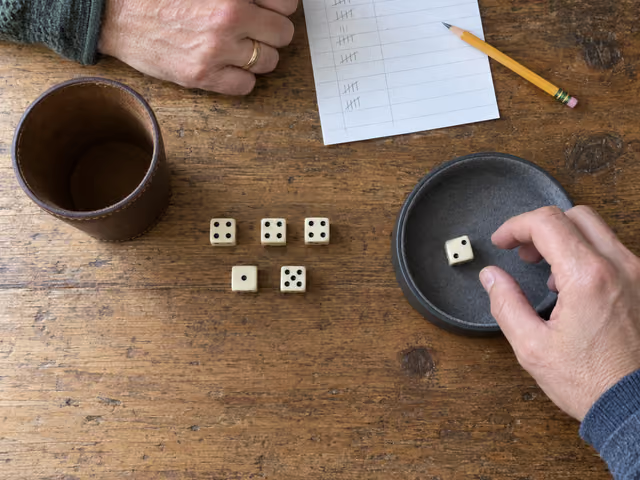
The PlayMonster item 6910 set contains six standard six-sided dice, a shaker cup, score pad and rules. Add a pencil. You can use six ordinary dice, a cup and paper instead, following the same scoring list below. A flat table is enough; a shallow dice tray is optional. Seat everyone where they can see the dice and reach the rolling area on their turn. Clear that area, with room beside it for dice kept out of later rolls.
Choose a scorekeeper and write each name with a starting total of zero. Everyone rolls one die; highest starts, and turns pass to the left. House procedure for a tied opening roll: only those tied for highest roll again until one starts.
Explain the two totals before playing: the turn total is at risk; the recorded game total is safe. Announce three 1s = 300, a first bank of at least 500, optional rerolling after all six dice score, and a single final turn for every other player. These details vary between editions and household versions. Do not import a different score chart midway through a game.
Read the dice from this roll only
Use this PlayMonster classic scoring list. A combination must come from one roll. Dice saved from earlier rolls keep their original points; they cannot join a new triple or other combination. Each die counts once.
- A single 1: 100. A single 5: 50. Single 2s, 3s, 4s and 6s: zero.
- Three matching dice: 1s = 300; 2s = 200; 3s = 300; 4s = 400; 5s = 500; 6s = 600.
- Four matching dice: 1,000. Five matching dice: 2,000. Six matching dice: 3,000. The face number does not change these values.
- One of each number, 1 through 6: 1,500.
- Three pairs, such as 2-2, 4-4, 6-6: 1,500.
- Four matching dice plus a pair, such as 3-3-3-3, 6-6: 1,500.
- Two triplets, such as 2-2-2, 5-5-5: 2,500.
You may keep some scoring dice and reroll others, but dice you keep must form valid scores. Add separate groups that use different dice: 4-4-4 plus 1 plus 5 gives 400 + 100 + 50 = 550. A pair of 2s alone scores nothing. A six-dice combination uses all six; do not add its individual dice or smaller groups again.
2-2-2-2-3-3 is four of a kind plus a pair: 1,500, not 1,000 plus another bonus. Six 1s score 3,000 as six of a kind; they do not also earn triplet, pair and single-die points.
Take a turn, bank or Farkle
Start with all six
Begin your turn total at zero and roll all six dice from the cup into the cleared area. Reroll any die that leaves the playing area. Read the scoring options before moving dice.
Keep a score
Set aside at least one scoring die or a complete scoring combination. Announce its points and your new turn total. Kept dice stay out of subsequent rolls until all six have scored. You cannot set aside a worthless die merely to reduce how many you roll.
Choose whether to bank
If you have never banked, keep rolling until your turn total is at least 500 or you Farkle. Once you reach 500, you may bank. On later turns, any positive turn score may be banked. Banking adds the entire turn total to your recorded score, ends your turn and passes all six dice to the next player.
Roll the dice left
If you continue, roll only dice you have not kept. Score this new roll separately and add it to the turn total. When all six dice have scored, you have hot dice: you may roll all six again while retaining the turn total, or bank if eligible. Hot dice do not force another roll in this edition.
Recognize a Farkle
If a roll offers no scoring dice or combination, your turn ends for zero points. Erase the whole turn total, including points earned before a hot-dice reroll. Your previously banked game total stays intact. Pass all six dice to the player on your left.
Your first roll is 4-4-4-1-5-2. Keep the three 4s, 1 and 5 for 550. You can bank 550 and finish, or reroll the one remaining die. A 2, 3, 4 or 6 ends the turn for zero; a 5 makes the turn total 600 and frees all six dice. You may bank that 600 or risk another six-dice roll.
Give everyone else one final turn
Only a banked total of 10,000 or more triggers the finish. You can pass 10,000; there is no exact-target bust. Continue to the left, giving every other player exactly one final turn under the same banking and Farkle rules. Mark each completed final turn. The triggering player does not play again, and a new leader does not restart the final round.
After those turns, compare recorded totals. Highest wins. House tie procedure: if the highest totals are equal, share the win; the manufacturer's sheet does not specify a tie-break. If your group wants a single winner instead, agree on that different tie procedure before the first roll.
For example, Alex banks a game total of 10,200. Blair finishes at 10,500 and Casey at 10,350. Blair wins when Casey's last turn ends; Alex does not get another reply. For a new game, reset all totals and choose the opener again.
Make the choices and close calls clear
Before the scored game, lay out the six-dice example in the turn section and ask someone to explain the bank-or-roll choice. Then show one saved 5 and two newly rolled 5s: they total 150, not a triple. Keep the scoring list visible and say the running turn total aloud so people can follow another player's decision. The roller makes that decision; other players can check arithmetic.
Confirm both the selected dice and points before the next roll. If two interpretations overlap, choose one score for those dice rather than stacking them. Read four matching dice plus a pair from its own line. Do not automatically take a chart from a digital Farkle game, Pocket Farkel or another person's familiar household version.
A die outside the rolling area is rerolled. House procedure for an unreadable die: reroll only a die leaning against an object or perched so its upper face cannot be agreed; keep the other newly rolled dice as they landed. Do this before selecting a score. Put saved dice beyond the rolling area so later dice do not knock them around.
There is no accumulated-score deduction for repeated Farkles in this selected edition. Each new player starts with six dice and a turn total of zero; points and leftover dice do not carry over from the previous player. With six people, expect more time watching others. If your group wants fewer turns, choose the lower-target variation before play rather than imposing a turn clock halfway through.
Already know the game?
Ideas & Twists
Choose a variation together before you start.
Farkle · See main rules
Suggested house variationRace to 5,000
Change the finish trigger from 10,000 to 5,000 banked points. Keep the 500 opening requirement and the complete scoring list. After someone reaches the new target, every other player still gets exactly one final turn. Highest final total wins; share a tied highest score. This lowers the target rather than promising a fixed game length.
Farkle · See main rules
Suggested house variationBank from the first score
Remove only the 500-point opening requirement. Any positive turn total may be banked from a player's first turn onward. Keep the 10,000 target, hot-dice choice and normal final turns. This lets people decide whether to record even a small first score instead of being forced to keep rolling.
Farkle · See main rules
Suggested house variationFirst across the line
Keep the normal scoring and 500 opening requirement, but end immediately when someone banks a total of 10,000 or more. That player wins; nobody receives a reply turn. Going over the target is allowed. This creates a straight race and makes turn order matter more, so agree to it before choosing the opener.
About this guide
Rules follow PlayMonster's classic Farkle, item 6910, using its linked sheet, copyright 2016, reviewed October 2, 2026. Opening-roll ties, unreadable dice and shared final ties are labeled house procedures. Hosting advice and the three variations are suggestions. Community accounts explain common disputes and differing experiences, not official rules.
Ready for something different?
Find another game →