

The quick version
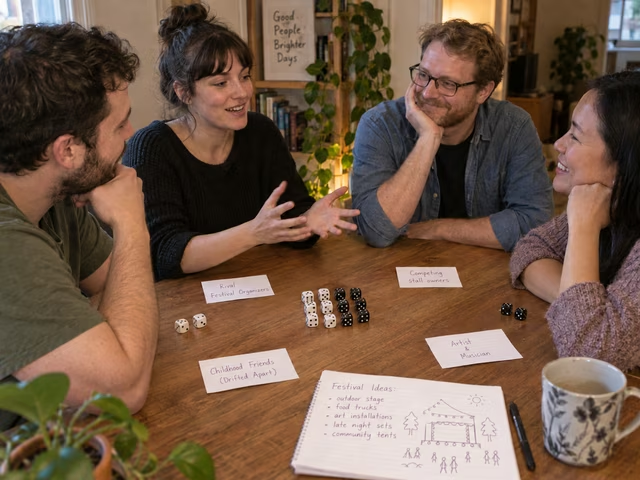
Give neighboring characters a relationship and a shared festival concern. Put four dice per player in a central pool. Each person gets two spotlight scenes in Act One: establish the scene or choose its positive/negative outcome, while others supply the other half. Give the outcome die away. Add two complications, then play two more scenes each, keeping dice. Roll your collected dice for a final character epilogue.
Saved on this device only — clearing your browser's cache or site data removes them (no account backup).
Make a festival everyone can complicate
Choose a fictional community festival opening tomorrow. Keep the story about misplaced props, rival plans, muddled schedules and ordinary responsibilities. Exclude adult-explicit, dating, substance and graphic-violence themes. Nobody plays themselves. Each player names an organizer and one overambitious goal, such as staging an enormous puppet parade with very little rehearsal.
Between every neighboring pair, write one relationship: longtime collaborators, friendly rivals, former classmates, neighbors or club officers. Add one shared detail that matters to both: a missing decoration, a double-booked room, a promised performance, an unfinished sign or a borrowed cart. Across the table include at least one need, one place and one object. This choice-based setup is a house replacement for the Classic playset-and-dice selection.
Put two light and two dark dice per player in a shared pool. Their values do not matter during scenes. Light means a positive outcome for the spotlight character, dark a negative one. Agree that a setback complicates the festival rather than harms a real person.
Choose the scene or its outcome
Take spotlight turns clockwise. On your turn, choose Establish or Resolve. Establish means you frame where the scene happens, who is present and what your character wants; the other players together select an available light or dark die to decide how it turns out. Resolve means you choose the available outcome color first and the others frame a scene that leads there. You cannot control both halves.
Play the scene through conversation or describe it in third person. Other players portray needed supporting characters. Once the outcome is clear, end promptly. In Act One, give the selected outcome die to any other player. Continue until everyone has had two scenes, using half the central dice.
For this house Tilt, jointly choose two new complications: a missing essential item, a mistaken announcement, an unexpected visitor, bad weather, conflicting promises or an early arrival. Write them on separate cards. They must arise from established details and both must appear during Act Two. This replaces the printed Tilt table and its selection rolls.
Play two more spotlight scenes per person under the same Establish/Resolve choice, but now keep the outcome die from your own scene. The last die in the central pool may count as either color, as in Classic. Do not undo an earlier scene merely to achieve a tidy ending.
Close every character’s part of the story
After Act Two, each player rolls all dice they received or kept. Add light values and dark values separately, then take the absolute difference. This guide’s original clean Aftermath scale replaces the published table: 0–3 means the character’s plan collapses but they learn something; 4–7 means a mixed result with one useful salvage; 8 or more means a surprising personal success with a comic cost. A player with no dice has a difference of zero.
Go clockwise with one short epilogue each, respecting that result and the established festival. There is no winning player; the dice shape endings. Finish after all epilogues and name one moment another player contributed that you enjoyed. Give the session room for four scenes per person plus setup, the midpoint and the ending.
Already know the game?
Ideas & Twists
Choose a variation together before you start.
Fiasco · See main rules
House suggestionNarrated scenes
Use third-person narration for every scene rather than acting dialogue. Keep spotlight turns, Establish/Resolve choice and dice exactly the same. Each contributor describes what their character does in a few sentences.
Fiasco · See main rules
House suggestionThe important object
Before Act One, choose one harmless prop from the shared details. Every player must feature it in at least one of their four spotlight scenes. Track appearances on its index card; do not change who currently holds it without a scene explaining the move.
Fiasco · See main rules
House suggestionFlashback allowance
Each player may frame one spotlight scene as a flashback explaining a current festival problem. Announce its time clearly and do not contradict an established event. Its outcome still uses and transfers or keeps a die according to the current act.
Fiasco · See main rules
House suggestionSingle-scene epilogue
After rolling Aftermath, place all characters together at the festival’s closing cleanup. Each player delivers their epilogue as one brief exchange there, expressing the assigned result. End after everyone contributes; do not begin another act.
About this guide
The official facilitation PDF was downloaded and text-extracted after its browser view exposed no text. Published mechanics retained: 3–5 players, four dice each, two scenes per act, Establish/Resolve division, Act One give-away, Act Two keep, final wild die and rolled color imbalance. Festival setup, Tilt selection, clean Aftermath scale and all variations are original house adaptations and are not represented as official Fiasco tables.
Ready for something different?
Find another game →