

The quick version
Shuffle the dedicated deck and deal one face-up card to each person, resolving actions as they appear. In turn, say Hit for one more card or Stay to keep your round score. Repeating a Number card busts you unless Second Chance saves you. Seven different Number cards end the round immediately and earn 15 extra points. Add every player's round score; when someone has at least 200, the highest total wins after the round is finished.
Saved on this device only — clearing your browser's cache or site data removes them (no account backup).
Bring the original deck and make room for rows
This guide hosts 3–8 people with the original English Flip 7 game from The Op Games. The current original-game product is labeled 2nd Edition; the linked rulebook is marked ruleset edition 3.1. Check for Freeze, Flip Three, Second Chance and positive score modifiers. Flip 7: With a Vengeance and themed sets can change cards or rules; use their own instructions.
Bring the complete 94-card deck, one sheet of paper, one pen and a table with a separate display area for each player. The deck has 79 Number cards: one 0, one 1, two 2s, three 3s, continuing up to twelve 12s. It also has three each of Freeze, Flip Three and Second Chance, plus one each of +2, +4, +6, +8, +10 and ×2. An ordinary playing-card deck does not replace this set. Write everyone's name and starting total of 0 on the sheet.
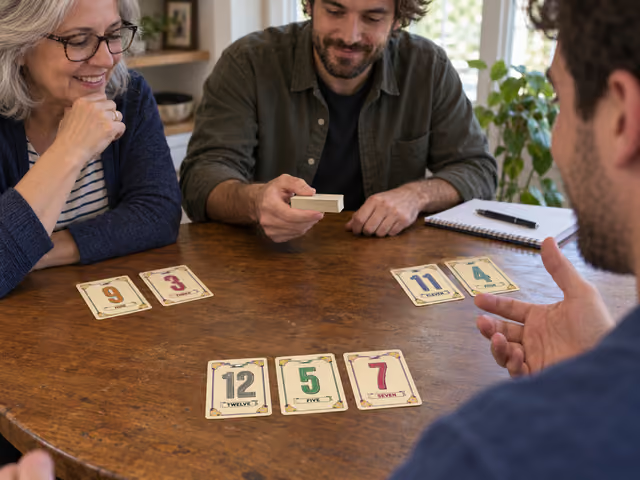
Choose a dealer and agree on clockwise turn order. The dealer also plays. Shuffle all 94 cards thoroughly and keep the draw pile face down. Leave space beside it for discards. Put your Number cards in a face-up row and modifiers or Second Chance above that row. Everyone should be able to see the numbers. For this guide, use softly spoken decisions; shouting is optional.
Deal, then ask for a card or stay
Begin the round
The dealer deals one face-up card to each person in the agreed order, including themselves. If an Action card appears, pause and resolve it before continuing the opening deal. An action can leave someone with no cards, several cards or already out of the round; do not add replacement opening cards merely to make the displays equal. Skip anyone already out.
Say Hit or Stay
After the opening deal, the dealer goes around the same order, asking each active player. Hit gives you one face-up card. Stay ends your participation in this round and protects your current round score from further actions. You can choose Stay only if you have a card in front of you; an empty display must Hit. Keep going around, skipping everyone who stayed, froze or busted. Receiving an action on another person's turn does not consume your next ordinary turn.
Check each new Number card
Compare its number with your own row, never another player's. A different number joins your row. A repeated number busts you: this round scores 0, including all modifiers, but your earlier total survives. Second Chance can cancel that duplicate instead. The 0 adds no points but counts as a different Number card. High numbers have more copies in the deck, so a valuable row can also be risky.
Separate modifiers from numbers
+2, +4, +6, +8 and +10 add points to your eventual score; ×2 doubles only your Number-card sum. Modifiers do not cause a bust or count toward seven different numbers. You may Stay with only a plus modifier and score its value; ×2 alone scores 0.
End the round
As soon as anyone has seven different Number cards, stop all dealing and pending actions. That player earns the 15-point Flip 7 bonus, and every other non-busted player scores their current display. Otherwise the round ends when nobody remains active, including players who were Frozen. Keep each exited player's cards on the table, turned face down to mark their status, until the round ends.
For a spoken example, imagine your row is 5 and 9. Staying gives 14 points. Hitting a 3 raises it to 17; hitting another 9 instead makes it 0 unless you have Second Chance. The 200-point target is checked after scoring the whole round, not the instant someone says Stay.
Resolve the three Action cards
Freeze: the player dealt this card chooses an active target, including themselves. That target stops immediately and keeps their current round score. Someone who already stayed, froze or busted is not a legal target. With only one active player, Freeze must affect that player. A target with no scoring cards keeps 0.
Second Chance: keep your first one above your row. When a duplicate Number arrives, discard the new duplicate and Second Chance, leaving the original Number in your row. You remain active; ordinarily your next card comes on your next turn. During Flip Three, continue any draws still owed. You cannot save Second Chance for later instead of resolving that duplicate, and it cannot block Freeze or Flip Three. You may hold only one: if dealt another, give the extra to another active player who lacks one; discard it if no eligible recipient exists. Unused Second Chances expire at the end of the round.
Flip Three: the player dealt this action chooses an active target, including themselves. The target must take the next three cards, one at a time, without choosing Stay between them. Every card type counts toward those three draws. Stop early if they bust or reach seven different Number cards. A newly drawn Second Chance works immediately, including against a later duplicate in that sequence. Set any newly drawn Freeze or Flip Three aside until all three required cards have been drawn. If the target busts, discard those delayed actions without using them. If they Flip 7, the round ends and delayed actions do not happen.
If all three draws finish and the player remains active, they choose active recipients for their delayed actions; those recipients can be other players or themselves. If only that player remains active, actions must target them. A fresh Flip Three starts another three-card sequence. The short printed rulebook does not specify the order of several delayed actions together: this guide uses a stated house convention to resolve them in the order revealed, fully finishing one before the next and choosing only targets still active. After the sequence and any delayed effects, resume the ordinary turn order.
Add the round, then check the finish
A busted player adds 0. For everyone else, add the Number cards, double that sum if they have ×2, then add all plus modifiers. Finally add 15 only for the player who reached seven different Number cards. For example, 2, 5 and 9 total 16; with ×2 and +6, the round scores 38. A row of 0, 1, 2, 3, 4, 5 and 6 totals 21; with ×2, +8 and the Flip 7 bonus, it scores 65. The multiplier does not double the plus cards or the 15-point bonus.
Add these results to the written running totals. At the end of a round in which anyone reaches at least 200, the highest total wins, even if someone else crossed 200 first. If the highest total is tied, everyone plays further complete rounds until one player has the highest total. This applies at exactly 200 too. Do not limit the extra rounds to the tied players.
If the game continues, move every card from the finished round to the discard area and pass the remaining draw deck to the player on the dealer's left, who becomes the new dealer. Do not reshuffle between rounds. When the draw pile empties, shuffle the discards to make a new pile. If that happens mid-round, leave every current player's display on the table, including cards belonging to people already out; only the discard pile is available to reshuffle.
Make the decisions easy to follow
Explain the duplicate-number risk first, then show the three actions and one scoring example. Keep a finger or verbal cue on the next player so a long Flip Three chain does not lose the ordinary turn order. Ask for one clear decision and give the player space to make it; table advice is optional. Read a card's number or effect aloud when useful and keep displays within everyone's view and reach.
A player who busts waits for the next round rather than leaving the game. Keep the deal moving and let the group decide whether it wants another full game afterward. Community players enjoy the shared suspense, but others dislike repeated early busts or scorekeeping. Use the five-round option below if the group wants a fixed number of rounds; choose it before starting.
Settle disputes using card type and active status: seven cards of mixed types are not a Flip 7; the same number in two different people's rows is harmless; a player who stayed cannot be targeted; a duplicate saved by Second Chance does not join the row. Agree on the stated delayed-action convention before the first deal.
Already know the game?
Ideas & Twists
Choose a variation together before you start.
Flip 7 · See main rules
House format · count rounds instead of racing to 200Five-round finish
Play exactly five complete rounds, using the same deck, actions, bust rules, scoring and dealer rotation. Ignore the 200-point finish. After round five, the highest cumulative score wins. If the highest score is tied, every player joins extra complete rounds until the highest total is unique. Add a round column to the score sheet so everyone sees how many remain.
Flip 7 · See main rules
House format · remove chosen targetsActions stay with the drawer
Every Freeze and Flip Three must target the person who draws it, including an action revealed during the opening deal or a Flip Three sequence. Keep the usual delay for Freeze and Flip Three drawn inside an unfinished three-card sequence. Keep your first Second Chance; discard an extra instead of passing it. All scoring, duplicate protection, the immediate Flip 7 ending and the 200-point finish stay the same. Choose this when the group wants the draw itself to decide who an action affects.
Flip 7 · See main rules
House team format · exactly 4, 6 or 8 peoplePairs to 400
Form equal teams of two before dealing and keep a separate Number-card row for each person. Everyone still takes individual turns and may briefly consult their partner before Hit or Stay. Actions may target any active player, including a teammate or yourself, under the main rules. At each round's end, add both partners' ordinary round scores to a single team total; one partner busting does not erase the other's points. Replace the individual 200-point finish with a team target of 400: finish the round when any team reaches it, then the highest team total wins. If the highest teams tie, all teams play extra rounds until one leads. A Flip 7 still ends the round for everybody and gives its achiever the usual 15 points before team scores are combined.
About this guide
Original-game mechanics follow the publisher-linked English rulebook marked ruleset edition 3.1 and the publisher's original-game FAQ. The purchased product's 2nd Edition label is distinct from that ruleset number. This guide supports 3–8 people at one indoor table; the publisher lists 3+ and recommends a second deck above 18, so eight is not an official maximum. The clockwise order, reveal-order convention for multiple delayed actions and all three twists are explicit hosting or house choices. Quiet decisions and paper scoring describe this authored setup. With a Vengeance, themed decks and solo/two-person challenges are outside it.
Ready for something different?
Find another game →