

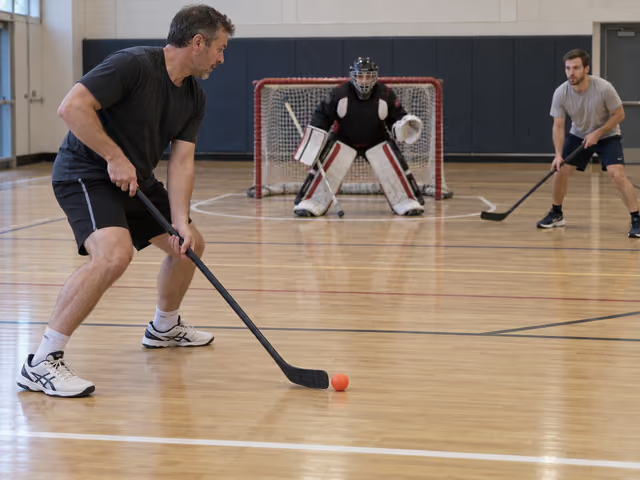
The quick version
Play two 25-minute halves. Each legal goal earns one; the higher total wins and a tie is a draw. Keep sticks low, avoid contact and leave both goalkeepers' creases clear. Stop for fouls, outs and a covered ball, then use the stated possession restart. No offside or icing applies to this house game.
Saved on this device only — clearing your browser's cache or site data removes them (no account backup).
Prepare the gym, teams and equipment
Book a gym that permits floor hockey and confirm its approved sticks, ball, floor protection and goal anchoring. Use an intact gym-hockey ball, not an ice puck or a perforated floorball ball. Get adult-sized sticks with plastic blades approved for that floor; do not assume a street or ice stick is accepted. Follow equipment instructions and remove damaged gear.
Use the facility's approved court. For a gym without a hockey layout, our house layout uses the basketball court's outer rectangle as the boundary, subject to facility approval and clear space around it. Center a goal on each end line with its opening facing the court; secure it by its manufacturer's instructions. The goal mouth sits on the line and the net extends outside the playing rectangle. There is no play behind the nets. Mark center and, with approved floor-safe tape, a semicircular goalkeeper crease extending 1.2 metres in front of each goal line. Keep bags, benches and spectators outside the playing area and clear of exits.
Split eight, ten or twelve players equally. Each side fields three court players and one goalkeeper; with ten there is one substitute per side, with twelve there are two. Use contrasting shirts. Each goalkeeper needs a correctly fitted full-cage goalkeeper helmet, chest/arm protection, leg pads suitable for gym use, blocker, catching glove and the same approved floor-hockey stick type. Both goalkeepers must be equipped before play. Wear indoor court shoes; court-player sports eye protection is recommended, and any facility requirement applies.
Choose a captain on each team to keep the paper score and resolve calls. Put a visible physical timer outside the boundary. Play two 25-minute halves with a five-minute halftime break. Our house clock runs through ordinary stoppages but pauses for injury, unsafe equipment or an unresolved dispute. Setup and any such pauses add time. Swap ends at halftime and retain the score.
Start, move the ball and finish
Take the first face-off
One court player from each team stands opposite the other at center, with blades on the floor beside the spot. Everyone else stays in their own half at least two metres away. A non-facing player drops the ball between the blades, then rejoins play. Wait until the ball touches the floor before playing it. Start the timer on that drop. Use a center face-off to begin the second half and after each goal; a player from the scoring team makes the drop after a goal.
Find space with passes
There are no alternating turns once the ball is live. Carry it with short blade touches, pass to a teammate or shoot toward the opposing goal. Defend by intercepting the ball and covering space. Our house rules prohibit all stick checking, lifting, pinning, body checking, pushing, holding and blocking someone with your body. Do not reach between a player's legs. Court players stay on their feet; no slides, dives or kneeling blocks.
Keep the stick and ball low
For this house game the blade stays below the player's waist at all times, including follow-through; use controlled push or wrist shots with no backswing above the knee and no slap shots. A pass or shot sent above knee height gives opponents a possession restart at the spot. An accidental high rebound stops play for a neutral center face-off. Never chase an airborne ball with a high stick. Court players may stop a ball with a foot, but cannot deliberately kick a pass or shot, carry it by hand or make a hand pass.
Protect the goalkeeper
Only the goalkeeper may put feet or a stick inside either crease in this house game, even when the ball is there. The goalkeeper stays in their own crease and may block or cover the ball there; nobody may jab at covered balls or equipment. Call stop as soon as the ball is covered. While play is stopped, the goalkeeper puts the ball beside the crease for a teammate to collect and place at the defending restart spot described below. No forward hand throws or goalkeeper pulling apply here. A goalkeeper may make a live stick pass but cannot score directly; another court player must touch first.
Count and confirm each goal
Award one when the whole ball crosses the goal mouth between the posts and below the crossbar during legal live play. An ordinary legal deflection or an own goal counts. A goal made with a high stick, deliberate attacking kick or hand action, crease intrusion, a direct goalkeeper shot, or a direct indirect-restart shot does not count. Agree the new score aloud before the center face-off. An invalid scoring attempt gives the defending team a possession restart beside its crease, unless a prior foul awards possession elsewhere.
Restart an out or a foul
Our house possession restart is always indirect: place the stationary ball at the restart spot, give opponents two metres and first pass with the stick. The taker cannot touch again until another court player touches; a goalkeeper alone does not supply the touch needed to score. If a direct restart shot enters the goal, even off the goalkeeper, award no goal and give defenders a restart beside their crease. A defending beside-crease restart spot is two metres outward from the side of the crease, inside the court. For an out, the team that did not touch last restarts where the ball crossed the line; for a foul, the non-offending team restarts where it happened. Move any restart inside or within two metres of a crease two metres outward from its edge. A ball crossing the boundary is dead even if it rebounds into court. Deliberate crease intrusion or touching twice on a restart is a foul.
Rotate and finish
With substitutes, agree a rotation order before starting. Swap the next bench player for the longest-serving court player at each ordinary stoppage, then put the outgoing player at the back of the bench order; the outgoing player leaves before the replacement enters. Change a goalkeeper only during a stopped clock after the replacement is fully equipped. Stop each half at the timer signal: the ball must have completely crossed the line before the signal for a goal to count. After half two, higher score wins; equal scores are a draw. No final attack, overtime or shootout is added in the main game.
After an out, Alex passes to Sam and Sam shoots: a goal may count. Alex shooting straight at the goalkeeper and scoring from that save does not count. Alex must also wait for a court player's touch before playing the ball again.
Explain the house rules and settle close calls
Before scoring, demonstrate one low pass, one legal shot, a covered-ball stop and an indirect restart. Let each person receive and return a short pass. This is an unscored rehearsal. Say the house differences aloud: no offside or icing, no stick checking, below-knee passes and shots, goalkeeper-only creases, no behind-net play, stopped-play substitutions and draws at full time.
Players call their own infractions, including accidental ones. Anyone can call stop for an injury, loose goal or dangerous action. For a disputed goal or last-touch call, pause the clock and have the captains compare what they actually saw. If they cannot agree, do not add a goal; take a neutral center face-off with the existing score. Re-secure a displaced net before resuming; our house rule cancels a disputed goal scored while it was displaced. Use a neutral center face-off when neither side can establish possession after outside interference.
These house rules use possession changes instead of timed penalties and penalty shots. Repeated dangerous play is a reason to stop the game and have the player leave play, not an opportunity to earn a tactical foul. Do not continue with an unequipped goalkeeper or an uneven lineup; stop and resolve it or end the session. Take a rest stoppage when needed, and reset the score and timer for a rematch.
Already know the game?
Ideas & Twists
Choose a variation together before you start.
Floor hockey · See main rules
Suggested house variationShorter booked-court match
Before the first face-off, replace the two 25-minute halves with two 10-minute halves and a three-minute break. Keep the same running-clock and safety-pause policy. Highest score at the second signal wins; ties remain draws. This changes playing time, not the preparation or equipment required.
Floor hockey · See main rules
Suggested house variationPass before the shot
After your team gains possession, complete one deliberate stick pass to a different teammate before a shot can score. Losing possession resets that requirement. A shot taken too early cannot score and gives defenders a possession restart beside their crease. An own goal still counts. All indirect restarts, crease rules, halves and the draw finish stay the same.
About this guide
Urban Rec's VSB three-court-players-plus-goalkeeper family informs the format. This is a separately specified house game, not a reproduction of either league's complete rules. Court geometry, even bench sizes, clock pauses/break, no offside/icing, stricter stick/ball/crease limits, out and foul restarts, goalkeeper distribution, substitutions, disputed calls and draw finish are explicitly adopted house choices. FCSSC supplies a comparison within adult gym floor hockey; its different rules are not silently imported. DOM supports the distinction between indoor and outdoor blades, not universal facility acceptance.
Ready for something different?
Find another game →