

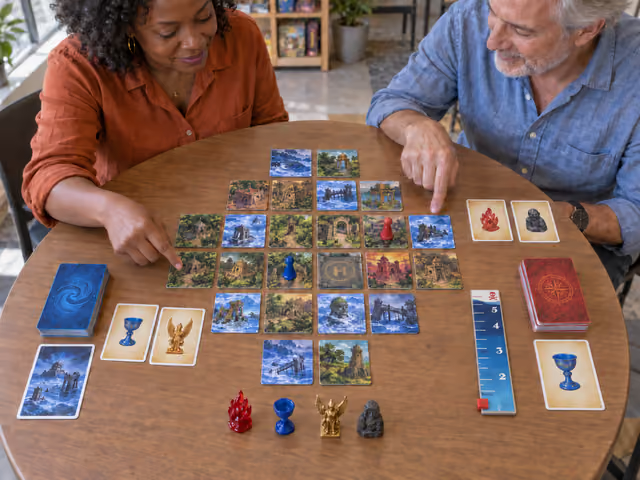
The quick version
Build the island, flood six tiles, deal one adventurer and two Treasure-deck cards to each person, and start the water meter at Novice. Take up to three actions, draw two Treasure-deck cards, then draw the current number of Flood cards. Four matching treasure cards plus one action on the right tile claim a treasure. After all four are claimed, gather every pawn at Fools' Landing and play Helicopter Lift to win together.
Saved on this device only — clearing your browser's cache or site data removes them (no account backup).
Build the island and meet your team
Use Gamewright's English physical base game, stock 317, with the publisher's eight-page rules credited 2010. This guide plays the standard island on Novice with two, three or four people, one adventurer each. Keep the six role cards available: the colored pawn symbol on each starting tile and the symbols on treasure tiles matter.
Shuffle all 24 island tiles and place them dry side up, leaving small gaps. Make a central four-by-four square. Add one tile beside each of the two middle tiles on each side: two above, two below, two left and two right. The finished shape has six centered rows of 2, 4, 6, 6, 4 and 2 tiles. Keep locations fixed; turning a tile never changes its position.
Put the four treasure figurines beside the island. Find both locations for each treasure using their matching symbols: two Caves for fire, two Gardens for earth, two Temples for the chalice and two Palaces for wind. Find Fools' Landing, the helicopter pad that must survive.
Separate the six Adventurer cards, 24 blue-backed Flood cards and 28 red-backed Treasure-deck cards. The Treasure deck contains five cards of each treasure, three Waters Rise!, three Helicopter Lift and two Sandbags. Shuffle the Flood deck; reveal six cards individually into its discard pile and flip their matching tiles to the blue-white flooded side.
Shuffle the Adventurer cards and deal one per person. Read each power aloud. Put each matching pawn on the tile with its colored pawn icon, even if that tile is already flooded; return unused roles and pawns to the box. Shuffle the Treasure deck and deal two face-up cards per person. Replace any Waters Rise! dealt during setup and shuffle it back into the remaining deck; it does not raise the water during setup. Keep everyone's cards visible and give each deck its own draw and discard spaces.
Clip the water meter at the Novice starting tick. The number beside the marker, initially 2, is the Flood-card draw count; each small tick is a separate water increase. The most recent island visitor starts, with turns passing left. If that does not identify someone, choose a starter together. Before starting, everyone should be able to see the island, meter and face-up hands.
Spend up to three actions
On your turn, combine or repeat these actions in any order, spending at most three. You may stop after zero, one or two. Teammates may advise, but you choose your actions. A first move might be to flip your flooded starting tile dry for one action; if you are the Engineer, you can repair a second reachable flooded tile within that same action.
- Move: spend one action to move to a neighboring tile up, down, left or right. Flooded tiles are usable. Ordinary movement cannot cross a missing tile or move diagonally. Several pawns may occupy the same tile.
- Shore up: spend one action to turn your own flooded tile or one of its four side-neighbors dry. Missing tiles cannot be restored.
- Give a treasure card: spend one action per card from your face-up hand to another player on your tile. Only the active player gives; receiving does not use the recipient's actions. You cannot take someone else's card or swap both ways in one action. Helicopter Lift and Sandbags cannot be given.
- Capture a treasure: while on either of its two matching locations, spend one action and discard four matching treasure cards from your own hand. Take that figurine for the team. The location may be flooded. Each treasure is captured only once; four cards spread across different hands do not qualify.
Keep at most five cards, including special cards. If a draw or gift puts you above five, immediately discard the excess before continuing. You may play a special card instead of merely discarding it. Five is a maximum, not a target you must maintain. Ordinary treasure cards leave your hand through gifts, captures and over-limit discards; there is no separate voluntary-discard action.
Use the adventurer powers
- Explorer: move and shore up diagonally as well as sideways. An emergency swim may also go diagonally.
- Engineer: repair up to two flooded tiles for one action. Each must be your tile or a side-neighbor; this does not extend your reach or create half-actions.
- Messenger: give treasure cards to anyone anywhere on the island, still one action per card. This does not let you receive remotely or give special cards.
- Pilot: once during your turn, spend one action to fly to any remaining tile. Your other moves follow the ordinary rule. If your tile sinks, you may escape to any remaining tile even if you already used your regular flight.
- Diver: for one action, travel through a connected chain of side-adjacent flooded tiles and missing spaces, ending on a remaining tile; the route may turn, but cannot pass through a dry intermediate tile. If your tile sinks, swim to a nearest remaining tile instead of being limited to a side-neighbor.
- Navigator: spend one action to move another pawn up to two adjacent spaces, from anywhere on the island. Explorer movement can be diagonal. The Diver may cross a missing first space but must finish on a tile after at most two steps; this is not the Diver's unlimited chain move. The Pilot gets adjacent steps, not a flight.
Your power changes only the action it describes. Shoring up, giving and capturing still need their own actions. The Navigator's movement exceptions are the designer clarification reproduced in the linked rules discussion.
Draw cards, raise the water and flood
Draw two Treasure-deck cards
After your actions, draw two cards individually, resolving each before the next. Add treasure and special cards to your face-up hand and enforce five immediately. Waters Rise! uses one of these two draws and gives no replacement during play. When the Treasure draw pile empties, immediately shuffle its discard to make the new deck; cards in hands stay out. Cards for captured treasures remain in circulation.
Resolve Waters Rise! immediately
Move the meter up exactly one small tick, not necessarily to a new printed number. Shuffle only the Flood discard pile and put it on top of the remaining Flood draw pile. Discard Waters Rise! to the Treasure discard. If two Waters Rise! appear consecutively, the water climbs twice, but the Flood discard is shuffled only once because it is already empty. If the Flood discard was empty, only raise the meter.
Draw the current Flood count
After both Treasure draws, use the meter's current number to draw that many Flood cards, one at a time. A dry matching tile becomes flooded; an already flooded tile sinks permanently. Remove both the sunken tile and that Flood card from play. If the Flood draw pile empties, immediately shuffle its discard into a new deck and complete any remaining draws. A tile can therefore appear again in the same flood phase.
Swim if your tile sinks
Flooding alone leaves a pawn in place: lift it, flip the tile and return it. When its tile actually sinks, each pawn there must immediately swim to a remaining side-adjacent tile, which may be flooded. This costs no action. Explorer, Diver and Pilot use their emergency exceptions above. If anyone cannot escape, the whole team loses immediately. Otherwise, after completing the Flood draw count, pass the turn left.
Keep rescue cards ready
Sandbags and Helicopter Lift cost no action and may be played during anyone's turn, including between Flood draws. Use them from your own hand and discard to the Treasure pile.
Sandbags repairs any one remaining flooded tile, regardless of your pawn's location. Decide before the next Flood card is revealed: once the matching card exposes a flooded tile's sinking, Sandbags cannot cancel it.
Helicopter Lift moves one or more pawns together from one remaining tile to any other remaining tile. Every passenger must share the same departure and destination; you may choose a subset. The card's owner need not be a passenger or stand on that tile. It also provides the final escape below. Keep a Lift for that finish rather than treating the Pilot's flight as a substitute.
Escape together or lose together
Once all four treasures have been captured, get every pawn onto Fools' Landing. Then any player there plays a Helicopter Lift from their hand to take everyone off the island. That immediately wins, even if Fools' Landing is flooded. Arriving there with the treasures alone is not enough.
The team immediately loses if Fools' Landing sinks; both locations for an uncaptured treasure sink; any pawn cannot escape a sinking tile; or the water reaches the skull. Losing both locations for a treasure already captured does not lose the game. Resolve cards and effects one at a time: a loss cannot be undone by a rescue card played afterward.
There are no individual points or ties. Everyone shares the escape or defeat, and turns need not be equal. To play again, restore all removed tiles and cards, reshuffle both complete decks, create a fresh island, deal roles and starting hands again, and reset the meter. Do not continue from the sunken map.
Plan together without taking over
Before each turn, ask the active player what they want to accomplish. Then offer a useful option if invited. Keep all hands visible so you can agree who will collect which treasure and when to meet for gifts. Check the recipient's five-card limit before giving. One person cannot simply reach into another hand and claim their four cards.
Balance repairs with progress. Keep Fools' Landing, at least one location for each uncaptured treasure and useful routes in mind; trying to repair every flooded tile can use all your actions while treasures remain unclaimed. Look through both discard piles whenever useful. A Flood card in the discard is likely to return soon after Waters Rise!; it is information, not certainty about the next card.
For a quick demonstration before play, point out a flooded location and show how its next Flood draw would remove it, then flip it dry to explain a repair. Return it to its original setup side afterward. Explain that a Waters Rise! during setup is replaced, while one drawn during a real turn counts as a draw and raises the water.
For a rules dispute, pause before the next card or action and consult the role card, special card and rulebook. If a tile was removed by mistake and its identity and state are certain, restore the recorded state before continuing. If the state cannot be reconstructed, this guide suggests restarting that game without declaring a winner. That restart is a house remedy. Chance can create a rough start even when the rules are correct; choose another shuffled game rather than quietly removing Waters Rise! cards.
Already know the game?
Ideas & Twists
Choose a variation together before you start.
Forbidden Island · See main rules
Official difficulty optionRaise the starting water
Keep the same 24-tile shape, six initial floods, random roles and two-card hands. Before the first turn, set the clip to Normal instead of Novice. For later games, choose Elite or Legendary at setup. Use the Flood count printed beside that starting tick from the very first turn. All actions, five-card limits, water increases, rescue cards and the cooperative escape or loss stay unchanged.
Forbidden Island · See main rules
House setup suggestionChoose your expedition roles
Before placing pawns or dealing Treasure cards, lay out all six Adventurer cards face up instead of dealing them randomly. Starting with the chosen first player and passing left, each person selects one unclaimed role. Put unused roles away and place each pawn on its normal starting tile. Keep Novice, six initial floods and every other rule unchanged. This lets the group try a particular combination; it does not add extra roles or extra turns.
Forbidden Island · See main rules
House discussion suggestionThe active player leads
At the start of each turn, let the active player describe their plan before others offer strategies. Until they invite advice, others may correct a rules mistake or announce a rescue card they want to play, but do not prescribe moves. Once advice is invited, discuss normally; the active player makes the decision. Keep face-up hands, rescue-card timing and all mechanics and finish conditions unchanged. No timer or extra supplies are needed.
About this guide
The Gamewright physical base rules supply the standard island, Novice game and official difficulty ladder. The publisher FAQ clarifies Helicopter Lift passengers. Navigator interactions follow the designer answer reproduced in the linked discussion. Role selection, the active-player discussion format, demonstration and uncertain-state restart are host suggestions. Forbidden Desert, Jungle, Sky and the app are separate games or implementations.
Ready for something different?
Find another game →