

The quick version
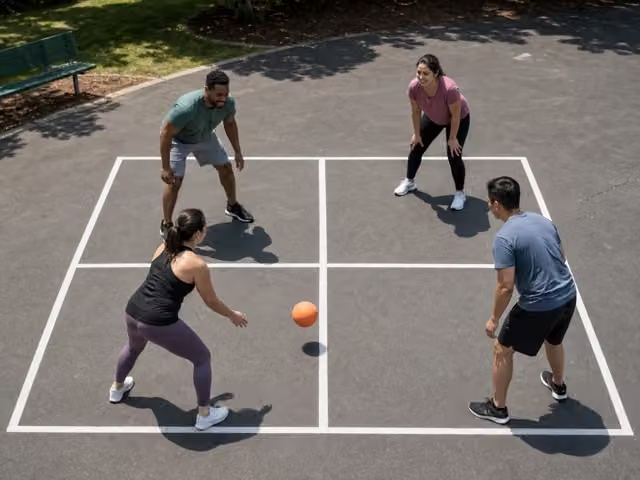
Square 4 bounces and hits the ball diagonally to square 1. After one bounce in your square, hit it once into someone else's square before a second bounce. A mistake sends you to the queue; lower-ranked players move up and the next person enters square 1. Play is unscored unless you choose a scoring variation.
Saved on this device only — clearing your browser's cache or site data removes them (no account backup).
Mark four squares and the waiting line
Use a dry, level outdoor hard surface where the ball bounces consistently. Mark a 16-by-16-foot square and divide it with a cross into four 8-by-8-foot squares. Make lines about 1 inch wide. Leave at least 6 feet of clear space around the court, away from traffic, furniture and other games. Grass is not the surface for this format.
Number the squares 1 through 4, with 1 and 4 diagonally opposite. Facing the court, one workable layout is 3 at back left, 4 at back right, 1 at front left and 2 at front right. Square 4 is highest; square 1 is the entry square. Outer boundary lines count as in; every part of the dividing cross counts as out.
Bring one roughly 8.5-inch rubber playground ball, inflated according to its maker so it rebounds predictably. Test a drop and a gentle hand hit. Use chalk and a measuring tape for an unmarked court; on an existing court you need neither. Wear shoes that grip the surface.
Shuffle the players into a starting order: the first four occupy squares 1, 2, 3 and 4; everyone else forms one queue outside the clear playing area. This guide supports 4–12 people, with only four active at once. Agree on bounce-first returns, clean hand hits, line calls and no midgame rule changes. Try one unscored demonstration before starting.
Serve, return and rotate
Start each rally
Wait until all four players are ready. From square 4, drop the ball in your own square, let it bounce once, then hit it underhand into diagonal square 1. Use a gentle, returnable serve with no deliberate spin. A serve that first lands outside square 1 or on an inside line puts the server out. There are no automatic serve or receiving retries in this house format.
Return after one bounce
The owner of the square where the ball lands hits it into any other square before it bounces again. Use one clean contact with one or both hands, from wrists to fingertips. Do not catch, carry, throw, juggle, double-hit or kick it. Unlike Squarefour's air-ball rule, every hit here must follow a bounce in the hitter's own square; hitting early or playing someone else's ball puts that hitter out. Returns may be underhand or overhand; only the serve must be underhand.
Call the mistake
The hitter is out if the next bounce hits an inside line, lands beyond the outer boundary or lands back in their own square. The receiving player is out if they miss a ball that bounced in their square or allow a second bounce anywhere before returning it. Any non-hand body touch puts that player out, even before the intended bounce. An outer-line bounce belongs to the adjacent square and must be returned. Stop at the first clear mistake; do not count a later error after the rally has ended.
Fill the vacancy
The out player goes to the back of the queue. Move only players below the vacant rank up one square; players above it stay put. The first waiting player enters square 1. With exactly four players, the out player returns directly to square 1 after the others move. For example, if square 2 is out, square 1 moves to 2, the newcomer takes 1, and squares 3 and 4 stay. Whoever is now in square 4 serves next.
Finish the session
There are no points, lives or overall winner in the main format; reaching square 4 is a position, not a permanent win. When the group is ready to stop, announce a final rally before its serve and stop when it ends. A disputed or interrupted final rally is replayed. No tie-break is needed because no score is kept. Reset the starting order if you begin another session.
A ball on the outside edge stays live. A ball touching the inside cross puts its hitter out, even if most of the ball is over a square. At a junction where the dividing cross meets the outer edge, the inside-line rule takes priority.
Settle calls and keep the queue moving
Demonstrate the first serve from 4 to 1, one legal return, then the rotation after square 2 makes an error. New arrivals join the back of the queue rather than choosing a square. If someone leaves between rallies, treat their vacancy like an out and fill it; pause if fewer than four remain.
For this house format, stay in your own square while the ball is live. Do not block, push or reach across another player; deliberate physical interference puts the interfering player out. If a stray person, second ball or other outside object interrupts play, stop and replay with the same positions. Nobody in the queue saves a ball or joins a rally.
Call a line or double bounce promptly. If the players cannot agree on what happened, replay with unchanged positions instead of arguing or holding a showdown. No one gets a scoring benefit from a replay. These replay and movement rules are house choices, replacing Squarefour's showdown and free movement.
Keep the ball returnable while learning; a caught-and-thrown cherry bomb is already illegal. Retrieve loose balls only after play stops, and keep waiting players beyond the court's clearance area. Choose any variation together before a new session, then keep it fixed. A long queue means more waiting, so larger groups may prefer a second separately marked court with another ball.
Already know the game?
Ideas & Twists
Choose a variation together before you start.
Four Square · See main rules
Suggested house variationUnderhand returns
Change every return, not just the serve, to an underhand hit with an open palm facing upward. An overhand return puts the hitter out. Keep one bounce, one contact, the same lines and the usual queue. This changes the legal hitting technique; it does not guarantee a slow rally.
Four Square · See main rules
Suggested house variationAround the court
Restrict returns to one physical circuit: 1 to 2, 2 to 4, 4 to 3, and 3 to 1. The opening serve still goes from 4 to 1. After that, hitting to a different square puts the hitter out. Keep all bounce, line and rotation rules. The fixed route replaces choosing any opponent and makes anticipation part of the game.
Four Square · See main rules
Suggested house variationRace to five serving points
Add paper and a pencil for individual scores, starting at zero. After each completed rally that began with a legal serve, award one point to the person who occupied square 4 when it began, even if that person was eventually out. Illegal serves award no point; disputed or interrupted rallies award none until their replay ends. Apply the usual rotation, then stop if the scorer has reached five. Only one person can score in a rally, so there is no tied winning score. This replaces the unscored finish and rewards holding the serving square; it is not championship scoring.
About this guide
Friendly house format, not an official edition. Squarefour supplies court size, ball type, line distinctions and ranked rotation. Bounce-first play, staying in your square, gentle underhand serves without retries, replayed disputes, the unscored finish and all three variations are explicit house choices. Squarefour allows air hits, free movement and a receiving fault; championship play has additional rules and a different tournament finish. Neither full ruleset is reproduced here.
Ready for something different?
Find another game →