

The quick version
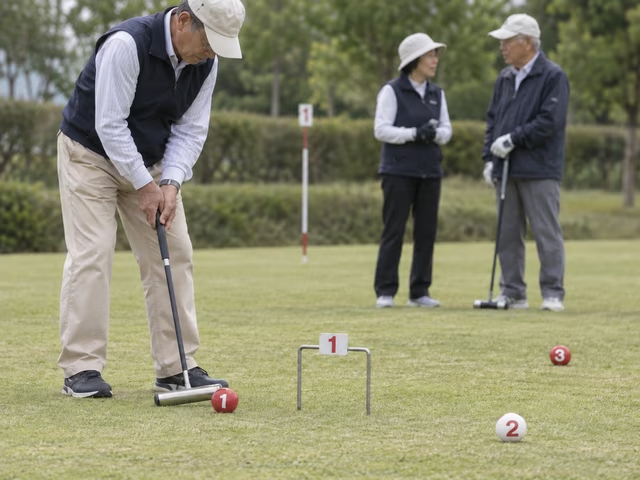
Five red players use odd-numbered balls and five white players use even numbers. Play in order from 1 to 10, repeating. Each ball scores one for gates 1, 2 and 3 in order, then two for the center pole. Contact with another ball can create a spark and a continuation shot. Most team points after thirty minutes and the final cycle wins.
Saved on this device only — clearing your browser's cache or site data removes them (no account backup).
Get the game ready
Use a club’s regulation rectangular court, normally 20–25 m long and 15–20 m wide, with its marked start area and directional gates. Ask the instructor to walk the group around the route; the gates are not all shared current targets as in Golf Croquet. Give each player one numbered ball. Red owns 1, 3, 5, 7 and 9; white owns 2, 4, 6, 8 and 10.
Choose a captain for each team and a recorder outside the ten players. The instructor demonstrates a normal stroke, a gate pass, a spark and re-entry from outside. Start a thirty-minute clock when ball 1 is called. In this house introduction, allow twenty seconds for each stroke or spark after the instructor says ready, instead of the competition ten-second allowance.
Play the first game
Enter through gate one
When your number is called, place your unentered ball in the marked start area and strike toward gate 1 in its correct direction. If it fails to pass completely, remove it and try again on your next numbered turn. A successful pass earns one even if it subsequently goes out; a ball that stays in earns a continuation stroke.
Advance or position
Strike only your numbered ball. Pass gates 2 then 3 in their indicated direction for one each. A valid gate pass with your ball remaining in bounds earns one continuation stroke. After all three gates, a legal touch of the center pole earns two and removes that ball from play; skip its number on later cycles.
Touch and spark
After your entered ball contacts another ball and both stop in bounds, wait for the instructor. Pick up the touched ball, secure your own ball under a foot, place the other against it, remove your hand and strike your own ball so the other travels at least 10 cm. Your own ball must remain secured. Only step away after the instructor confirms the spark. One or more successful sparks from a stroke earn one continuation; a gate pass and successful touch/spark from the same stroke earn two.
Respect the turn limits
Spark every eligible ball touched before taking a continuation, under the referee’s direction. Do not touch a ball you have already sparked during the same numbered turn. A normal stroke earning no continuation ends the turn. An out-ball is placed just outside where it left; on its next turn it gets one re-entry stroke and cannot earn a continuation then. The referee resolves fouls, restores affected balls and explains the next legal action.
Thirty minutes, then finish the cycle
At thirty minutes, this house version finishes the current numbered cycle through ball 10, including earned continuations, so both teams finish the same cycle. Add each ball’s gate and pole points, at most five per ball and twenty-five per team. Higher total wins; equal totals are a draw. A team completing all five balls wins immediately. This final-cycle and draw procedure differs from competition tie resolution.
Help everyone get started
Keep the scorecard visible: each numbered ball needs its own gate history. The instructor should supervise every beginner spark until it is controlled, with feet, fingers and bystanders clear of the stroke. A captain may suggest positioning, but the player should understand why before committing. Do not reuse a damaged ball; the referee handles replacement.
Already know the game?
Ideas & Twists
Choose a variation together before you start.
Gateball · See main rules
Suggested house variationTwo captains, ten balls
Use two players, each controlling all five balls of one color. Keep the 1–10 sequence, court and scoring. Each must decide how one ball’s position helps another. Use the same thirty-minute final-cycle finish and an instructor for sparking and rules.
Gateball · See main rules
Suggested house variationRotating captain
With ten players, move captaincy to the next teammate in numerical order at the start of each new 1–10 cycle. Only that captain gives tactical suggestions during the cycle; everyone may still ask the referee a rules or safety question. Keep normal points and the timed finish.
Gateball · See main rules
Suggested house variationDeclare the purpose
Before each initial stroke of a numbered turn, say gate, position or touch. If you declare gate and legally pass your next gate, or declare touch and complete a legal spark, add one house bonus point for that turn. Position carries no bonus but leaves the ordinary options open. Track bonuses separately and add them at the timed finish; do not change a ball’s gate history.
Gateball · See main rules
Suggested house variationFinish together
A ball may not hit the final pole until all five of its team’s balls have passed gate 2. An early pole contact scores nothing and leaves the ball in place. Other scoring and continuation rules stay the same. Use the normal timed finish, encouraging the leading balls to help the trailing ones advance.
About this guide
The main is a coached introduction with a twenty-second stroke allowance, final full cycle and shared tied result. Those are house choices. All five variations are editorial, including two-player and pairs formats rather than claims of sanctioned divisions. The 2025 rulebook and August 2026 English correction were opened.
Ready for something different?
Find another game →